Hartmann and Legat's secret meeting in Munich
MunichHartmann and Legat's secret meeting in Munich turns a chance to speak into a covert exchange of evidence. As Neville Chamberlain’s government weighs whether to urge Czechoslovakia to accept Adolf Hitler’s demands, Paul von Hartmann tells Hugh Legat that Hitler’s ambitions reach beyond the Sudetenland and that German opponents are prepared to act if an invasion order is issued. Legat cannot secure the private audience Hartmann seeks, but he agrees to deliver the proof. The meeting ends with a plain envelope hidden inside Der Stürmer, and Legat alone in his hotel room, preparing to discover what it contains.
A meeting concealed in the conference
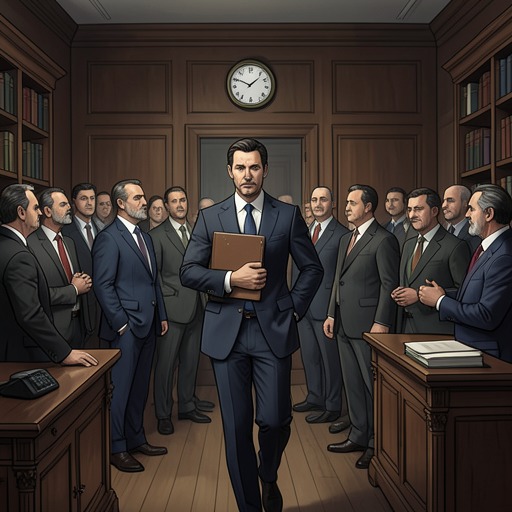
The encounter begins not at a negotiating table but in the margins of the Munich conference. After Hartmann and Legat leave the corridor near Adolf Hitler’s study, Hartmann takes the service stairs down. Legat invents an excuse to separate from Frank Ashton-Gwatkin, then follows. His pursuit carries him through a basement passage and out into a courtyard crowded with black Mercedes. Hartmann stays ahead of him, leading him past the Temples of Honour, across Königsplatz and along a street lined with monumental Nazi buildings. The route makes Legat’s covert errand feel exposed: he is a British civil servant moving through the architectural theatre of the regime he has come to investigate.
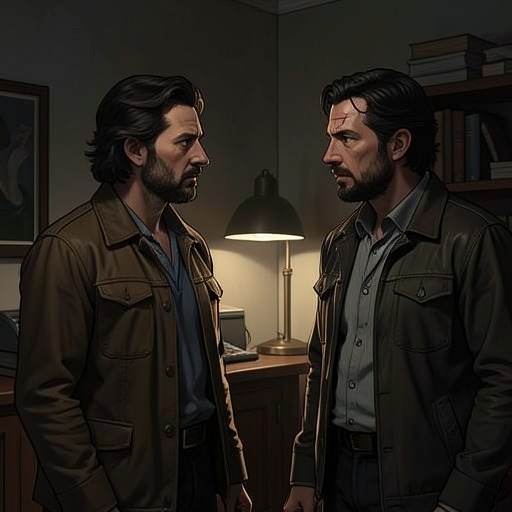
Hartmann enters Park-Café, and Legat follows a minute later. The bar is crowded at the end of the working day, with many brown Party uniforms among the customers. Hartmann sits with his back to the room and his face toward a mirror, using it to watch what happens behind him. Legat takes the opposite seat. The familiar grin briefly recalls the old friendship between the men, but Hartmann’s first practical concern is whether anyone followed them. Legat can offer no certainty; he admits he is unpractised at this kind of secrecy. Hartmann’s wry welcome to the new Germany turns their reunion into a warning about the habits fear now requires.
The warning and its political stakes
Their conversation returns to an earlier argument in Munich, when Legat had accused Hartmann of being a Nazi at heart. Hartmann refuses to reopen that dispute: there is too little time. Instead, he asks Legat to arrange a meeting with Chamberlain. Legat explains that the request has already been anticipated in London and that a private audience is not possible. Hartmann counters that Legat is the Prime Minister’s secretary and should be able to arrange meetings; the exchange establishes the practical obstacle that will shape the rest of their encounter.
The British government’s predicament gives Hartmann’s request its immediate urgency. In London, Chamberlain has questioned how the public could be persuaded to continue a winter war if Czechoslovakia collapsed, particularly when Britain had already conceded the Sudeten Germans should not have been placed under Czech rule. Lord Halifax reports that the Dominions will not support war over so narrow an issue, while the United States will not join and Ireland will remain neutral. Chamberlain also rejects the idea of relying on Soviet intervention, arguing that geography would require the Soviet Union to enter through Poland or Romania, potentially drawing both into the war against Britain’s side. Lord Gort warns that a wider conflict could mean fighting Germany in Europe, Italy in the Mediterranean and Japan in the Far East, endangering the Empire.
Sir Horace Wilson proposes a telegram urging the Czechs to accept Hitler’s terms before the deadline: withdraw from the Sudetenland and permit German occupation. Lord Halifax objects that this would be complete capitulation under threat and that Britain cannot guarantee the German Army would stop at the Sudetenland’s borders rather than occupy the rest of the country. This division explains why Hartmann insists that a warning alone will not suffice. He wants Chamberlain to see documentary proof before the British government proceeds further with negotiations under duress.
Proof, promise, and concealment
Hartmann says that the reversal of the Versailles settlement is no longer enough for Hitler; he describes it as only a prelude to what is coming. His claim is not simply that Hitler intends to invade Czechoslovakia the next day if Chamberlain refuses to continue negotiating under pressure. Hartmann also says that an invasion order would change everything, because opponents in the Army and elsewhere would then act against Hitler. The meeting therefore exposes both the alleged scale of Hitler’s ambitions and the conditional character of the resistance Hartmann invokes: the planned action depends on Hitler issuing the order.
Legat is sceptical that the situation can be made so simple. He refuses to arrange a private meeting, but offers a narrower route: if Hartmann gives him proof of Hitler’s ambitions, he will try to ensure the Prime Minister sees it. When Hartmann asks whether this can happen before Chamberlain signs an agreement in Munich, Legat hesitates, then promises to try if an opportunity arises. The promise is limited, not a guarantee of access or of political effect. Its importance lies in converting Hartmann’s appeal into an immediate, dangerous piece of work for Legat to carry out.
Hartmann makes the transfer with deliberate concealment. He picks up Der Stürmer and shields himself with the tabloid while unfastening his shirt; then he folds the paper and slides it across the table. He tells Legat to stay and finish his beer and says they should not acknowledge one another from then on. The ordinary-looking newspaper becomes a disguise for a high-stakes document, while the instruction to disown the meeting preserves their separation once Hartmann leaves. Legat waits as the café’s patrons remain absorbed in their own amusement, aware that watchers could be hidden in the surrounding undergrowth.
The envelope reaches Legat’s room
After Hartmann goes, Legat cautiously opens the newspaper. Beside an antisemitic story in Der Stürmer is a plain manila envelope, heavy enough to contain perhaps two dozen sheets. He refolds the paper, waits five more minutes, and leaves by the other side of the smoky bar. Outside, the offices of the Deputy Führer and the Four-Year Plan have lit windows, suggesting activity and purposeful preparation. Near the Nazi Party administration building, uniformed officials identify him as an Englishman and laugh. The remark sharpens the risk of his passage through a public, highly visible space, beneath spotlit swastika banners towering over Königsplatz.
Rather than return directly to the conference, Legat goes to the Regina Palast Hotel. In his room he sees people moving in illuminated rooms across the courtyard, including a man who seems to be looking straight at him. He draws the curtains, locks the door, and tries to steady himself; the widening gulf he feels between himself and Hartmann remains with him. Only then does he sit at the desk beneath the green-shaded reading lamp and open the envelope. Its pages are typed in the same large letters as a document he had received in London, in German that blends Hitlerian and bureaucratic language. The pages begin with the words “TOP SECRET.” The meeting has thus delivered its promised proof to Legat, but the passage ends as he starts to decipher it, leaving its full contents—and the consequences of showing it to Chamberlain—still to come.