German opposition plot to prevent the Munich agreement
MunichThe German opposition plot to prevent the Munich agreement is a conspiracy whose opening depends on a possible military revolt and whose purpose changes when that prospect falters. With Adolf Hitler threatening to invade Czechoslovakia, German officers and civilian officials prepare to arrest him if mobilisation begins; when that immediate crisis is postponed, Paul von Hartmann argues that the remaining chance is to disrupt the agreement through British intervention. The plot’s urgency comes from its shrinking window: each diplomatic pause buys time, but also weakens the conditions on which the conspirators’ action depends.
Crisis and the opening for a coup
Neville Chamberlain tells the British Chiefs of Staff that the planned orderly transfer of the Sudetenland, subject to a plebiscite, has been overtaken by Hitler’s deadline. Hitler has said he will invade on Saturday, and has dismissed the prospect of Britain and France fighting in response. Chamberlain says that, if France fulfils its treaty obligations to Czechoslovakia, Britain will be obliged to support it. The threat is therefore not simply a diplomatic manoeuvre: it presents the conspirators with an approaching decision about war and mobilisation.
The prospect of a British response is itself disputed. When Chamberlain considers partial mobilisation, he recognises that it could signal that Britain is prepared to fight, but also fears that it might drive Hitler into war. His account of having looked Hitler in the eyes informs his judgement that the German leader cannot tolerate losing face. The discussion makes the crisis’s central problem plain: a signal intended to deter an invasion could instead accelerate it, while hesitation might be read as weakness.
The opposition’s hope rests on a secret disclosed by General Ludwig Beck. He tells Colonel Hans Oster and Hans Bernd Gisevius that he resigned as Chief of the General Staff nearly six weeks earlier to protest the plan to go to war with Czechoslovakia, but kept his resignation private after promising Hitler not to publicise it. Beck says he remains in touch with former colleagues in the high command and believes that, if Hitler orders mobilisation, the Army may disobey and move against the regime. His disclosure turns the conspirators’ resistance from a handful of civilians’ aspiration into a plan that might, under particular conditions, draw on military power.
The military plan and its constraints
That possibility is limited by the Wehrmacht’s oath of loyalty to Hitler. Beck argues that the Army could intervene to restore order if a disturbance began in the Chancellery, but that the first move against Hitler could not come from the Army itself. The conspirators must therefore create the disturbance that would allow the military to act without, in Beck’s view, violating its oath. The distinction is more than a technicality: it makes the success of a coup depend on the sequence of actions as much as on the Army’s willingness to support it.
Oster and Captain Friedrich Heinz estimate that surprise, together with an assurance that the Army will protect the plotters from a rescue attempt by the Nazi SS, would make an initial force of about fifty men sufficient to arrest Hitler. Heinz says they already have experienced fighters prepared to move the following day. The scheme is thus presented as a specific operation, not merely a general wish for a change of government, but its small force requires the promised protection and the right moment.
The conspirators settle what to do if they reach Hitler. Oster insists that stopping him from issuing the mobilisation order must take priority over debating the form of government after the Third Reich. They would take Hitler alive if he surrendered into custody; if he seemed likely to escape, Oster says they would have to shoot him. Hartmann is the first to agree, and the others follow, with Beck joining last and most reluctantly. Their decision gives the plan a stark operational limit: political questions about what comes after the regime are deferred until they can prevent the imminent order.
The postponement and loss of military momentum
The anticipated moment shifts when Neville Henderson telephones from Berlin with news that Benito Mussolini has asked Hitler to postpone mobilisation for twenty-four hours so the situation can be reconsidered. Italy, Henderson reports, will stand by Germany in a conflict, but Hitler has accepted the request to delay. The pause interrupts the conspirators’ timetable without removing the danger: an invasion has not been ruled out, but the immediate trigger on which their plan depended is no longer certain.
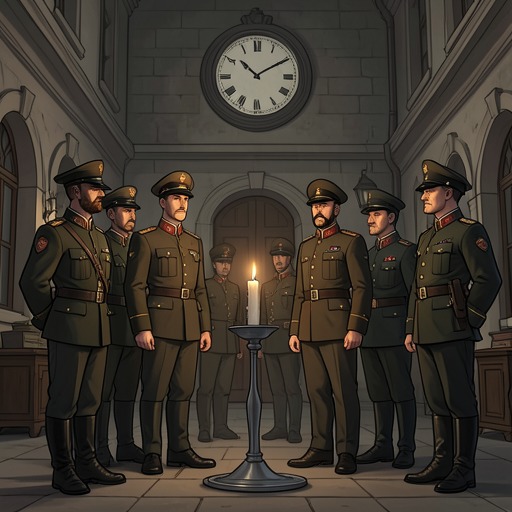
At a five o’clock meeting in Erich Kordt’s office in the Prussian State building, six conspirators gather: Gisevius and Count von Schulenburg from the Interior Ministry, Hans von Dohnányi from Justice, Oster from the Abwehr, and Kordt and Hartmann from the Foreign Service. The proposed cover is an informal interdepartmental planning meeting for the newly “liberated” Sudeten territories. The label exposes the political reversal confronting them. Hitler has already gained Austria and now the Sudetenland without firing a shot; Schulenburg observes that the regime may be more popular, not less, as a result.
Hartmann’s posture captures the collapse of confidence. He lies stretched along the sofa, his feet over the armrest, and asks what happened to the Army. Oster says that everything had depended on Brauchitsch, who was still deciding what to do when mobilisation was postponed. Reports of Halder’s sympathy are not enough for Hartmann: he challenges the distance between second-hand assurances and action. Oster explains that the Army had been expected to intervene only if it believed Germany was heading for war against Britain and France. Its opposition is conditional, not an unconditional commitment to overthrow Hitler.
From arrest to diplomatic intervention
The conspirators consequently see themselves as powerless civilians if the Army will not act and Hitler’s government continues to command the country. Hartmann proposes a new objective: prevent an agreement from being signed at Munich the next day. Kordt judges this unlikely, since Hitler is expected to accept terms the British and French have already offered. Hartmann counters that the twenty-four-hour postponement has delayed mobilisation, not cancelled it. For him, the conference is not yet a settled outcome; it remains a narrow opportunity to expose the danger behind the negotiations.
Hartmann says he can show proof that Hitler is bent on a war of conquest and that this may be the last chance to stop him. His proposal depends on a personal channel: he knows one of Chamberlain’s private secretaries and believes he may be able to reach the Prime Minister, or at least put the information into his hands. He asks Oster to use his contacts in Whitehall and explore whether the secretary can fly to Munich as part of Chamberlain’s entourage. The shift is consequential. The conspirators move from planning an arrest with a possible Army shield to trying to alter the calculations of the foreign government negotiating with Hitler.
The plot’s stakes are restated when Sir Horace Wilson briefs Chamberlain and his party on the meeting with Hitler. Wilson reports Hitler’s Saturday deadline, his demand that the disputed territory begin evacuation, and his apparent readiness to march if it does not. He says that Hitler kept looking at his watch as if monitoring the end of the mobilisation pause, and concludes that the situation must be settled that day or war will follow. Against that compressed timetable, Hartmann’s appeal is both an act of resistance and a last resort. The evidence establishes the conspirators’ plan and their attempt to influence the negotiations; it shows how their military opening narrowed into a diplomatic intervention, without making that attempted intervention itself proof that the Munich agreement was prevented.