Munich Conference (1938)
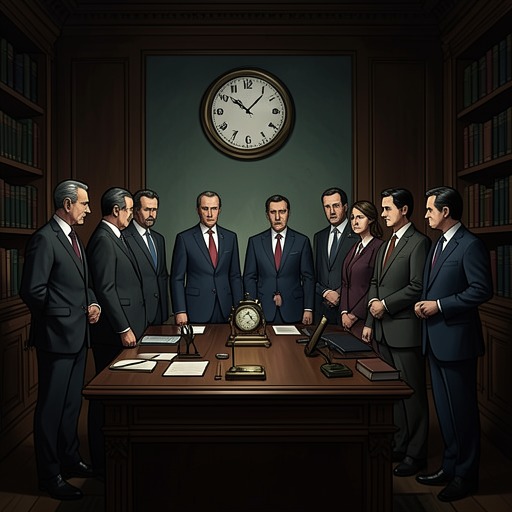
MunichThe Munich Conference (1938) is presented as an emergency negotiation conducted under the threat of invasion, where the pressure of a military deadline meets the contested language of diplomacy. The meeting offers a chance to delay war, but its proposed settlement concerns the transfer of Sudeten territory from Czechoslovakia to Germany, and the British participants dispute whether urging that transfer would be a defensible act of peace or a capitulation under force.
Background and the narrowing choices
The conference follows a sharp escalation. Neville Chamberlain tells his Cabinet that an orderly transfer of the Sudeten territory, subject to a plebiscite and accepted by the Czechoslovak Government, had been under discussion. Adolf Hitler has now declared that he will not wait even a week and will invade on Saturday. Sir Horace Wilson has warned him that Britain may support France if France honours its treaty obligations to Czechoslovakia; Hitler’s reported answer is that he is prepared for every eventuality and expects war by the following Monday. The deadline turns each diplomatic exchange into a question of time as well as principle.
The Cabinet considers partial mobilization as a signal that Britain is prepared to fight. Chamberlain recognizes the danger in either direction: mobilization might demonstrate resolve, but it might also push Hitler into war, especially if Hitler cannot tolerate losing face. The disagreement is not simply between action and inaction. It is over whether a credible threat can deter an invasion or instead accelerate one.
The British government also weighs the likely limits of support for a war. After a visiting colonel has reported directly to the Cabinet, Chamberlain asks how the public could be persuaded to continue fighting through the winter if the Czechs collapsed before the end of October, particularly when Britain had already conceded that the Sudeten Germans should not have been placed under Czech rule. Lord Halifax, Foreign Secretary, reports that the Dominions oppose a war over so narrow an issue; the United States will not enter, and Ireland will remain neutral. Sir Alexander Cadogan points to the Soviet treaty with Czechoslovakia, but Chamberlain notes the lack of a shared border and the prospect that Soviet intervention through Poland or Romania would bring those states into the war on Germany’s side. Lord Gort warns that a wider conflict could involve Germany in Europe, Italy in the Mediterranean, and Japan in the Far East, placing the Empire’s existence in grave jeopardy.
Against this background, Sir Horace Wilson proposes a telegram urging the Czechs to accept Hitler’s terms before a two o’clock deadline the next day. He argues that this is the surest way to avoid a war of enormous scale. Halifax objects that ordering the Czechs to surrender territory under threat would amount to complete capitulation; he also doubts the House of Commons would accept it and stresses that Britain cannot guarantee the German Army would stop at the Sudetenland rather than occupy the whole country. The conference is therefore framed by a conflict between averting immediate war and refusing to advise another state to yield without assurance of what would follow.
Invitation and public relief
A telephone message from Sir Nevile Henderson brings a temporary reprieve: Benito Mussolini has assured Hitler that Italy will stand by Germany in a conflict, but asks for a twenty-four-hour postponement of mobilization so the situation can be reconsidered. Hitler agrees. Later, in the House of Commons, Chamberlain asks about the mood of the members before making his statement. When he announces that Hitler has invited him to Munich the following morning, along with Mussolini and Édouard Daladier, the House erupts in relief and applause. Members from Labour and the Liberals join the Conservatives in rising; even Winston Churchill eventually stands. Chamberlain presents the pause as an opportunity to try reason and discussion, and the debate is adjourned so he can make the attempt.
The announcement also shapes how the meeting is first understood in Germany. Listening to a special radio bulletin, Paul von Hartmann hears the invitation described as Hitler’s last effort to secure a peaceful cession of Sudeten German territory, with all three other leaders said to have accepted. Hartmann recognizes the presentation as a political construction: the communiqué makes the initiative appear to have been Hitler’s, and he reflects that people may accept a reassuring account because it spares them from confronting inconvenient truths. The public language of peace thus arrives already carrying an argument about who is responsible for the meeting and what it means.
The conference at the Führerbau
The gathering takes place at the Führerbau, a new building whose ceremonial appearance gives the negotiations a staged, court-like quality. German and Italian flags mark the southern entrance, British and French flags the northern; bronze eagles bearing swastikas stand above the doors, and an honour guard presents arms as Hartmann enters. Inside, marble surfaces, grand staircases, and crowded rooms of dark suits and uniforms surround the leaders’ negotiations. The public formality is striking beside the uncertainty of what the meeting can achieve.
Hartmann has a document concealed beneath his vest. In a lavatory cubicle he takes it from his suitcase, hides it under his clothing, and checks his cold, slightly shaking hands before returning to the crowded lobby. His role also places him close to the machinery of the talks. Paul Schmidt asks him to tell the others that the meeting is ready to begin; Hartmann then summons the leaders and one adviser each. Before the talks start, Adolf Hitler asks for Hartmann’s watch. Hartmann unfastens it and hands it over, then rubs the pale mark left on his wrist where he has worn it day and night for eight years. The missing watch becomes a small, physical measure of his estrangement from events: he is inside the conference’s procedure, yet feels detached from what is unfolding.
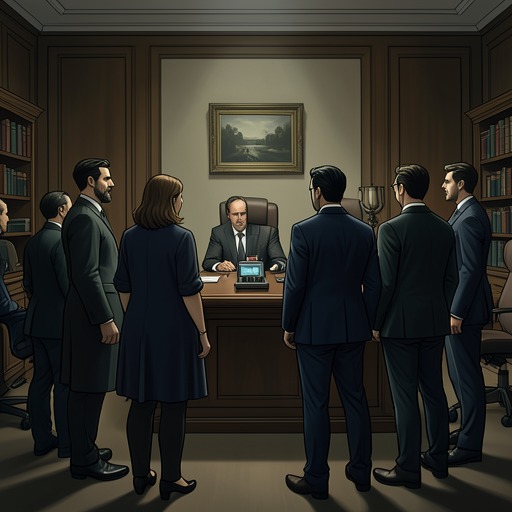
Hartmann leads Neville Chamberlain, Benito Mussolini, and Édouard Daladier into Hitler’s study, followed by their advisers. The room’s huge globe, bookcase, desk, central table, semicircle of chairs, and portrait of Bismarck organize the encounter around Hitler, already seated beside Schmidt. Chamberlain takes the chair closest to Hitler; Wilson sits to Chamberlain’s right, while the Italians sit opposite the fireplace. An empty chair remains for the absent French Foreign Ministry head, Léger. The scene gives the negotiations a precise geography, with each delegation’s position visible even before the substance of the talks is known.
The proposal and its wording
After the first session, Chamberlain and the other delegates leave Hitler’s study. Hartmann sees them stream into the gallery and hears Chamberlain announce that they are leaving. Hitler follows with Mussolini, gesticulating angrily. For a moment Hartmann hopes the conference has collapsed. The uncertainty is soon replaced by the work of reporting and drafting. At the Regina Palast Hotel, Wilson briefs the British delegation: he says Hitler has called Czechoslovakia a threat to European peace, cited a quarter of a million refugees who have fled the Sudetenland into Germany in recent days, and demanded a settlement by Saturday. As Wilson recounts it, the choice presented was a guarantee that evacuation would begin that day or a German march into the territory. He says Hitler repeatedly checked his watch, as though measuring the remaining hours of the mobilization pause, and concludes that he does not believe Hitler is bluffing.
Mussolini produces a draft agreement in Italian, which the Germans have translated into German. Hugh Legat spends the next hour translating that text into English, handing completed pages to Joan for typing while British delegates read over his shoulder. The eight-paragraph document sets October 1 as the beginning of evacuation and October 10 as the date by which Britain, France, and Italy would guarantee its completion. These specific dates give the proposed arrangement an administrative precision that contrasts with the threat of force behind it.
The draft’s language becomes a negotiation in its own right. Sir William Malkin, the Foreign Office lawyer, proposes changing “guarantee” to “agree,” a seemingly small revision that substantially alters the obligation expressed. He also objects that the original framing makes three powers appear to be conceding to a fourth. His preamble instead names Germany, the United Kingdom, France, and Italy together as parties that have agreed to terms governing the cession and that each hold themselves responsible for the measures needed to fulfil it. Chamberlain accepts both changes. The words do not undo the threatened transfer, but they change how responsibility and agreement are represented on the page.
The conference as an unfinished effort
Chamberlain asks for the folder containing the results of the 1930 Czech census from his red box, and Joan retypes the document from the beginning. Just after four o’clock, the revised text is finished and the delegation prepares to return to its cars. Chamberlain emerges looking tense, smoothing his moustache with his thumb and forefinger, and Legat hands him the census folder. Wilson remarks that a more fitting Shakespeare quotation for the Prime Minister’s earlier arrival at Heston might have been “Once more unto the breach, dear friends.” Chamberlain’s expression tightens rather than brightens, and he leaves to resume the effort.
The episode ends not with a final account of the settlement but with the British delegation moving back toward the conference after the draft has been translated, revised, and approved by Chamberlain. That stopping point preserves the event’s central tension: a diplomatic pause has opened, and a document now gives the proposed cession a timetable, but the preceding threat of invasion and the disagreement over what Britain can justly demand remain present. The conference’s dramatic force lies in the interval between those facts—the hope that discussion can postpone war, and the knowledge that the terms being prepared are shaped by the danger of what happens if it fails.