Sudeten Crisis of 1938
MunichThe Sudeten Crisis of 1938 is the September confrontation over the Sudetenland in which Adolf Hitler’s invasion threat, British and French calculations, and a German military conspiracy converge around a succession of urgent deadlines. The episode makes time itself a weapon: Chamberlain tries to preserve peace without appearing weak, while German opponents of Hitler see a narrow opening to stop mobilisation and perhaps overthrow the regime. A twenty-four-hour delay changes their prospects, but leaves the underlying danger unresolved.
Causes and competing stakes
In September 1938, Hitler was determined to start a war, while Chamberlain was desperate to preserve peace. The immediate dispute concerned the transfer of the Sudeten territory to Germany. Chamberlain told the Cabinet that the Czech Government had agreed to an orderly transfer subject to a plebiscite, but Hitler had rejected even a further week of waiting and announced that he would invade on Saturday. After Sir Horace Wilson warned him that Britain would support France if France honoured its treaty obligations to Czechoslovakia, Hitler’s reported response was that he was prepared for every eventuality and expected war by the following Monday.
The military assessment before the Cabinet made the danger plain. Lord Gort read the Chiefs of Staff’s conclusion that British and French pressure by sea, land, or air could not prevent Germany from overrunning Bohemia and decisively defeating Czechoslovakia. Restoring the country’s lost integrity, the memorandum judged, would require Germany’s defeat in a prolonged struggle that would become an unlimited war from its outset. Chamberlain saw the prospect as a return to August 1914, but questioned what such a war would be fought to achieve: Britain had already accepted that the three and a half million Sudeten Germans should have self-determination, so separation of the Sudetenland could not readily serve as an Allied war aim.
The question was not only whether Britain could fight, but whether a war over this issue could be sustained politically. Chamberlain worried that if Czechoslovakia collapsed before the end of October, the British public might not accept the sacrifices of continuing through the winter. Lord Halifax, Foreign Secretary, reported that the Dominions would not support a war on so narrow an issue; America would not join, and Ireland would be neutral. Sir Alexander Cadogan raised the Soviet treaty with the Czechs, but Chamberlain pointed out that the Soviet Union had no common border with Czechoslovakia and could intervene only by crossing Poland or Romania, potentially drawing them into the war on Germany’s side. Lord Gort warned that a wider conflict could mean fighting Germany in Europe, Italy in the Mediterranean, and Japan in the Far East, placing the Empire’s existence in grave jeopardy.
Ultimatums, signals, and delay
As the deadline approached, British leaders debated whether a military signal could deter Hitler or provoke him. Chamberlain recognised that partial mobilisation would mean Britain mobilising before Germany. Its advocates argued that it could show Hitler that Britain was prepared to fight and might make him reconsider. Chamberlain feared the opposite: based on his two meetings with Hitler, he believed that Hitler could not tolerate losing face. The dispute exposed the risk in every signal. Restraint might be read as weakness; a show of readiness might push the crisis into war.
Sir Horace Wilson proposed a telegram advising the Czechs to accept Hitler’s terms before a two o’clock deadline the following day, withdraw from the Sudetenland, and allow German occupation. Wilson considered this the surest way to keep Britain out of a potentially vast war; if the Czechs refused, he argued, Britain would at least have done its best and would no longer be under the same moral obligation to intervene. The proposal showed how the search for peace could place the immediate burden of concession on Czechoslovakia.
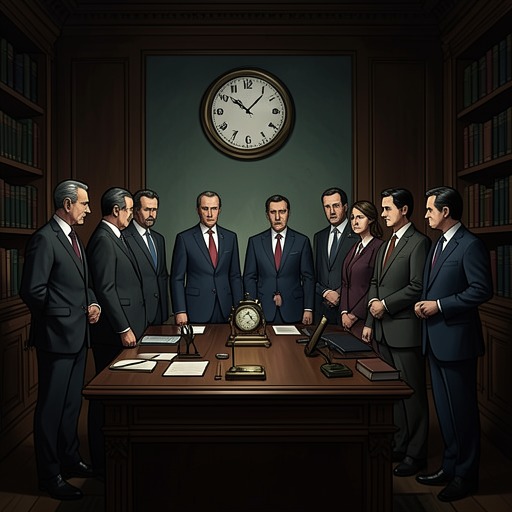
The crisis also unfolded in rooms crowded with papers and competing reports. A little after ten at night, Hugh Legat delivered telegram 545 from Berlin to Chamberlain as the Cabinet considered Hitler’s reply. Twenty ministers were present, along with Wilson and Cabinet Secretary Edward Bridges; an open sash window did little to disperse the smoke from cigars, pipes, and cigarettes. The telegram’s arrival made diplomacy tangible as a document handed across a table, while the deadline outside the room continued to draw nearer.
At seven minutes past two, Legat took a telephone message from Sir Nevile Henderson. Benito Mussolini had sent Hitler a message, delivered by the Italian Ambassador, assuring him that Italy would stand by Germany in the event of conflict while asking him to postpone mobilisation for twenty-four hours so the situation could be reconsidered. Hitler agreed. The postponement interrupted the countdown, but it was a delay rather than a settlement: the question of whether the crisis would lead to invasion or war remained open.
The German opposition’s narrow opening
At the same time, German officers and officials opposed to Hitler were considering action from within the regime. General Ludwig Beck disclosed that he had resigned as Chief of the General Staff nearly six weeks earlier in protest at the plan to go to war with Czechoslovakia. He had kept his resignation private at Hitler’s request, but said he remained in contact with former colleagues in the high command and believed the Army might disobey a mobilisation order and move against the regime. Colonel Hans Oster treated this prospect as a decisive change: the group had to be ready to act the following day.
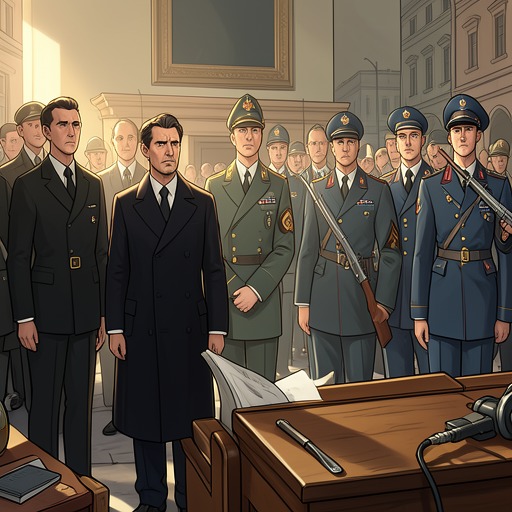
The Army’s oath of loyalty to Hitler imposed a critical constraint. Beck argued that the Army could enter the Chancellery to restore order if there were a disturbance, but that the first move against Hitler could not come from the Army itself. It had to be initiated by others. Oster and Captain Friedrich Heinz estimated that surprise, followed by an assurance that the Army would protect the conspirators against an SS rescue attempt, could make an arrest possible with an initial force of about fifty men. Heinz said the men were already available: experienced fighters prepared to move the next day.
The conspirators postponed broader questions about what government might follow the Third Reich. Oster insisted that their first priority was preventing Hitler from issuing the mobilisation order. If Hitler surrendered, they would take him alive; if he seemed likely to escape, Oster judged that they might have to shoot him. Paul von Hartmann was the first to agree, and the others followed, including Beck, reluctantly. The decision converted opposition into a conditional operational plan, but its success depended on the Army’s willingness to act after the conspirators made the opening move.
The postponement and its consequences
The twenty-four-hour delay exposed how fragile that plan was. When Paul von Hartmann later asked what had happened to the Army, Oster explained that everything had depended on Brauchitsch. He was still deciding what to do when Hitler issued the postponement order. The Army’s possible intervention had therefore not become an established course of action; its readiness to oppose Hitler remained uncertain, and the pause removed the immediate moment around which the conspirators had organised their move.
The opposition then confronted the prospect that the Munich conference would merely formalise concessions already offered. Hartmann argued that their remaining chance was to prevent an agreement from being signed. Erich Kordt considered that unlikely, since Hitler would receive substantially what he had originally demanded and the conference might amount to ceremony. Hartmann countered that Hitler had postponed mobilisation, not cancelled it. The distinction kept danger alive even as the immediate deadline receded.
At a later briefing, Wilson described Hitler’s position as relayed in their meeting: Czechoslovakia was presented as a threat to European peace, a quarter of a million refugees were said to have fled the Sudetenland into Germany in recent days, and the matter had to be settled by Saturday. Britain, France, and Italy were to guarantee that Czech evacuation began then, or Hitler would march in. Wilson noted Hitler’s repeated attention to his watch as the twenty-four-hour pause expired, and concluded that he did not believe Hitler was bluffing. Mussolini then produced an Italian draft agreement, which the Germans translated. The crisis thus moved from the immediate threat of invasion toward conference diplomacy, without removing the coercion behind it.
The episode’s decisive reversals are all provisional: a military warning cannot stop an invasion, a partial mobilisation might deter or provoke, a conspiratorial plan depends on an Army whose senior command has not settled its course, and Mussolini’s intervention postpones rather than cancels German mobilisation. The novel’s intercutting of Cabinet deliberations and clandestine resistance makes the same interval carry two kinds of suspense: whether the European powers can avert war, and whether Hitler’s opponents can act before diplomacy closes their opportunity.