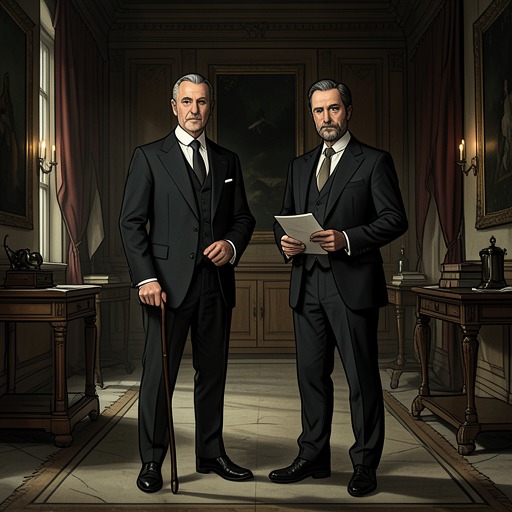
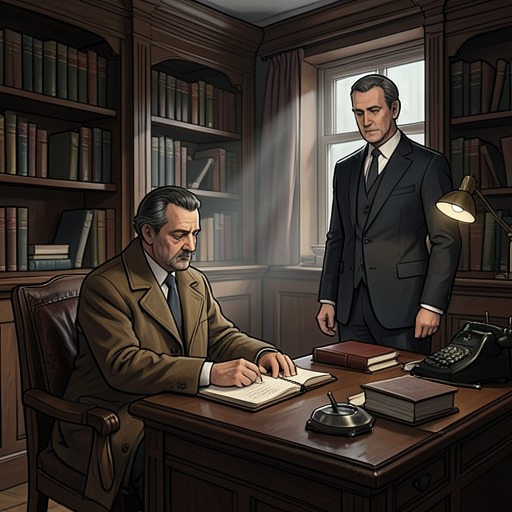
Wilson's meeting with Hitler on 27 September 1938
MunichWilson's meeting with Hitler on 27 September 1938 made the threat of war immediate: Sir Horace Wilson told Adolf Hitler that Britain would support France if Germany attacked Czechoslovakia, and Hitler answered that he was prepared for every eventuality. The encounter was at once a diplomatic warning and a test of resolve. Its account travelled from the German Foreign Ministry to Paul von Hartmann, while events in Berlin and London showed how little time remained for either side to retreat.
Crisis and diplomatic purpose
The meeting took place against the collapse of an attempted settlement. The Government of Czechoslovakia had agreed to an orderly transfer of the Sudeten territory to Germany, subject to a plebiscite, but Hitler had refused to wait and announced that he would invade on Saturday. Reporting this deterioration to the British Cabinet, Neville Chamberlain said Wilson had warned Hitler privately but firmly that, if France fulfilled its treaty obligations to Czechoslovakia, Britain would be obliged to support France. Hitler's threat put a deadline on the dispute; Wilson's warning tried to make clear that an invasion could bring more than a local conflict.
The stakes were sharpened by Britain's own choices. In Cabinet discussion, Chamberlain recognized that partial mobilisation could signal that Britain was not bluffing, but feared that it might instead push Hitler into war. The dilemma was not merely how to state Britain's position: it was how to make the warning credible without turning the threat into the trigger for the very conflict it was meant to deter. Wilson's visit carried that uncertainty into a face-to-face encounter with Hitler.
The encounter and its written record
A typewritten report of the meeting was prepared by the German Foreign Ministry's chief interpreter, Paul Schmidt. Erich Kordt brought the six-page document to Hartmann; it had been typed in the unusually large characters Hitler preferred for bureaucratic documents. The report's official language was restrained, but its account disclosed the competing purposes in the room. Wilson had congratulated Hitler on the reception of his speech at Berlin Sportpalast and thanked him for his favourable references to Chamberlain. He also asked the others present—Joachim von Ribbentrop, Sir Nevile Henderson and Ivone Kirkpatrick—to leave briefly, so that he could speak to Hitler privately and personally.
In that private exchange, Wilson said London would continue to put pressure on the Czechs. Schmidt recorded one sentence in Wilson's original English: I will still try to make those Czechos sensible. The conciliatory assurance sat beside the central warning. Wilson read a prepared statement that Britain would support France in the event of hostilities, then asked Hitler to repeat what he had said to ensure there was no misunderstanding. The report thus shows Wilson attempting both to preserve diplomatic pressure on the Government of Czechoslovakia and to remove any doubt about Britain's response to war.
Hitler reacted angrily. As Hartmann understood the report, Hitler said he did not care what Britain or France did, that he had spent billions preparing for war, and that if war was what they wanted, war was what they would get. Hartmann saw the imbalance in the exchange as an unarmed passer-by trying to persuade a madman to hand over his gun. His image captures the meeting's dangerous asymmetry: Wilson could state the consequences of an invasion, but his words did not demonstrate that Hitler would be deterred by them.
From warning to military movement
The report's significance was confirmed by what followed. Kordt told Hartmann that half an hour after the meeting ended, Hitler had ordered the armoured column passing the German Foreign Ministry. Its route took it directly past the British Embassy in Berlin. Kordt identified the troops as Witzleben's men from the Berlin garrison, heading for the Czechoslovak frontier. The column made the diplomatic warning visible as a military signal: while Wilson had spoken of what Britain would do if hostilities began, Hitler's order showed that preparations to use force were already under way.
In London, Chamberlain's account likewise connected Wilson's visit to the immediate prospect of invasion. He reported Hitler's position to the Cabinet and quoted the warning conveyed through the British Ambassador in Berlin: Hitler had said that if France and Britain struck, he was prepared, and that the parties would be at war by the following Monday. The meeting therefore did not produce an agreement or a retraction. Instead, it clarified the opposed positions and left the British government facing the choice between signalling readiness and risking escalation.
The deadline shifts, but the pressure remains
The crisis briefly changed course when Chamberlain's office received a telephone call from Henderson in Berlin. Henderson reported that Benito Mussolini had sent Hitler a message, delivered by the Italian Ambassador, promising Italian support for Germany in the event of conflict while asking him to postpone mobilisation for twenty-four hours so the situation could be reconsidered. Hitler agreed. The pause came not from Wilson's warning alone, but from intervention by an ally of Germany; it bought time without resolving the confrontation.
At a later briefing, Wilson described Hitler's renewed insistence that the dispute be settled by Saturday: Britain, France and Italy were to guarantee that the Czechs began evacuating the disputed territory, or Hitler would march in. He said Hitler kept looking at his watch as if measuring the remaining mobilisation pause, and judged that the alternatives were to settle the matter that day or face war. The episode gives Wilson's Berlin meeting its lasting significance in the crisis: it exposed the limits of private persuasion, set out Britain's threatened commitment to France, and began a chain of warnings, military gestures and temporary delays in which the clock itself became part of the confrontation.