Event 1
Goldmund’s arrival at Mariabronn
[Goldmund’s arrival at Mariabronn](entity:event-recall-event-goldmund-s-arrival-at-m-b27cf5f9215d) begins the novel’s central relationship and places him inside an institution whose traditions will both shelter and shape him. In spring, the adolescent is brought to the monastery school by his father, but his attention already turns elsewhere: to the unfamiliar chestnut tree, to the porter who welcomes him, and soon to [Narcissus](entity:character-recall-character-narcissus-8ac539c49d81), the young teacher whose example will help awaken a self that cannot remain within the cloister’s order.
## The Cloister and Its Order
[Mariabronn](entity:location-recall-location-mariabronn-d697cde40052) is more than a school or a religious retreat. Its cells, halls, classrooms, and refectory sustain teaching, administration, worship, scholarship, and practical life across generations. Books are written and annotated, ancient texts collected, and knowledge passed from one generation to another. Piety and erudition coexist with worldly interests; the character of the abbot and the concerns of the time determine which aspect of the house predominates. The institution is thus a durable world of shared practice, not merely a background for [Goldmund](entity:character-recall-character-goldmund-6408ea5ed221)’s arrival.
The cloister’s long continuity is figured by its chestnut tree. Boys pass beneath it through changing seasons and generations; some become monks and remain for life, while others leave for homes and occupations beyond the walls. Former pupils return as adults with sons of their own, pause by the tree, and depart again. This recurrent movement between the cloister and the world gives Goldmund’s entrance a larger significance: he joins a community that has seen many young lives begin there, even as his own future will eventually lead beyond it.
At the time of his arrival, two unusually prominent figures give the house a distinctive character. [Abbot Daniel](entity:character-recall-character-abbot-daniel-1b4be7de30d0) is loved for kindness, humility, and simple wisdom, though he is not a scholar. Narcissus, still a novice, has been appointed a teacher—principally of Greek—despite the customary order of advancement. His learning, refinement, and reserve command admiration as well as resentment. The contrast between the abbot’s unassuming authority and the novice’s exceptional intellectual gifts anticipates the different kinds of influence each will exert on Goldmund.
## Arrival and First Impressions
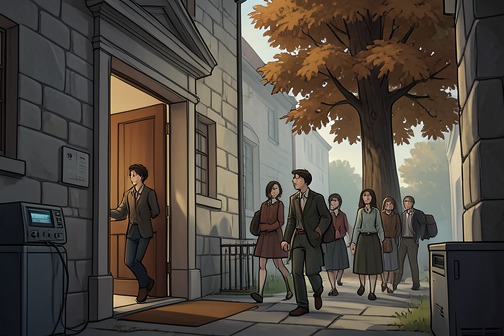
Goldmund arrives in spring with his elderly father, an imperial servant. They tether their horses beneath the chestnut tree, which is still bare after winter. Goldmund asks what kind of tree it is, but his father does not answer; the porter tells him. Goldmund introduces himself by name and says that he will attend the school. Before entering the cloister, he has already formed a tentative attachment to two parts of his new surroundings: the tree and the friendly porter.
The father is received by the school’s head priest and, toward evening, by Abbot Daniel. He is invited to remain as a guest but stays only one night, explaining that he must ride back the next day. He gives one of his two horses to the cloister, and the gift is accepted. His manner remains courteous but cool. The priests, by contrast, take an immediate liking to the respectfully silent, delicate-looking boy. They are content to let the father depart, while Goldmund is shown to his teachers and assigned a bed in the students’ dormitory.
At the outer gate, Goldmund watches his father disappear beyond the cloister wall and sheds a tear before turning away. The porter consoles him by noting that many newcomers feel homesick at first, then offers reassurance that life in the cloister can be good. Goldmund smiles and asks to see the horse his father has left behind. In the stable, he recognizes the little brown animal that carried him there, embraces it, and gives it pieces of bread he had hidden in his sleeve. The horse is a tangible remnant of home, and his promise to visit it often shows how he begins to make the unfamiliar place habitable through attachments rather than through rules alone.
## Meeting Narcissus
The porter leads Goldmund across the courtyard toward the classroom. At the inner gate, Goldmund thanks him and shakes his hand; when he realizes he has forgotten the way to the classroom, he blushes and asks the porter to guide him again. This small dependence extends the welcome that began at the entrance. He enters a room where a dozen boys and young men sit on benches, and introduces himself as the new scholar.
Narcissus, the assistant teacher, acknowledges him without smiling, indicates a seat at the rear, and continues the lesson. Goldmund is struck by the teacher’s youth, handsome appearance, refinement, and controlled manner. He listens gratefully, though at first he does not understand what is being taught. His attention is drawn repeatedly to Narcissus’s figure, eyes, lips, and precise speech; the young teacher becomes, almost at once, a source of fascination and a possible friend.
That first classroom impression is not yet mutual intimacy. Goldmund has entered the school expecting to find good and likable men, and the porter and abbot have already helped him feel at ease. Narcissus adds a different attraction: intellectual authority joined to personal composure. The moment also carries a touch of embarrassment. When the lesson ends, Goldmund realizes that he has fallen asleep, and the other pupils have noticed. His initial happiness at belonging is therefore mixed with the awkwardness of being the new boy, still tired from the journey and not yet adjusted to the school’s routines.
## What the Arrival Foreshadows
The setting Goldmund enters is governed by hierarchy as well as hospitality. When Narcissus later disputes a teaching method with Father Lorenz, the disagreement reaches Abbot Daniel. Narcissus argues passionately for changes, but the abbot’s ruling makes clear that even a persuasive improvement must yield to the monastery’s rule of obedience when a superior decides otherwise. The episode reveals a central tension in Goldmund’s new home: the cloister cultivates learning and individual gifts, yet it also requires submission to institutional order.
For Narcissus, this order is bound to a chosen vocation. When Goldmund later asks whether their friendship has reached its end, Narcissus tells him that he still loves him as a friend, but cannot be in love: he is a monk who has taken vows, and his goal remains in the cloister. He urges Goldmund to ask his mother, or her image, for direction, while acknowledging that he cannot lead or accompany him toward an uncertain destination. He plans to withdraw from teaching for a period of fasting and exercises before consecration. The friendship that begins with Goldmund’s admiration in the classroom thus develops into a relationship that awakens him, but cannot give him the same settled purpose Narcissus finds in religious life.
Much later, Goldmund returns to Mariabronn with a changed understanding of what the cloister contains. Its architecture and art, which he had seen as a student, now appear to him as works belonging to a unified whole shaped over centuries. He recognizes that the old stone Madonna in the upper chapel is beyond the reach of his own best work. Under Abbot John, Narcissus has become the ruler of the house; Goldmund sees him as serving the same enduring order once served by Abbot Daniel, despite the two abbots’ differences in character. The boy who arrived feeling that a tree, a porter, a horse, and a teacher might be his friends now stands before a community whose scale and continuity make him feel small.
## The Beginning of an Artistic Vocation
The arrival’s significance reaches beyond school life because it opens a path toward art that will eventually bring Goldmund back to the cloister. During his wanderings, he sees a wooden Madonna in a side chapel and is moved by the figure’s living expression and beauty. The priest tells him that the work is controversial: some consider it too worldly to represent the mother of God. It was made by [Master Niklaus](entity:character-recall-character-master-niklaus-5e0a4b4d7e3f), a celebrated carver in [the bishop’s city](entity:location-recall-location-the-bishop-s-city-1a91fb8e7f27). Goldmund’s response to the statue directs him toward its maker and toward sculpture as a possible vocation.
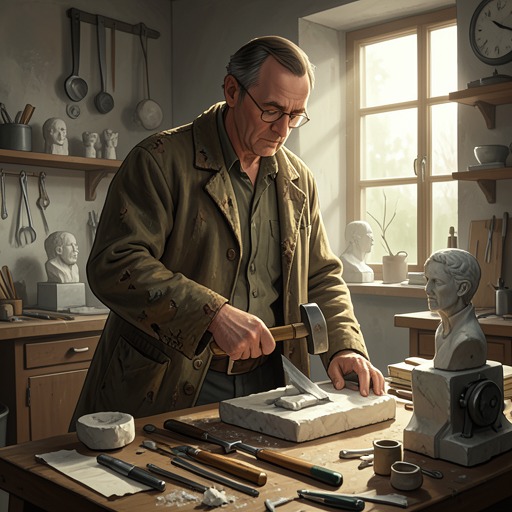
In Niklaus’s workshop, Goldmund learns to draw and is allowed to model in clay as well as carve wood. His first successful work is a small figure of [Julie](entity:character-recall-character-julie-5a82eb7a07d7), [Lydia](entity:character-recall-character-lydia-3e7a560b729c)’s sister, but Niklaus refuses Goldmund’s wish to have it cast in metal, judging it too worldly for him to sponsor. Goldmund then begins a wooden statue of Narcissus as the Apostle John, intended for a commissioned crucifixion group. The early classroom fascination has become artistic remembrance: at the carving bench, Goldmund rediscovers his skill and soul through the image of his friend, while the work also gives lasting form to a person who belongs to a different vocation.
On his eventual return to Mariabronn, Goldmund seeks a work that will fit the monastery rather than stand as an arbitrary display. He chooses the unadorned niche in the refectory from which a young brother reads during meals and proposes carved panels for its steps and lectern. His design joins two domains: the lower structure, growing from an oak trunk and winding upward, represents creation through images of nature and the lives of patriarchs and prophets; the upper parapet bears the four apostles. He plans for one evangelist to carry the features of Abbot Daniel, another those of [Father Martin](entity:character-recall-character-father-martin-9cf710720e65), and Luke those of Master Niklaus. The work gathers the relationships and artistic encounters that began with his arrival into a form intended to belong to the house’s continuing life.
## Significance
Goldmund’s entrance into Mariabronn is both a first separation from home and the beginning of a durable connection. His father leaves him behind; the horse, tree, and porter offer immediate points of attachment; and Narcissus introduces a bond that will outlast Goldmund’s student years. Yet the cloister’s educational welcome is inseparable from its discipline, its hierarchy, and the vows that determine Narcissus’s path. Goldmund’s later departures and returns give the arrival a double meaning: Mariabronn is the setting of his formation, but not the final answer to his vocation. The school first gives him a place to belong; the life he discovers beyond it eventually gives him the art with which he can return and contribute to its shared world.
Event 2
Goldmund’s nocturnal visit to the village

[Goldmund’s nocturnal visit to the village](entity:event-recall-event-goldmund-s-nocturnal-vi-7cbd174749cf) begins as a classmate’s invitation to break the rules, but becomes a turning point in [Goldmund](entity:character-recall-character-goldmund-6408ea5ed221)’s inner life: a brief encounter with a girl exposes the conflict between his expected monastic discipline and an attraction he cannot simply will away. Its aftermath also gives [Narcissus](entity:character-recall-character-narcissus-8ac539c49d81) the first opportunity to care for Goldmund, opening a new dimension in their relationship.
## The invitation and the forbidden excursion
Goldmund has studied at [Mariabronn](entity:location-recall-location-mariabronn-d697cde40052) for more than a year when Adolf approaches him during the recreation hour after supper. The two had first met in a fistfight and later studied Euclid together. Adolf asks Goldmund to promise not to tell the teachers about what he is planning. Goldmund gives his word, guided by the unwritten student code even when it conflicts with the monastery’s formal rules.
Adolf’s plan is to go to the village at night. Goldmund knows the phrase for these illicit outings and understands their appeal: the danger and secrecy make participation a mark of distinction among the regulars. He is tired, weak, and has had a headache, and initially wants to refuse. Yet embarrassment in front of Adolf and the possibility that the outside world might offer something new persuade him to join.
The monastery’s outer gate is locked, so Adolf leads Goldmund to the mill, where the noise of the wheels conceals their escape. They climb through a window onto wet planks and use one as a bridge across a stream. At the forest’s edge, they meet Konrad and later Eberhard; together the four walk through the night to the village. The excursion is at once a breach of discipline and an experience Goldmund finds exciting, distinct from the cloister’s ordered routine.
## The meeting in the village
After less than an hour, the students reach a village that appears asleep. They move quietly around houses and through a garden before Adolf knocks at a shutter. A servant girl lets them into a kitchen, where a younger girl with long dark braids also appears. Adolf has brought gifts, including some white bread from the cloister, and the group shares apple cider from a clay jug.
The boys talk in whispers. The others exchange tentative gestures of affection with the servant girl, while no one touches the younger girl. Goldmund sits apart, silent and fixed on the lamp, trying to forbid himself from looking at the girl with the braids. He believes that he is destined for the ascetic life of a monk and regards even this visit as sinful. Yet whenever his attention strays toward her, he finds her dark eyes already fixed on him. The encounter’s significance lies less in anything the students do together than in the mutual attention Goldmund cannot suppress.
When it is time to leave, the students say goodbye to the girls in turn. As Goldmund climbs out of the window, the younger girl holds him back by the shoulder. She calls him by name, asks whether he will come back, and urges him to do so with a kiss. Goldmund leaves the garden and follows the others toward the forest. His will insists that he must never return, while his heart immediately longs to go back the next day. The moment gives the secret excursion a personal consequence that the other students’ brief adventure does not have for him.
## The return and its immediate cost
The four boys make their way back to Mariabronn by the same concealed route, crossing the stream and passing through the mill before returning to the dormitory. The following morning they attend the usual services and lessons, but Goldmund looks so pale that [Father Martin](entity:character-recall-character-father-martin-9cf710720e65) asks if he is ill. Adolf warns him not to disclose their outing, and Goldmund says he is all right.
During Greek, Narcissus watches Goldmund closely and recognizes that he is unwell. Rather than expose him in front of the other students, Narcissus sends him to the library on an errand and follows him there. He offers practical help, suggesting that Goldmund could be put to bed and given soup and wine if he is ill. Goldmund cannot explain himself. He leans against a lectern and breaks into violent weeping; Narcissus waits, then comforts him and takes him to the sickroom without passing the study halls.
The visit has left Goldmund worn down not by the walk through the forest or the mechanics of escaping the cloister, but by the effort to forget the girl’s question, her hands, and her kiss. His distress is therefore both physical and inward: the night has unsettled the identity he tries to maintain as a future monk. The tears release some of that strain. After eating some gruel, white bread, and red wine, he falls asleep, and the color returns to his cheeks.
## Narcissus’s care and the event’s significance
Narcissus understands that Goldmund is not suffering from an ordinary illness. Seeing him asleep, he recognizes that the crisis has passed and that the encounter between them has changed their relationship. Until this point, Narcissus has guarded himself against becoming too close to Goldmund, believing that friendship could threaten his dedication to serving the mind and guiding pupils. Now Goldmund has needed his help, and Narcissus sees the possibility that one day he too might be able to accept care and affection from the younger man.
The event thus joins two kinds of awakening. In the village, Goldmund experiences an attraction that conflicts with the ascetic vocation he believes is expected of him; back at the monastery, he discovers that his apparent weakness can bring him into a more intimate relation with Narcissus. The girl’s brief invitation remains unresolved, held between Goldmund’s command never to return and his heart’s contrary desire. The emotional aftermath, however, has a clear consequence: Narcissus and Goldmund move toward friendship through a moment of distress rather than through scholarly achievement.
Event 3
Goldmund’s recovery of his mother’s memory
[Goldmund’s recovery of his mother’s memory](entity:event-recall-event-goldmund-s-recovery-of-8c2a64b51f12) is a crisis of recognition: [Narcissus](entity:character-recall-character-narcissus-8ac539c49d81)’s words bring a lost childhood image into consciousness, separating [Goldmund](entity:character-recall-character-goldmund-6408ea5ed221)’s own love for his mother from the condemnatory story he inherited from his father. The painful return of that image changes his understanding of himself, dissolves his imagined obligation to atone through monastic life, and marks the beginning of a path Narcissus can help uncover but cannot follow for him.
## Background: A childhood obscured
Goldmund had little independent knowledge of his mother. The account he knew came chiefly from his father, who described her as a beautiful woman of noble but impoverished birth, once a dancer, whom he had taken from poverty, baptized, instructed in religion, and married. According to that account, after several years of domestic life she resumed her former ways, caused trouble, and disappeared after her husband had brought her home more than once. Her reputation as a witch endured in the stories told about her.
That account did more than explain her disappearance: it shaped Goldmund’s sense of what he owed the world. His father educated him in place of the absent wife and instilled the belief that he must give his life to God to expiate her sins. The story of a wayward, shameful mother displaced Goldmund’s own living memory of the woman he had loved as a child. He had almost forgotten that original image, and had learned to treat his mother as a forbidden subject.
## Narcissus names the forgotten wound
After an earlier conversation had perplexed and hurt Goldmund, he returned a few days later willing to hear more. Narcissus described their contrasting natures and defined wakefulness as the ability to recognize one’s inner forces and weaknesses through conscious reason. Goldmund, he said, had forgotten his childhood, which was still calling to him from the depths of his soul. Narcissus regarded this recognition as a possible reason the two friends had met: Goldmund needed to understand himself, while Narcissus could help him do so.
Narcissus went further, contrasting Goldmund’s sensuous, artistic nature with his own life of thought. He portrayed Goldmund as belonging to life, feeling, and the maternal world, and himself as a thinker oriented toward ideas. This account overwhelmed Goldmund. At the words about forgotten childhood, Goldmund flinched, though Narcissus did not see his reaction; later, Goldmund told him that the conversation had struck him deeply and asked to be left alone. Narcissus, realizing that his words had hurt his friend, withdrew.
## Crisis and recognition
Goldmund’s distress did not resolve in tears, as it had on an earlier occasion. He felt an unbearable inner pressure and fled through the quiet parts of the cloister into the court of the cross. There, images associated with the experience pressed on him: the carved heads of dogs and wolves above the garden arches seemed to take on an alarming significance. The episode left him with a sense of having encountered something terrible and important, though he could not yet name it.
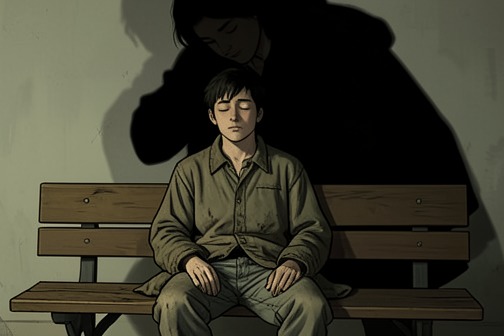
When Goldmund later came to, he could not place himself or recover what had happened. He remembered a distant experience that had seemed both sublime and frightening, but its meaning remained out of reach. Images of dogs’ heads and the scent of roses returned, followed by the pain of the episode. In the narrowing interval between waking and sleep, he found the image again: a tall, radiant woman with glowing hair and a full mouth. He recognized her as his mother, and Narcissus’s words about forgotten childhood came back to him. With that recognition, the old memory returned, displacing the accumulated stories and rumors that had obscured it.
## The recovered mother and its consequences
Goldmund understood his mother not through his father’s moral judgment but through the intensity of his own childhood attachment. He told Narcissus that he had loved and admired her more than anyone, and that she had been sun and moon to him. The contrast is decisive: the remembered mother is a radiant, beloved presence, while the inherited account had gradually turned her into an evil and shapeless figure. Recovery restores not a new account of her later life but Goldmund’s own lost relation to her.
The change reaches beyond memory. After the crisis, Goldmund seemed to have shed what had been unformed and inauthentic in him, including the belief that monkhood was his vocation and that he owed God a special service to make amends for his mother. He appeared both younger and older: released from a false obligation, yet newly conscious of a self and destiny still taking shape. The narration presents Narcissus as having helped Goldmund reach this point, but not as the source of the inner life that follows. Narcissus recognizes that Goldmund has found access to something beyond his own experience; their friendship remains profound, yet Goldmund’s newly recovered self is ready to follow a path Narcissus cannot share.
## Narrative significance
The episode is structured as a delayed recognition. Narcissus first supplies the words that touch the hidden wound; Goldmund then undergoes a crisis whose images he cannot interpret; only after the return of the mother’s image does the experience become intelligible. The passage moves from inherited testimony and imposed guilt toward personal memory and recognition. Its resolution does not erase the mother’s disappearance or verify the stories told about her. Instead, it establishes that the father’s account had displaced a different truth: Goldmund’s own remembered love.
That distinction redirects the larger shape of Goldmund’s life. The recovery breaks the connection between his mother’s alleged sins and his own supposed duty of religious atonement. Narcissus can name the division between Goldmund’s conscious understanding and buried childhood, but the memory that answers him belongs to Goldmund. The event therefore marks both a healing and a parting: the friendship has made recognition possible, while the life opened by that recognition leads beyond Narcissus’s guidance.
Event 4
Goldmund leaves Mariabronn
[Goldmund leaves Mariabronn](entity:event-recall-event-goldmund-leaves-mariabr-544528799daa) after an encounter with [Lise](entity:character-recall-character-lise-265234fabf09) turns an inward awakening into an irrevocable departure. The event joins bodily experience to the mother’s call that [Narcissus](entity:character-recall-character-narcissus-8ac539c49d81) has helped him recognize: [Goldmund](entity:character-recall-character-goldmund-6408ea5ed221) does not leave with a settled destination, but with the conviction that the cloister can no longer contain the life opening before him. His night crossing of the brook becomes the threshold between institutional routine and a world without a prescribed route.
## The Cloister and the Limits of Its Order
[Mariabronn](entity:location-recall-location-mariabronn-d697cde40052) is not merely a school or refuge but a many-layered institution, sustained by generations of boys, monks, teachers, and administrators. Its halls carry on learning and religious practice alongside arts, sciences, and worldly pursuits; its life shifts with the character of the abbot and the interests of the day. Against this broad, durable order, Goldmund’s departure is a personal rupture rather than a rejection of an empty place. He has lived within a community that gives shape to time and conduct, but the demands of that life cannot answer the awakening he experiences outside its walls.
The cloister’s teaching hierarchy also supplies a contrast. Narcissus, though still a novice, has been appointed to teach Greek because of his gifts, and he presses for changes to the teaching of grammar. When Father Lorenz resists, [Abbot Daniel](entity:character-recall-character-abbot-daniel-1b4be7de30d0) hears the dispute patiently and is asked to decide it. The episode shows a house governed by ranks and responsibilities, even when a younger member’s knowledge may exceed his superior’s. Goldmund’s own departure is different: rather than seek a change within that structure, he leaves it altogether.
## Lise and the Awakening
The immediate change begins with a practical errand. [Father Anselm](entity:character-recall-character-father-anselm-4706d68dd37a) sends Goldmund from class to gather John’s-wort, explaining that knowledge of nature is a science too. Goldmund gladly accepts the afternoon outside, rides Bless into the fields, and searches the fallow ground for the plant. The assignment takes him beyond the classroom’s intellectual routine and into the natural setting where he falls asleep among the gathered herbs.
Lise finds him there and approaches after deciding that the sleeping young man does not seem dangerous. Their encounter is largely wordless. When Goldmund wakes with his head in her lap, he first meets her gaze without fear; the exchange that follows leads him to connect the woman before him with a more profound inner recognition. He later tells Narcissus that he did not mistake Lise for his actual mother: her dark hair and brown eyes were unlike his mother’s blond appearance. Yet he felt that his mother had come to take him home, and understood Lise’s presence as a message from her.
Goldmund describes the encounter as a transformation. Longings and dreams that had remained indistinct become newly meaningful; he feels that Lise has shown him what a woman is and awakened knowledge that changes how he understands himself. The realization is not simply that he is attracted to Lise. He concludes that he cannot remain at Mariabronn another day, and decides to leave as soon as night falls. His sudden departure therefore follows both the immediate encounter and the deeper interpretation he gives it: a woman’s presence has become the point at which his repressed sense of the maternal and his own sensual nature meet.
## Farewell to Narcissus
Before leaving, Goldmund seeks Narcissus in his cell and apologizes for disturbing him. He tells his friend that he is going that very day, without his father and without permission, and admits that he is running away. Narcissus recognizes that Goldmund’s account is more than a passing infatuation, but asks where he intends to go and whether Lise is his destination. Goldmund says he will go with her, although she is a stranger and seems homeless; he has no further goal.
Narcissus does not attempt to keep him. He has already understood their friendship as having brought Goldmund to an awakening, while its next direction remains uncertain. For Narcissus, the cloister is still his own vocation: he has taken vows, and is preparing to withdraw for fasting and exercises. The two friends thus separate at a moment when their paths diverge sharply. Goldmund speaks of giving himself to a woman as a way toward life’s meaning; Narcissus remains committed to discipline, prayer, and the life of the mind.
Their farewell nevertheless confirms the friendship rather than ending it. Narcissus tells Goldmund that he will never forget him and asks him to come back if he is ever in need. Goldmund embraces him and, knowing that Narcissus dislikes caresses, strokes his hands instead of kissing him. The restraint of that gesture preserves their affection in a form suited to Narcissus, even as the parting leaves each to follow a different vocation.
## Crossing the Threshold
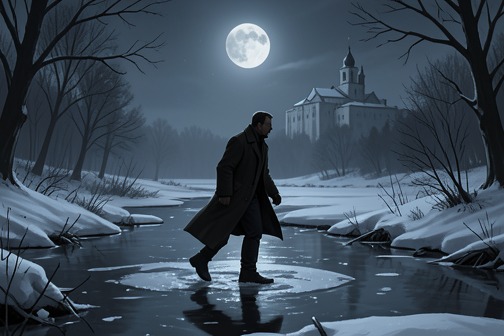
At nightfall Goldmund leaves by the cloister’s secret route. The old memory of sneaking out to visit the village returns, but this time he is not setting out on a forbidden excursion that will end in return. He crosses the brook without a bridge, removes his clothes, throws them to the opposite bank, and wades through the cold, deep water. The crossing makes the break concrete: behind him lies a place that had become home through habit and affection, though he now recognizes it as home only in appearance.
As he dresses on the far bank, Goldmund sees that Narcissus had understood and guided him toward this change before Goldmund himself could name it. He recalls Narcissus’s distinction between his own dreams of girls and Narcissus’s dreams of boys, a line that makes their difference in nature plain without undoing their bond. Goldmund then calls like an owl, as Lise had asked him to, and receives an answering call. Their meeting continues without a plan or an extended conversation: Lise comes out of the forest, and he lets her lead him through the darkness. The movement away from the cloister becomes a movement into a world organized by bodily presence and action rather than lessons, vows, and explanation.
## The Open World
After the night with Lise, Goldmund wakes and sets out alone. For the first time the landscape ahead is not a view framed by a student’s window or a walk that must end in a return to school. It is an open world in which he will have to find his way, and whose fortunes may bring either good or harm. The change is practical as well as inward: bells no longer summon him to bed, Mass, lessons, or meals.
His first experiences of wandering give this new freedom a material cost and texture. Hunger becomes immediate; he eats half-ripe corn and gathers green hazelnuts, then rests among abundant blueberries in the forest. At a farmhouse, he asks whether he can stay until the next day, but there is no room under the roof, so he is directed to find a bed in the hay outside. The contrast between cloister life and wandering is not a simple contrast between confinement and ease: Goldmund has gained the open road, but must depend on uncertain shelter, food, and encounters with strangers.
The departure also changes the meaning of his relationship with Narcissus. Goldmund leaves without knowing whether he will succeed or where his road will end, yet Narcissus’s promise gives the separation a future horizon: should he be in need, he can return or call for his friend. The event therefore begins a life apart without severing the relationship that helped make the departure possible. Goldmund crosses into uncertainty, carrying both the memory of the cloister and the conviction that his own way must now be lived beyond it.
Event 5
Goldmund and Lydia’s secret romance
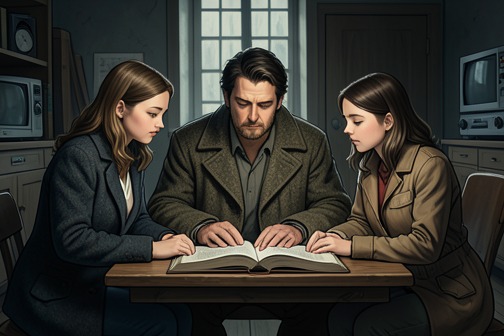
[Goldmund and Lydia’s secret romance](entity:event-recall-event-goldmund-and-lydia-s-se-97d77e5ecbf2) takes shape during [Goldmund](entity:character-recall-character-goldmund-6408ea5ed221)’s winter refuge at a knight’s household, where study and courtship proceed side by side. Its decisive change for Goldmund is the discovery that he can be loved, not merely desired; for [Lydia](entity:character-recall-character-lydia-3e7a560b729c), the relationship offers a powerful intimacy that she knows cannot become a marriage and may end when the homeless wanderer leaves.
## The household and the beginning of attraction
Goldmund has been walking the roads for a year or two when, in early autumn, he reaches the home of a prosperous knight with two daughters. Concerned about the coming cold, he asks for food and a bed. The knight learns that he has studied Greek and invites him to the family table, where Goldmund meets the daughters, Lydia and [Julie](entity:character-recall-character-julie-5a82eb7a07d7). When Goldmund means to continue his journey the next day, the knight offers him clothes and free shelter in exchange for correcting and copying a book about his pilgrimage and helping him finish it. Goldmund accepts, knowing the hardships of winter travel but also welcoming the chance to stay near the two young women.
Their arrangement gives Goldmund a place in the household without making him its equal. He works with the knight on the manuscript for at least two hours a day, correcting faulty Latin and reshaping awkward sentences. The knight praises his work, while Goldmund is given an outfit between a page’s and a huntsman’s, rather than the scholar’s gown his host first proposed. Hunting, riding, and company fill the rest of his days. He keeps aloof from an opportunity for an intrigue with the miller’s wife, but his attention to the knight’s daughters is unmistakable.
Julie, the younger and more beautiful sister, is shy and speaks little to him. Lydia, the older, meets him with curiosity and a teasing, faintly ironic manner, asking about his life at the cloister. Goldmund treats Lydia as a lady and Julie almost as a little nun; he is content when conversation keeps the sisters at the table or when Lydia talks with him in the yard or garden. Their early courtship is therefore tentative: Lydia permits his company, but neither openly declares what the growing attention means.
## Jealousy turns courtship into a secret bond
The turning point comes when a neighboring couple arrives for an overnight visit. Goldmund’s bed is moved from the guest room to the writing room, and the household prepares a festive meal. He notices the visiting wife’s interest and responds to it. At dinner, their flirtation is visible in small gestures and conversation, while Lydia watches in silence. Julie withdraws, but Lydia remains with the company, drawn to the exchange even as it hurts her. The scene makes her jealousy legible before she has admitted her love: Goldmund’s attention to another woman affects her as a personal betrayal.
The next morning, Lydia watches Goldmund help the guest mount, seeing his hand hold her foot. Soon afterward Lydia rides out. Goldmund follows her across the autumn countryside. When he catches up, she stops racing but remains silent; he tells her that her flight has made him understand that she cares for him. She breaks into tears when he lifts her from her horse. Her anger is specific: she condemns his flirtation with the visitor, especially because it took place in front of her, and challenges his lack of shame. Goldmund does not argue. He reads love in her expression despite her rebuke, acknowledges that he has done wrong, and tells her that he loves her.
Their return to the household is cautious. Goldmund feels joy although he has not kissed her; Lydia fears that coming back together will expose them. When they meet privately later, she asks whether he spent the night with the visitor, and he denies it. She also asks whether he truly loves her and what will happen between them. Their questions define the relationship’s constraint from the outset: attraction is mutual, but neither a public union nor a secure future is available to them.
## A private language of intimacy
In their first kiss, Goldmund approaches Lydia gently, and the scene recalls his own earlier initiation into love by [Lise](entity:character-recall-character-lise-265234fabf09). The memory links this new intimacy to his past without making the two relationships alike: Lydia’s affection is marked by a tenderness and emotional reciprocity he has not previously known. Afterward, Lydia draws herself upright and asks to be let go, aware that she has stayed with him too long. Their meetings remain secret, and she sets the terms of their closeness.
They find a private hour each day. Sometimes Lydia holds Goldmund’s hand and leaves after a kiss; at other times she kisses him at length but does not allow him to touch her. Once she lets him see one breast as a deliberate gift, then covers herself again, deeply embarrassed. They invent names for each other, and Lydia tells him about her childhood, dreams, and games. The relationship thus develops through alternating gestures of permission and restraint, conversation and silence, with Lydia’s agency shaping its pace. She also grieves that their love is wrong because Goldmund cannot marry her, and secrecy becomes inseparable from the sadness she associates with their attachment.
For Goldmund, the relationship changes the meaning of his experience. He has thought of his wandering as a way to learn women and love in many forms; with Lydia, he feels for the first time not only desired but loved. The distinction is central to the romance: his earlier attention to women involved observation, experience, and the pleasures of encounter, whereas Lydia’s affection gives him a sense of being known and valued. He often answers her anxieties not with explanations but with gentle closeness, holding her and making soothing sounds rather than promising a future he cannot offer.
## The wanderer and the unpromised future
Lydia sees the sorrow in Goldmund’s eyes and connects it to his homelessness. She imagines that he will eventually return to the roads and sleep outdoors, while she will remain in her father’s house, with her sister and her own room. Yet she says that his departure would leave her without a home in the deeper sense. Her words make the romance a meeting between different forms of insecurity: Goldmund has no settled household to lose, while Lydia’s home is physically present but cannot protect her from the anticipated loss of him.
She imagines that Goldmund will not have an ordinary life, that he may become a poet, and that women may love him while he remains alone. She also suggests that he might return to the cloister and to [Narcissus](entity:character-recall-character-narcissus-8ac539c49d81), and hopes he will not die alone in the forest. These are Lydia’s fears and hopes, not assurances about his destiny; their significance lies in how clearly she recognizes that the relationship cannot hold him in one place. The autumn rides, riddles, and play with leaves and acorns sit beside her serious predictions, giving their days a double character: youthful delight carried within an awareness of impermanence.
## Narrative significance
The romance places Goldmund’s wandering life inside a household governed by work, family, and social boundaries. His employment with the knight permits his stay, but his attraction to Lydia cannot erase the fact that he is a guest and a wanderer. The episode’s movement from the visiting woman’s arrival, through Lydia’s jealousy and the pursuit on horseback, to the secret daily meetings gives emotional force to a relationship that remains constrained rather than resolved by marriage.
Lydia’s love also offers a measure of change in Goldmund’s understanding of intimacy. He has been learning to distinguish women and their forms of desire; she is the first to make him feel the difference between being wanted and being loved. At the same time, her foreknowledge of his departure prevents that discovery from becoming a promise of permanence. Their secret romance is therefore both a genuine homecoming in feeling and a bond already marked by the road that may take Goldmund away.
## Event metadata
Event 6
Goldmund is expelled from the knight’s household
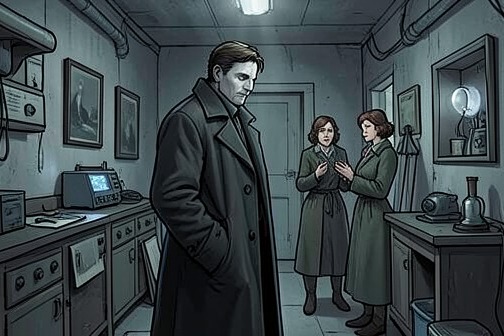
[Goldmund is expelled from the knight’s household](entity:event-recall-event-goldmund-is-expelled-fr-cd9e4a53c5bf) after a nighttime confrontation between [Lydia](entity:character-recall-character-lydia-3e7a560b729c) and [Julie](entity:character-recall-character-julie-5a82eb7a07d7) makes his intimate involvement with the sisters impossible to conceal. The expulsion ends his life under the knight’s roof and sends him back to the wandering existence he had once imagined choosing for himself. Its meaning deepens in retrospect: amid the plague and anti-Jewish violence, [Goldmund](entity:character-recall-character-goldmund-6408ea5ed221) encounters [Rebekka](entity:character-recall-character-rebekka-ce4c68e68f99), whose grief and accusation force him to recognize how easily his offers of help can reproduce the harm and entitlement of the world around him.
## The confrontation and its disclosure
On the first snowy day of winter, Lydia comes to Goldmund’s room at night, as she customarily does. She is troubled by fear that Julie may betray their secret, but does not tell Goldmund what is weighing on her. Their private intimacy is interrupted when Julie enters. Lydia, startled, clings to Goldmund; Julie makes clear that she will either be admitted to the bed or wake her father. Goldmund lets her in, and the three remain together in the narrow bed.
The moment brings Goldmund’s hidden desire into the open without resolving the sisters’ relationship. When Lydia hears Julie respond to his attention, she abruptly ends the encounter and tells Julie to leave with her. Goldmund, feeling rejected, turns toward Julie and asks her to meet him the following day. Lydia nevertheless helps her sister on the way out, placing Julie’s coat around her. That gesture both conveys Lydia’s distress and touches Julie, briefly reconciling the sisters even as the encounter has set them against one another.
The confrontation continues in its aftermath. The sisters return to their room without speaking and lie awake separately. Lydia spends the remainder of the night in distress, then kneels in prayer before the small wooden Saviour in her room. In the morning she tells the knight what she has decided to disclose, but does not mention Julie’s part. Her account is enough to bring the secret to the household’s authority: Goldmund finds the knight dressed for the outdoors rather than for their usual writing, and understands that he is being taken away.
## The knight’s sentence and Goldmund’s departure
At dawn, the knight leads Goldmund down the stairs, across the courtyard, and out through the gate. The snow underfoot is slightly frozen, and the sky is red, but the two men walk in silence. Goldmund looks back at the house, his room’s window, and the steep snow-covered roof as they disappear from view. The departure is painful precisely because the household has become more than a place of shelter: he must leave the study, the bedroom, and the two sisters all at once.
After about an hour, the knight stops and tells Goldmund to continue alone in the same direction, returning to the wanderer’s life he had led before. He says that if Goldmund ever appears again near his house, he will be killed. The threat is conditional, not an attempt to pursue him immediately; the knight says he does not wish to take revenge, but admits he should not have allowed such a young man to live intimately with his daughters. He ends by telling Goldmund to go and asking God to forgive him.
The knight remains where he is until Goldmund has disappeared over the next ridge. The dawn’s reddish light fades, the sun does not appear, and snow begins to fall. The visual separation seals the expulsion: Goldmund’s imagined sudden departure has become an imposed one, governed by the knight’s warning and accompanied by the loss of the home he has formed there.
## The plague road and Rebekka
The expulsion returns Goldmund to wandering, a life that later carries him through regions devastated by plague. He encounters abandoned homes, unburied dead, starving animals, and survivors driven by fear. The epidemic also fuels accusations against supposed sources of infection. In one town, Goldmund watches a mob burn the entire Jewish ghetto, driving people back into the fire; he is appalled by the killing of innocent people and by the search for scapegoats amid general suffering.
Outside a small town, he finds Rebekka mourning beside rubble. Her father has been burned with fourteen other Jews on the town authorities’ orders. Rebekka had escaped, but returned in despair, blaming herself for not having died with the others. Goldmund helps her gather her father’s bones from the ashes and bury them in a hidden place in a field. He then offers to protect her and asks her to travel with him, promising not to touch her until she is ready.
Rebekka rejects the offer. She accuses Christians of first helping a daughter bury the father their people murdered and then expecting the daughter to belong to them. Goldmund recognizes that his attempt to move her from grief toward companionship has repeated, in another form, the assumption that her needs should yield to his wishes. He admits that she may be right and asks forgiveness. The encounter complicates the moral aftermath of his expulsion: wandering exposes him not only to mortality and violence, but to the obligation to see the person before him rather than turn suffering into an occasion for his own desire or consoling story.
## Retelling and significance
Later, [Narcissus](entity:character-recall-character-narcissus-8ac539c49d81) asks Goldmund whether he witnessed Jews being burned and whether he prevented it. Goldmund answers that he did not, and then tells Narcissus Rebekka’s story in detail, growing heated as he speaks. He asks whether the world in which people are made to live is hellish and revolting; Narcissus agrees that the world is indeed like that. The exchange sets Goldmund’s helpless witness beside his act of assistance to Rebekka: he could not stop the violence, but he could help bury her father and listen to her condemnation.
The expulsion’s immediate cause is a household secret disclosed by Lydia, while its immediate consequence is Goldmund’s renewed homelessness under threat of death if he returns. The later plague episodes do not undo that separation; instead, they widen its significance. The knight’s order sends Goldmund into a world where private desire, bereavement, prejudice, and violence repeatedly collide, and where even a well-meant offer must be measured against the suffering of the person receiving it.
Event 7
Goldmund kills Viktor
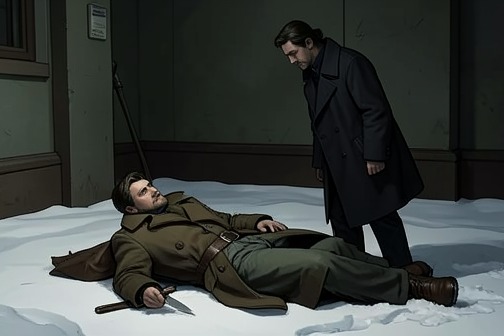
[Goldmund kills Viktor](entity:event-recall-event-goldmund-viktor-48a26aa11d5c) during a night in their forest camp, when suspicion between the two traveling companions becomes a fight for survival. The killing ends their companionship and sends [Goldmund](entity:character-recall-character-goldmund-6408ea5ed221) into the snow alone; later, as he recounts [Rebekka](entity:character-recall-character-rebekka-ce4c68e68f99)’s story to [Narcissus](entity:character-recall-character-narcissus-8ac539c49d81), the memory belongs to a wider reckoning with violence, fear, and the limits of individual resistance.
## Suspicion and confrontation
Goldmund has come to distrust [Viktor](entity:character-recall-character-viktor-b7b35c6bd11e). He regrets having told him about [Lydia](entity:character-recall-character-lydia-3e7a560b729c) and wonders how to separate from his companion. When Viktor wakes and offers him a turn to sleep, Goldmund lies down but remains awake, unsettled by the man beside him. About an hour later, Viktor bends over him and searches his pockets and seams. Goldmund opens his eyes and tells him to go away, saying he has nothing worth stealing.
Viktor responds by attacking him. Goldmund struggles to rise, but Viktor holds him down. As Goldmund fears he is about to die, he reaches into his pocket, draws his small hunting knife, and strikes Viktor repeatedly. Viktor releases him, and Goldmund survives. The reversal is immediate: the companion whose presence had become a source of distrust is dead, and Goldmund is left to confront what he has done.
## Flight and aftermath
Goldmund recognizes the killing as murder and addresses the Mother of God in shock. He wipes the knife on the woolen vest Viktor is wearing, puts it back in its wooden sheath and in his pocket, and runs away. The act of flight does not resolve his distress. As daylight comes, he washes Viktor’s blood from himself in the snow, then wanders for another day and night, anguished and without direction.
The killing also marks a distinction between dangers Goldmund believes he can resist and those he cannot. In the later account of his journey, he remembers the night when Viktor threatened his life as a danger he could fight and escape. Plague, by contrast, seems impossible to oppose by personal strength. The recollection therefore makes Viktor’s death a brutal turning point in Goldmund’s encounter with mortality: survival has required violence, but surviving does not deliver him from grief or from the larger devastation that follows.
## Recounting the killing amid the plague
The later recollection places Viktor’s death within Goldmund’s passage through a landscape where plague has overturned ordinary life. He distinguishes the winter struggle with Viktor from the disease spreading through the region: that earlier danger could be fought, and he had defended himself and escaped, whereas plague could not be met by individual resistance. This contrast does not make the killing a triumph. Goldmund’s survival in the forest remains bound to the death of his companion, while the plague brings him into contact with suffering on a scale no single act can master.
The distinction becomes morally unsettled as Goldmund witnesses people blaming Jews, foreigners, the poor, or doctors for the disease. In one town he sees a ghetto burned and its fleeing inhabitants driven back into the fire; he watches the violence with rage and revulsion. The episode broadens the significance of the forest encounter without making the events equivalent: Goldmund killed Viktor while struggling to save his own life, while the burning of the ghetto is violence against an innocent group under the cover of collective fear. Both enter a world in which death is no longer remote, but the later scene makes clear that fear can also be turned outward and organized into persecution.
## Rebekka’s story and the question of complicity
The contrast between self-defense and violence against the vulnerable sharpens when Goldmund meets Rebekka, a Jewish survivor mourning her father. The town’s authorities had ordered her father and fourteen other Jews burned; she escaped, then returned and blamed herself for not dying with them. Goldmund helps her gather her father’s bones from the ashes and bury them in a hiding place in the field. The scene gives the persecution a particular human cost: not an abstraction about plague-era disorder, but a daughter’s grief and the precarious act of burying the dead.
Goldmund offers to protect Rebekka and promises not to touch her, but she rejects his courtship. She accuses Christians of first helping her bury a father murdered by their people and then expecting his daughter to belong to them. Her rebuke forces Goldmund to recognize that his intended kindness does not erase the assumptions behind his offer. He acknowledges that she may be right and asks forgiveness. Her refusal also distinguishes her grief from his attempts to answer surrounding death with companionship or desire; she insists on the right to mourn without being hurried toward consolation.
When Goldmund later tells Rebekka’s story to Narcissus, he recounts it in detail and grows passionate. Narcissus asks whether he prevented Jews from being burned; Goldmund admits that he did not. The exchange shifts the question from whether one person can command or stop every cruelty to what it means to witness violence and remain powerless to prevent it. Goldmund’s own killing of Viktor arose from an immediate threat to his life, but the later conversation refuses to let that private struggle stand for the persecution of a whole community. Rebekka’s story makes the difference visible, while leaving Goldmund’s anger at a world he calls hell in tension with the fact that he, too, had watched and failed to intervene.
Event 8
Goldmund decides to pursue sculpture

[Goldmund](entity:character-recall-character-goldmund-6408ea5ed221)’s decision to pursue sculpture begins with an encounter with a wooden Madonna and becomes a turning point in his wandering life: for the first time, his road acquires a definite destination. The figure’s unusual union of sorrow, beauty, and spiritual presence seems to confirm thoughts he has carried without knowing what to do with them. He seeks out [Master Niklaus](entity:character-recall-character-master-niklaus-5e0a4b4d7e3f), wins permission to learn despite being far older than a customary apprentice, and discovers in carving a practice through which memories, bodily experience, and ideas about suffering can take form.
## The Madonna and the Discovery of a Vocation
After confessing in a cloister church, Goldmund is preparing to leave when a shaft of sunlight draws his attention to a wooden Madonna in a side chapel. She leans forward beneath a blue cloak, extending a delicate hand; her living expression combines a grieving mouth with beauty and spiritual intensity. The statue arrests him. He turns away more than once, but each time feels drawn back to look again, as if it embodies something he has seen in dreams and long wished to find.
The priest explains that the image is controversial. Some viewers consider it too modern and worldly to represent the Mother of God, while others respond to it as a work of great force. It was made by Master Niklaus, a carver in [the bishop’s city](entity:location-recall-location-the-bishop-s-city-1a91fb8e7f27), and had been given to the cloister by a benefactor the previous year. That account connects Goldmund’s private response to the public life of religious images: the same statue that speaks to him as an intimate discovery is also an object of debate and a recent addition to a cloister church.
Goldmund recognizes in the Madonna an expression he had been trying to understand: suffering that is also joy. He had thought about how bodily forms correspond to temperament, and how the face of pain during childbirth can resemble that of ecstasy. In the statue, these perceptions appear joined rather than opposed. The encounter does not merely inspire admiration; it makes his scattered thoughts seem usable and gives them a possible artistic purpose.
## From Wandering to the Workshop
Goldmund leaves the church with a goal. The highway that had been a place of freedom and diversion becomes a road leading to the city and to the master. He arrives before evening, asks strangers where Niklaus lives, and persists until he finds the right street. The next morning, after staying overnight at a cloister, he reaches the workshop and tells Niklaus that love and reverence for the Madonna have brought him there. He asks to become the master’s apprentice.
To explain his request, Goldmund describes his observations of the relation between bodily shape and character, as well as his conviction that pain and ecstasy can share an expression. He says that [Niklaus’s Madonna](entity:object-recall-object-niklaus-s-madonna-ca3fb5ef987d) gives form to what he had only thought and dreamed, and that seeing it made him understand where he must go. Niklaus listens, but distinguishes the ability to speak about art from the ability to make it: in his workshop, work is carved, and a person’s ideas matter only alongside what his hands can produce. He asks Goldmund to draw so that he can judge his capacity directly.
The terms of entry reflect the distance between Goldmund’s calling and the ordinary structure of the craft. A guild apprentice would generally begin at thirteen or fourteen, serve for years, and have his apprenticeship paid for by his father. Goldmund is a grown, homeless wanderer, not a boy entering the standard route. Niklaus therefore does not take him on under a formal contract. After seeing Goldmund’s drawing, he calls it flawed but beautiful and offers him the chance to learn informally, provided he can support himself in the city. He may use the workshop, break carving knives or spoil blocks, and leave whenever he chooses; if wood carving proves unsuitable, he can try something else. Goldmund accepts the arrangement gratefully, understanding that the master will not assume responsibility for him as he would for a young apprentice.
## Learning, Experiment, and Artistic Difference
In the city, Goldmund learns to work with wood, plaster, colors, varnish, and gold leaf, and develops into an able draftsman. Niklaus occasionally lets him model in clay. His first successful work is a small clay figure of [Julie](entity:character-recall-character-julie-5a82eb7a07d7), [Lydia](entity:character-recall-character-lydia-3e7a560b729c)’s younger sister. Niklaus praises it but will not sponsor its casting in metal, judging it too worldly and unchaste. The episode marks an early difference between Goldmund’s attraction to the living and sensual world and the master’s judgment about what is appropriate to make and authorize.
Goldmund’s next important undertaking is a wooden Saint John, intended to represent [Narcissus](entity:character-recall-character-narcissus-8ac539c49d81). Niklaus hopes that, if successful, it can join a crucifixion group on which his assistants have been working. Goldmund approaches this work differently from his diversions in the city. Love affairs, drinking, dancing, gambling, and quarrels can keep him from the workshop or leave him distracted at his bench; when he is ready to work on Saint John, he does so with devotion and humility. In the carving, he feels that Narcissus’s identity is emerging through his hands, rather than being imposed by the artist’s conscious will. The work becomes a means of giving a lasting form to a person Goldmund loves and remembers.
The Madonna also leads Goldmund toward a larger, still unrealized artistic ambition. His image of the mother, once bound to the memory of his own mother, has absorbed the faces of women he has known, including [Lise](entity:character-recall-character-lise-265234fabf09) and Lydia. It changes with each new encounter, yet he hopes one day to make visible not a portrait of one particular woman but an original maternal figure, joining ecstasy, pain, and death. Sculpture thus offers him a way to work with memory and experience without reducing them to a single remembered face.
## Vocation Against Stability
Niklaus’s workshop gives Goldmund access to training and materials, but it also exposes the friction between artistic vocation and settled professional life. Goldmund can find the master’s commissioned work, the prospect of money, and the claims of property repellent. Niklaus, for his part, is troubled by his pupil’s indifference to money, repeated love affairs, brawling, and unreliable attendance. He nevertheless continues to tolerate him because he sees the exceptional quality developing in the Saint John. Their relationship is therefore sustained by the work even when their habits and expectations do not agree.
After Goldmund completes the statue, the city’s comforts and the workshop’s purpose lose their hold on him. He feels the impermanence of desire and beauty, and his attention turns again to the eternal mother: the work has reached completion, but completion does not make him willing to remain. Niklaus tries to give him a permanent professional future. He persuades the guild to grant Goldmund a master’s diploma and proposes that they become partners, sharing important commissions and earnings rather than keeping Goldmund as a subordinate. The offer is also meant to secure the workshop’s future, since Niklaus believes Goldmund can make work beyond the ability of his paid assistants.
Goldmund does not settle into that future. His departure makes clear that the initial decision to pursue sculpture is a commitment to making art, not a promise to accept a fixed home, career, or professional identity. Later, after returning to [Mariabronn](entity:location-recall-location-mariabronn-d697cde40052), he again puts the craft at the center of his life. He prepares an empty shed as a workshop, arranges for tools and materials, selects timber, and builds a drying roof. For his first work at the cloister, he chooses the unadorned steps and lectern in the refectory, designing carved panels that will belong to the building and its daily life. The plan divides the work into the world and the word of God: the oak-trunk stairs will carry scenes of creation, nature, patriarchs, and prophets, while the upper parapet will bear the four apostles, including figures recalling [Abbot Daniel](entity:character-recall-character-abbot-daniel-1b4be7de30d0), [Father Martin](entity:character-recall-character-father-martin-9cf710720e65), and Master Niklaus.
## Narrative Significance
The decision to pursue sculpture transforms an inward recognition into a course of action. Goldmund does not arrive at the craft through a conventional apprenticeship or a secure professional plan; he follows the Madonna’s example, persuades a cautious master to test him, and learns through work whose outcomes remain uncertain. The contrast between his nonconformity and the guild’s age, payment, and advancement rules makes the material conditions of his vocation visible without making them its measure.
The episode also establishes sculpture as a way of holding together experiences that Goldmund repeatedly encounters as inseparable: beauty and pain, bodily life and spiritual meaning, individual memory and a more universal image. The Madonna awakens the vocation, Saint John turns attachment to Narcissus into a carved likeness, and the later refectory project places sculpture within communal religious space. His artistic purpose persists through changes of location and circumstance, even as his resistance to settled life repeatedly draws him away from the institutions that might make a stable career possible.
Event 9
Goldmund completes the Saint John carving
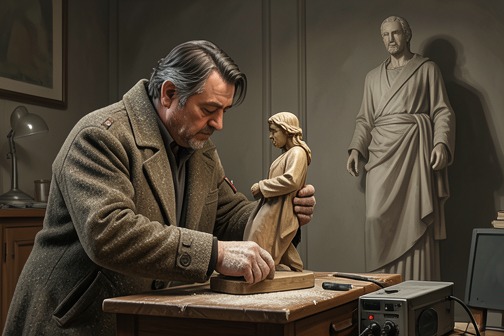
[Goldmund completes the Saint John carving](entity:event-recall-event-goldmund-50915538a553) after a year of uneven training in [Master Niklaus](entity:character-recall-character-master-niklaus-5e0a4b4d7e3f)’s workshop. The figure, modeled on his friend [Narcissus](entity:character-recall-character-narcissus-8ac539c49d81) as the Apostle John, becomes more than a test of craft: [Goldmund](entity:character-recall-character-goldmund-6408ea5ed221) experiences its making as a rare convergence of skill, memory, and receptivity. Niklaus recognizes the statue’s exceptional truth and proposes that the guild make Goldmund a master, but Goldmund’s sense that the achievement cannot be repeated points him back toward the unsettled life he had left behind.
## Apprenticeship and the Work’s Origins
Goldmund reached Master Niklaus after seeing a wooden Madonna in a cloister church. Its living, worldly beauty moved him so strongly that he repeatedly turned back to look at it; when he learned that Niklaus had carved it, he sought out the master in [the bishop’s city](entity:location-recall-location-the-bishop-s-city-1a91fb8e7f27). Niklaus’s admission that the Madonna was controversial did not diminish Goldmund’s admiration. The encounter gave him a concrete image of what sculpture might accomplish and set his artistic journey in motion.
Niklaus could not take Goldmund through the ordinary guild route. Apprentices generally began at thirteen or fourteen, spent years serving and learning, and required their father to pay for the apprenticeship; Goldmund was already an adult, and guild rules would not allow him to progress from apprentice to master without serving the prescribed term. Niklaus nevertheless offered informal instruction without a contract, allowing Goldmund to come and go. The arrangement left him outside the usual structure of training even as the master recognized promise in his drawing and agreed to help him test whether he could become an artist.
Over the following year Goldmund improved as a draftsman and also tried modeling clay. His first successful sculpture was a figure of [Julie](entity:character-recall-character-julie-5a82eb7a07d7), the younger daughter of the knight whose household had once sheltered him. Niklaus praised it but declined to have it cast, judging it too worldly. Goldmund then began the wooden Saint John, intended for a crucifixion group Niklaus had been commissioned to make. The new work gave his restless study a sustained purpose, though it did not remove the distractions of life outside the workshop.
## Making the Figure of Narcissus
Goldmund’s progress was repeatedly interrupted by love affairs, dancing, drinking, dice, and fights with his working companions. Sometimes he stayed away from the workshop for a day or longer; at other times he stood distracted at his bench. He returned to the Saint John in periods of readiness, working with devotion and humility. As the figure’s thoughtful features emerged from the wood, the concentrated labor restored a sense of direction that his unsettled days often obscured.
The subject was Narcissus, Goldmund’s friend and guide during his adolescent years at [Mariabronn](entity:location-recall-location-mariabronn-d697cde40052), represented as the Apostle John. Goldmund felt that the image’s stillness and purity belonged to his friend, not to himself. In his understanding, Narcissus was using the artist’s hands to pass from life’s changing forms into an enduring image. This was not simply a claim of technical imitation: the work joined Goldmund’s memory of a particular person to his belief that genuine art could reveal something essential beyond the maker’s conscious intention.
The distinction between a true image and accomplished decoration mattered deeply to Goldmund. He admired [Niklaus’s Madonna](entity:object-recall-object-niklaus-s-madonna-ca3fb5ef987d) and believed that certain works endured because they had been made in a secret, sacred state, rather than from vanity or delight in skill alone. He feared that art could become only polished craftsmanship, producing attractive ornaments without the force to express a soul. The Saint John became his test of whether a sculpture could carry that deeper truth. Its making did not erase his dissatisfaction with the settled life of the workshop, but it gave that life a meaning while the work remained unfinished.
## Completion and Recognition
Goldmund finished the carving in a small wooden shed behind the assistants’ workshop. In the morning, he swept the shed clean, brushed the remaining sawdust from the statue’s hair, and stood before it for a long time. He experienced the moment as solemn and exceptional, while also fearing that its intensity would soon be absorbed into ordinary days. Completion brought not a casual sense of having finished a task but an awareness that a rare creative experience had reached its end.
Niklaus examined the statue in silence. His stern expression lightened as he looked at it, and he praised its piety, gravity, joy, and peace. He called it very good and told Goldmund that his learning was finished; he would show the work to the guild and seek a master’s standing for its maker. The recognition mattered to Goldmund, although he did not highly value the guild itself. The master’s response established that the figure had achieved a public and professional distinction as well as the private significance Goldmund had found in it.
Goldmund explained that the statue portrayed his dearest friend rather than himself, and that Narcissus had given the image its light and peace. Niklaus accepted that the work’s source was a mystery: he had made many sculptures that surpassed it in neither care nor technique, yet fell short in truth. He also warned, in effect, that such a work could not be repeated. Goldmund had reached the same conclusion while looking at the finished figure. Its success therefore offered recognition but no straightforward formula for continuing in the same way.
## Aftermath and Significance
Niklaus’s response to the completed Saint John led him to seek a permanent future for Goldmund. He persuaded the guild to issue a master’s diploma and planned to make Goldmund an associate, sharing important commissions and earnings with him. The proposal answered practical needs within the workshop: Niklaus was growing older, wanted to preserve its reputation, and believed that none of his paid assistants could have made a figure like the Saint John. He also considered the prospect of Goldmund joining his family through [Lisbeth](entity:character-recall-character-lisbeth-d8cb11a053ea), who was not opposed to his settling down.
Goldmund, however, experienced the finished work differently. While Niklaus planned a larger workshop, an attic room, and new clothes for his guild recognition, Goldmund felt the life around him losing its force now that the Saint John was complete. The work had made the workshop bearable; when it ended, the settled city seemed emptied of purpose, and the fleetingness of desire and beauty pressed on him again. The contrast does not diminish the accomplishment. It shows that professional success and artistic fulfillment did not amount to the same thing for Goldmund: the guild could certify his standing, but it could not promise another work of equal inward necessity.
The carving also makes visible the friendship between Goldmund and Narcissus in a form that can outlast their immediate circumstances. Goldmund sees his friend’s identity carried into the statue, while Niklaus recognizes in it a truth beyond technical skill. That convergence gives the event its decisive significance: Goldmund has demonstrated that he can create an enduring image, yet the very singularity of the achievement makes a settled artistic career uncertain. His completion of the Saint John is both a culmination of his informal training and a threshold toward leaving the life that training had briefly made possible.
Event 10
Goldmund rejects Niklaus’s partnership offer and leaves the city
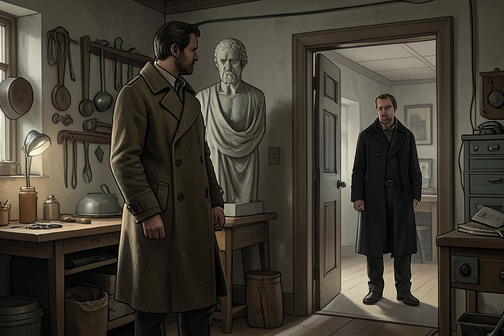
[Goldmund rejects Niklaus’s partnership offer and leaves the city](entity:event-recall-event-goldmund-niklaus-cad897238184) at a decisive break between the security of a recognized artistic career and the freedom of wandering. [Master Niklaus](entity:character-recall-character-master-niklaus-5e0a4b4d7e3f) has arranged an unusually rapid promotion and offers him a place as an associate in the workshop, but [Goldmund](entity:character-recall-character-goldmund-6408ea5ed221) has already decided to go. His departure is not a rejection of the art or the master who taught him: he leaves with gratitude, and with a final visit to the Saint John that had earned Niklaus’s confidence. It is the stability attached to the offer, rather than the value of the work or the relationship, that he cannot accept.
## The offer and its stakes
Niklaus’s proposal grows out of Goldmund’s achievement as a carver. The master has watched him make a Saint John that, despite Goldmund’s uneven attendance and difficult moods, promises to be a work beyond the ability of ordinary assistants. Concerned that his famous workshop might otherwise decline as his own creative strength wanes, Niklaus persuades the guild to grant Goldmund a master’s diploma without the customary apprenticeship. He plans to enlarge the back workroom for him, give him an attic room, provide new clothes for his guild standing, and share important commissions and their earnings with him. The partnership would make Goldmund neither a subordinate assistant nor merely a temporary learner, but the intended continuing partner in the workshop.
This offer reverses the uncertain terms on which Goldmund first came to learn from Niklaus. Guild custom normally required an apprentice to begin at thirteen or fourteen, with a father paying for the training; much of the apprenticeship involved errands and service. Goldmund was already a grown man, and the master had acknowledged that neither a conventional contract nor a long apprenticeship suited him. Instead, Niklaus had let him try carving without obligation, free to leave whenever he chose. His later elevation is therefore exceptional, but it also places a settled occupational identity before someone whose freedom to leave had been part of the original arrangement.
The master’s plan includes more than workshop economics. He has considered the possibility that Goldmund might become his son-in-law, and has sounded out his daughter [Lisbeth](entity:character-recall-character-lisbeth-d8cb11a053ea), who is not opposed to the prospect if Goldmund settles into his craft. Niklaus believes the offer will secure both the future of his workshop and the future of his family. The dinner at which he presents it has been carefully prepared: Goldmund is invited again, and the master waits until his daughter has left before disclosing the proposal. Niklaus regards the place he has made for Goldmund as a fortune, a warm home and professional future offered together.
## Goldmund’s decision
Goldmund receives the offer with embarrassed surprise. He had expected a mild reprimand for his recent absences and perhaps a proposal to remain as an assistant; instead, Niklaus has placed before him a rapid promotion and a share in the workshop. He cannot immediately answer. But his hesitation does not mean that he needs time to weigh the terms: he tells Niklaus that the decision to leave was made before he accepted the dinner invitation and before he knew of the offer.
Goldmund thanks the master for his goodwill and, especially, for the patience with which he taught him. He insists that he will not forget his debt to Niklaus, but says that he will not remain in the city: he must travel and be free. His refusal thus distinguishes gratitude from consent. He does not claim that the workshop has failed him, or that its offer is unworthy. Rather, even a position designed to accommodate his talent and make him a partner cannot overcome his attachment to the road.
## The farewell
Niklaus first gives Goldmund time to think, but the refusal quickly becomes a rupture. When Goldmund repeats that nothing will change his decision, the master turns pale, refuses the hand Goldmund offers, and paces in anger. He finally tells him to leave at once and not to make him see him again, trying to control himself before saying or doing something he might regret. The scene turns a generous offer into a painful separation: Niklaus’s anger is the response of a teacher whose carefully prepared future has been rejected, while Goldmund leaves without withdrawing his thanks or his wish for a friendly farewell.
Goldmund’s last moments in the house are quiet rather than argumentative. He puts on his cap, descends the stairs, and lets his hand brush over the carved heads. In the small courtyard workshop, he stops before the Saint John and takes leave of the sculpture that had sustained Niklaus’s belief in him. He then leaves the house, carrying a deeper pain than he felt when he departed the knight’s castle and [Lydia](entity:character-recall-character-lydia-3e7a560b729c). The familiar city seems transformed as he crosses the threshold: the master’s door has become the door of a house now closed to him.
## What he leaves behind
Goldmund’s departure makes visible the tension between artistic vocation and the institutions that can support it. Sculpture depends on a workshop, materials, tools, training and recognition; Niklaus has offered a way to turn Goldmund’s ability into an enduring livelihood. But the institutional reward also implies a settled life, and Goldmund’s refusal confirms that artistic achievement has not made him willing to exchange movement for security. His earlier impatience with ownership and settled craft helps explain why the master’s plan, however generous, cannot hold him.
The Saint John gives the farewell its emotional measure. Goldmund does not leave because the work has become meaningless: he pauses before it, and Niklaus’s confidence in that work is what made the offer possible. Yet the completed artistic achievement does not bind him permanently to the place where it was made. His departure closes his apprenticeship and his immediate relationship with Niklaus’s workshop, while carrying forward the pattern of leaving even when affection, recognition and material shelter are available. The journey that follows belongs again to the road, though Goldmund’s return to [Mariabronn](entity:location-recall-location-mariabronn-d697cde40052) will later bring his art back into a settled community.
## Narrative significance
The event is a double ending: Niklaus’s workshop loses the partner he hoped would preserve its excellence, and Goldmund relinquishes the most secure professional future yet offered to him. The refusal does not erase the teacher’s influence. It makes the bond more consequential by separating what Goldmund has learned from the settled career in which Niklaus hoped that learning would culminate. The carving remains as evidence of their shared artistic work; the departure shows that, for Goldmund, mastery and belonging are not the same thing.
Event 11
The Black Death sweeps through German lands
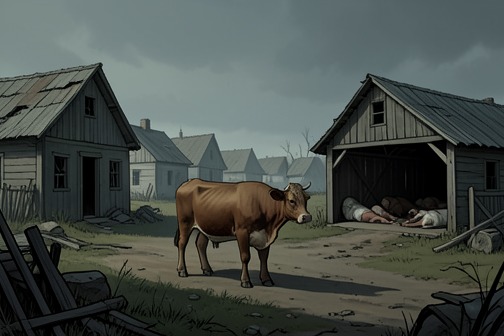
[The Black Death sweeps through German lands](entity:event-recall-event-455030d54718) as both a public catastrophe and a decisive trial of [Goldmund](entity:character-recall-character-goldmund-6408ea5ed221)’s way of seeing. The epidemic empties homes, interrupts travel, and turns fear into social violence; Goldmund encounters its dead and its survivors with a fascination that unsettles his companions, while his care for particular people exposes the ethical cost of treating suffering as spectacle.
## Spread and Recognition
The danger first interrupts Goldmund and [Robert](entity:character-recall-character-robert-dcc9e88f1178)’s journey at the edge of a village. Peasants armed with cudgels, poles, and flails threaten them and drive them away; Robert runs, while Goldmund stops to ask why strangers are being refused. The next morning, their discovery at an isolated farm supplies a terrible answer. The homestead is silent except for a cow left unmilked, and inside Goldmund finds the entire family dead. When Robert recognizes the signs and names the plague, he fears that Goldmund has been infected and tries to flee. Goldmund holds him back: if they share the danger, he insists, they must face it together rather than leave one another to die alone.
As the two continue, the disease is present in different forms from place to place. Some villages bar strangers; elsewhere the travelers pass through streets without obstruction. Farms stand deserted, bodies remain unburied in houses and fields, and livestock wander or starve. Goldmund and Robert milk and feed animals, kill some for food, and use provisions left behind in empty cellars. The abundance does not make their journey easy: Robert remains convinced he may have caught the disease, repeatedly examines himself for swellings, and uses campfire smoke as a supposed preventive. Goldmund mocks his fear but does not share it.
At a fortified town, the scale of death becomes public and organized. No sentinel guards the open gates; instead, a priest carrying a cross emerges behind three carts piled with corpses, accompanied by hooded men. Goldmund follows them to a vast pit on a deserted heath. The men unload the bodies with staffs and boat hooks, the priest blesses the dead, and fires are lit around the grave before the workers return to the city. Goldmund sees at least fifty bodies in the pit, many uncovered, with limbs raised above the heap. Robert cannot bear to remain, but Goldmund goes on alone into the town, drawn toward the very horror his companion wants to escape.
## Death as Witness and Image
Goldmund’s attention to death begins with the farmhouse family. He studies the dead not as an indistinct mass but as separate figures whose postures suggest different encounters with the end: the parents in bed, the old woman still seated, and the boy lying across the threshold. The child’s clenched hands and position at the doorway make visible an unavailing struggle; a cat hole has been cut into the door beside him. The sight repels and attracts Goldmund at once. He gives himself to close observation, combining compassion for the dead with the artist’s impulse to attend to form and detail, while Robert’s anxious calls go unanswered.
The contrast between the men becomes a measure of the epidemic’s effect on their relationship. Robert fears contamination and recoils from the corpses; Goldmund believes that death in the hut is not a fate reserved for plague victims but an end awaiting everyone. During their travels, Robert’s dread repeatedly returns, while Goldmund walks through the stricken country absorbed by what he sees. He sometimes helps with practical needs, including feeding abandoned animals and carrying or covering the dead, but he also seeks out scenes of suffering rather than turning away. The plague thus intensifies a trait already central to his character: his wish to look steadily at experiences others cannot face.
A painted [Dance of Death](entity:expression-recall-expression-dance-of-death-e0f8a577b1e0) in a cloister gives Goldmund another way to understand what he has witnessed. The fresco shows Death leading people of every rank—including a king, bishop, abbot, knight, doctor, and peasant—toward the same end, accompanied by skeletal musicians. Goldmund recognizes the painting as an effective lesson in the inevitability of death, but feels that its severe, skeletal image does not capture the whole of his experience. For him, death is not only a judge or executioner: it also carries a maternal and intimate aspect, a return-call that can make the remaining light of life seem more vivid. The fresco therefore sharpens rather than resolves his response to the epidemic, renewing his desire to return to [Master Niklaus](entity:character-recall-character-master-niklaus-5e0a4b4d7e3f)’s city and artistic work even as new encounters delay him.
## Social Breakdown and Persecution
The epidemic destroys more than households. Goldmund sees parents abandon sick children and husbands abandon sick wives; frightened people avoid one another, while others gather in feverish attempts to drink, dance, and seize pleasure. Some survivors mourn or curse outside cemeteries and empty houses. Amid this disorder, people search for someone to blame, accusing supposed criminals of spreading disease through corpses, wells, walls, or cattle. The suspected may be killed by legal authorities or by mobs. The account presents such accusations as products of collective misery and fear, while making clear that they turn uncertainty into a pretext for violence.
Jews become among the most vulnerable targets. In one town Goldmund watches the ghetto burn while a mob drives those trying to escape back into the flames. Elsewhere he meets [Rebekka](entity:character-recall-character-rebekka-ce4c68e68f99), who has returned to mourn after her father and fourteen other Jews were burned by order of the town’s authorities. She had escaped, but grieves that she was not killed with them. Goldmund helps her gather her father’s bones from the ashes and bury them in a hiding place in the field. His aid is concrete, but the encounter also exposes the limits of his understanding: he initially turns from burial toward courtship, and Rebekka condemns the Christians whose people murdered her father. Goldmund accepts that her accusation has force and asks her forgiveness.
Later, in conversation with [Narcissus](entity:character-recall-character-narcissus-8ac539c49d81), Goldmund tells Rebekka’s story in detail and asks whether the world in which such things happen is hellish and revolting. Narcissus agrees that it is. The exchange connects the epidemic’s social violence to the novel’s larger question of suffering and evil: the plague does not merely kill indiscriminately; fear and existing hostility determine who is abandoned, accused, or attacked. The episode also recalls Goldmund’s own admission that he saw Jews burned without preventing it, a fact Narcissus uses to challenge his moral certainty.
## Goldmund’s Passage Through the Plague
Goldmund has little fear of the epidemic itself. He distinguishes plague from dangers against which a person can fight, recalling the earlier mortal danger he survived at the hands of [Viktor](entity:character-recall-character-viktor-b7b35c6bd11e). Plague, by contrast, cannot be resisted in the same way; in the narration, Goldmund has already surrendered to its possibility. After leaving [Lene](entity:character-recall-character-lene-ea80f5569793) behind, he seems less attached to preserving his own life, yet remains awake and indefatigable, driven by curiosity and a desire to witness the world’s extremity. He moves among empty houses, desperate revels, the dying, and the dead, sometimes finding food or shelter and sometimes helping in exchange for a meal or a few coins.
This journey is not simply a record of exposure. Its episodes test the difference between looking at suffering and responding to it. Goldmund’s attention can produce care, as when he restrains Robert from fleeing and helps Rebekka bury her father; it can also become so absorbed in observation that he neglects the needs or feelings of those around him. Rebekka’s rebuke makes that tension explicit. The plague’s scale invites a universal vision of mortality, but her grief insists on the irreducible particularity of the person killed and the community responsible.
The Black Death consequently alters both the landscape of Goldmund’s travels and the terms of his reflection. Abandoned farms, unburied bodies, mass graves, and the burning ghetto reveal a society where ordinary protections have weakened and fear can become persecution. Against that collapse, Goldmund’s recurring acts of companionship and burial are small but consequential. His journey through the epidemic leaves him with a vision in which death is at once collective destruction, intimate loss, and an image that the artist seeks to comprehend without being able to undo it.
Event 12
Goldmund takes Lene from the plague-stricken city and establishes a temporary shelter
[Goldmund takes Lene from the plague-stricken city and establishes a temporary shelter](entity:event-recall-event-goldmund-lene-32dd1a85239f) during the Black Death, turning a chance encounter at a city window into a brief household in the woods. The episode places escape and companionship beside the devastation that makes both possible: [Goldmund](entity:character-recall-character-goldmund-6408ea5ed221) offers [Lene](entity:character-recall-character-lene-ea80f5569793) safety from a dying town, but their shelter cannot become the lasting home she hopes for.
## Background: A town under the plague
Goldmund and [Robert](entity:character-recall-character-robert-dcc9e88f1178) arrive at a fortified town whose wide-open gates and empty defenses offer no reassurance. Robert refuses to enter. Then a priest emerges carrying a cross, followed by three carts piled with corpses. Goldmund watches the procession to a vast grave outside the town and sees the dead placed in it before he enters alone. Robert remains outside, distressed by Goldmund’s absorption in what he has witnessed.
Inside, Goldmund sees signs of a city in distress, including a woman at an upper-floor window combing her hair. He calls up to ask whether she is sick. When she shakes her head, he invites her to leave the city with him and live in the woods. He asks whether she is with her parents or serving strangers; learning that she is in service, he urges her to come before she has time to reconsider. The offer is both practical and impulsive: the plague has made the city dangerous, but Goldmund’s appeal also promises youth, company, and a little enjoyment while life remains.
## Lene leaves the city
Goldmund walks on, leaving the choice open rather than immediately pressing the woman to follow. When he comes back, she is still at the window and waves to him. She then runs after him, carrying a small bundle and wearing a red kerchief. At the city gates, she gives her name as Lene and says that everyone in the city is dying and that she wants to leave.
Robert, waiting near the gates, reacts with alarm when Goldmund returns with her. He objects to taking someone from a plague-stricken town and threatens to leave rather than share the danger. Goldmund lets him complain, then tells him that Lene will stay with him and that the three of them will find a hut or build one. He imagines himself as head of the household, Lene as its mistress, and Robert as their friend. The arrangement is not an equal household: Goldmund even forbids Robert to touch Lene, though he presents the prohibition as reassurance. Robert accepts the plan once he is told that he need not make physical contact with her.
## Making a refuge
The next day the travelers find an empty log cabin in a small birch forest, perhaps built by woodcutters. They break open its door and agree that the hut and its secluded surroundings will serve as a refuge. A stray goat they have taken along provides milk. Goldmund assigns Robert, who had once worked as a cabinetmaker, the task of making a partition: one room for Goldmund and Lene, another for Robert and the goat. With supplies short, they must make do with little food while they establish the shelter.
The work is shared but divided by circumstance. Goldmund and Lene gather straw, fern, and moss for bedding; Robert cuts birch posts with his knife and begins the partition. It takes more than a day, so Robert sleeps outside at first. When the partition is completed, they make its rough openings prettier with woven juniper. Lene gathers berries and tends the goat, Goldmund searches for food, and Robert works with the limited tools at hand. They later find another goat and a small field of turnips; Goldmund also catches two stray chickens. They build beds and a hearth, and a nearby brook supplies clear water. Their shelter gradually becomes more comfortable, and they sometimes sing as they work.
The refuge remains precarious. The region seems uninhabited, a quality Robert values because it reduces the risk of infection and quarrels, but isolation also means scarcity. Goldmund proposes bringing useful objects from an abandoned peasant hut nearby. Robert refuses to enter it; he will not touch anything Goldmund brings back until it has been smoked and washed. The objects Goldmund retrieves are few—a pair of posts, a milk pail, some crockery, and a hatchet—yet they help furnish the home. The effort to make the cabin pleasant is real, but every improvement rests on materials salvaged from a depopulated landscape.
## A temporary home and its limits
As the three drink milk and praise their settled life, Lene asks what they will do when winter comes. Neither man answers at first. She recognizes that Goldmund and Robert have not seriously imagined remaining in one place for so long: to them, the hut is a stop along the way, not a home. Goldmund reassures her that the plague cannot last forever and that she might return to her parents, if they survive, or find work as a maid. For the present, he says, they can stay as long or as briefly as they please.
Lene asks what will happen afterward—whether Goldmund will leave her. Her questions bring the cost of their arrangement into view. She does not want to leave or to let him go, and she cannot be happy while knowing that their life together will end. Goldmund responds that lasting happiness does not exist. He also warns that if their present life is no longer enough for her, he will set fire to the hut and each of them can go his own way. Lene yields, but a shadow falls over her joy.
The shelter is therefore both a practical answer to epidemic danger and an unstable refuge from loss. Its partition, beds, hearth, livestock, and shared work create the appearance of domestic continuity, while the unanswered question of winter reveals the limits of that appearance. Goldmund treats the household as temporary and insists that Lene accept its brevity; she seeks a future the circumstances and his terms cannot provide. The episode’s decisive turn is not simply their escape from the town, but the discovery that safety and affection do not make a home permanent.
Event 13
Anti-Jewish violence and Rebekka’s father’s death
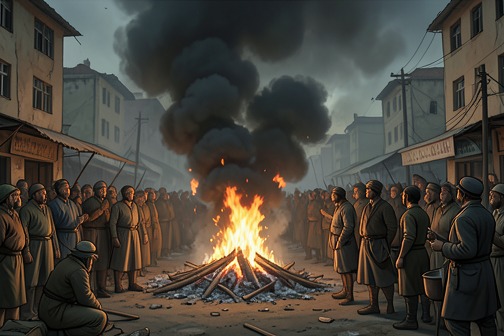
[Anti-Jewish violence and Rebekka’s father’s death](entity:event-recall-event-rebekka-3603b3bbe655) form one of the Black Death’s defining episodes: a local authority turns fear into collective punishment, and a survivor’s grief forces [Goldmund](entity:character-recall-character-goldmund-6408ea5ed221) to face the limits of his own compassion. The episode joins the epidemic’s broad social collapse to a specific encounter in which help, presumed innocence, and the desire to rescue someone from death are all called into question.
## Violence amid the epidemic
As the plague spread, fear and hardship unsettled ordinary bonds and made communities search for someone to blame. People accused one another of deliberately spreading disease, and Jews, alongside other groups, were made scapegoats. Those suspected of causing the epidemic could be condemned by law or mob; in one town, Goldmund witnessed the ghetto burned, with a crowd preventing people from escaping. The violence against [Rebekka](entity:character-recall-character-rebekka-ce4c68e68f99)’s family belongs to this wider pattern: it is not presented as an isolated dispute but as persecution sanctioned by local authority amid epidemic panic.
The account gives the killing a specific human and communal scale. Rebekka’s father was burned to ash with fourteen other Jews by order of the town’s authorities. She had managed to flee, but later returned to the place where they had been killed. The persecution had taken her father and forced his surviving daughter into danger and isolation; even mourning him required returning to the site of the violence.
## Rebekka and Goldmund
Goldmund found Rebekka crouched beside rubble outside a small town, grieving and blaming herself for not having died with the others. He stopped her from hurting herself, listened, and offered protection. At her request, he helped gather her father’s bones from the ashes, carry them to a concealed place in the field, and cover them with earth. The burial is a concrete act of care, but it cannot undo the murder that made it necessary.
Afterward, Goldmund tried to persuade Rebekka to travel with him, presenting his offer as protection from further violence and danger. He promised not to touch her and said she could grieve for as long as she needed. Rebekka rejected the offer. To her, the timing made his courtship inseparable from the help he had just given: a Christian had helped a Jewish daughter bury the father murdered by Christians, then expected the daughter to accompany him. Her accusation makes the encounter’s ethical conflict explicit. Goldmund intended kindness, but his assumption that he could turn protection into intimacy obscured the difference between his intentions and her experience.
Her rejection changed Goldmund’s understanding of the moment. He recognized that he had not understood her grief and conceded that she might be right about him; he apologized and left. He did not rescue her or persuade her to live. The encounter ends with his recognition of a limit, rather than a reconciliation: the person offering aid cannot decide what the bereaved survivor should feel or want.
## Witness, responsibility, and memory
The episode returns later when Goldmund recounts Rebekka’s story to [Narcissus](entity:character-recall-character-narcissus-8ac539c49d81). The conversation turns on the distinction between ordering cruelty and witnessing it without preventing it. Narcissus says that he might have to tolerate such an act if he lacked the power to stop it, then asks Goldmund whether he prevented the burning he witnessed. Goldmund says that he did not. His story therefore reaches beyond his good intentions toward Rebekka to the harder question of responsibility in the face of violence: seeing an atrocity and grieving over it do not amount to having stopped it.
That question also resists an easy explanation of persecution as a simple consequence of epidemic suffering. The broader account shows how fear can be converted into accusations, sanctioned punishment, and mob violence; Rebekka’s experience keeps the victims and their bereavement in view. Goldmund’s response is neither to defend the Christians who killed her father nor to claim that his assistance repaired their crime. Her words expose the presumption inside his attempted courtship, and her father’s death remains the episode’s irreparable fact.
## Narrative significance
The event brings collective violence into focus through its aftermath for one survivor. The community’s order to burn Jews, Rebekka’s return, the burial of her father’s remains, and Goldmund’s later confession to Narcissus form a progression from persecution to mourning to moral self-examination. Rebekka is not merely an image of loss in Goldmund’s journey: her rebuke gives her own judgment decisive force, correcting the role he had imagined for himself as protector.
The episode also tests the novel’s recurring concern with death against the social causes of particular deaths. Goldmund may encounter death as an inescapable part of life, but the killing of Rebekka’s father is not simply an abstract emblem of mortality. It is an act ordered by authorities and sustained by collective hostility. The distinction matters: acceptance of life’s transience does not erase human responsibility for violence, and compassion after the fact cannot substitute for preventing it.
Event 14
Lene dies of plague; Goldmund burns the hut and leaves
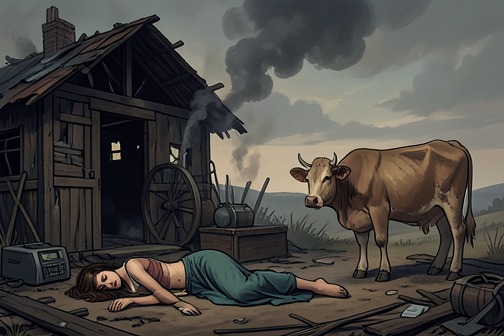
The death of [Lene](entity:character-recall-character-lene-ea80f5569793) from plague, followed by [Goldmund](entity:character-recall-character-goldmund-6408ea5ed221)’s burning of their hut and departure, is a turning point in his passage through a devastated countryside. Faced with the illness in the shelter they share, he chooses to remain with her rather than protect himself by leaving. After her death, he burns the hut and walks on alone, carrying the experience into a broader encounter with mass death, social collapse, and the meaning of mortality.
## [The Plague](entity:state-recall-state-the-plague-84f70685ffed) Reaches the Shelter
The episode grows out of a journey through a region already marked by the Black Death. Goldmund and [Robert](entity:character-recall-character-robert-dcc9e88f1178) come upon an isolated farm where the entire household is dead. The deserted buildings, an unattended cow, and the bodies inside reveal the danger that had prompted villagers to keep strangers away. Robert understands that they may have encountered plague and fears that Goldmund has been exposed. Goldmund refuses to let him flee alone: he insists that the two remain together, either to survive or to die in one another’s company. As they travel onward, they see abandoned farms, unburied bodies, and livestock left without care. The countryside offers food and shelter, but its abundance is shadowed by death.
Goldmund and Robert eventually establish a temporary shelter with Lene. When she falls ill, Goldmund examines her and finds plague boils. He keeps his discovery from her, while Robert becomes alarmed and proposes sleeping outside with the goat to avoid infection. Goldmund responds furiously, drawing the goat to his own side of the juniper partition and ordering Robert away. The quarrel makes their different responses to danger explicit: Robert is governed by fear of contagion, whereas Goldmund will not abandon the sick person in his care.
## Goldmund Stays with Lene
Goldmund tells Lene that he will stay and that she will recover. She does not share that hope. She urges him not to come too close, but also says she would rather die than wake to find that he has left her alone. Her words give the vigil its central conflict: care may expose Goldmund to the same illness, yet leaving would repeat the abandonment she fears.
As Lene weakens, Goldmund continues to tend her. He gives her water and remains beside her, going outside only briefly for air. The practical demands of their shelter continue around them: he lets the goat out to feed and drink, and, when Lene can no longer swallow milk, he drinks it himself because there is no other food. He watches her closely as her strength fails. Her face changes rapidly, and she speaks only occasionally, addressing him as Goldmund or as her lover. He wets her swollen lips with drops of water. She dies the following night, with only a brief movement before her breathing stops.
The moment recalls for Goldmund the fish he had pitied in the market, whose lives also ended in a final quiver. That association connects Lene’s death to his wider attention to vulnerable, vanishing life. His grief does not make him leave at once. He kneels beside her, then sits outside, remembers the goat, and releases it. When he returns to the hut, he looks once more at Lene’s dead face.
## Burning the Hut and Leaving
Goldmund cannot accept leaving Lene’s body in the shelter. He gathers dry wood and brush, throws it into the hut, and sets it alight. He takes nothing from the dwelling except the flint. The juniper wall catches quickly; he watches outside as the roof burns and beams fall, while the frightened goat cries out. Although he knows that killing and eating the goat would give him strength for the road, he cannot bring himself to do it. He drives the animal out onto the heath and walks away as smoke follows him into the forest.
The departure is not presented as relief or a clean return to freedom. Goldmund has long been drawn to wandering, but he leaves this shelter profoundly disconsolate. Lene’s death has made the journey more than a succession of encounters: he has stayed through another person’s dying, and the act of leaving comes only after he has faced the obligations of care and burial through fire.
## From Private Loss to a Stricken Land
Beyond the shelter, the scale of death expands. Goldmund encounters empty houses, starving dogs, unburied corpses, abandoned children, and death pits at city gates. The plague has damaged not only bodies but the bonds that ordinarily organize life: parents leave sick children, husbands leave sick wives, and frightened people avoid one another. Others answer the terror with drinking, dancing, and frantic pursuit of pleasure. Goldmund witnesses both reactions, at times fleeing the feverish gatherings and at times joining them.
The crisis also turns fear into accusation. People claim that enemies deliberately spread disease, blaming the poor, the French, doctors, and especially Jews. Goldmund watches one town’s ghetto burn as a mob prevents those trying to escape from getting away. The episode of Lene thus precedes a wider landscape in which illness and death become occasions for abandonment, violence, and scapegoating. Goldmund’s own passage through that landscape is marked less by fear of infection than by an intense, watchful attention to what death reveals about people and their world.
## Narrative and Thematic Significance
Lene’s death brings the Black Death’s public catastrophe into an intimate scene of care. Earlier, Goldmund had insisted that Robert should not face possible death alone; with Lene, that principle becomes a sustained choice. He remains despite the danger, tends her as her condition worsens, and refuses to leave her body unattended. Burning the hut closes the period of shared shelter while making his departure an act shaped by grief rather than mere onward movement.
The episode also prepares Goldmund’s changing understanding of mortality. As he travels, he sees death figured in a painted [Dance of Death](entity:expression-recall-expression-dance-of-death-e0f8a577b1e0), but the image seems incomplete to him: it presents death as stern and unavoidable, while his own experience gives it a more intimate, maternal quality. The narrative links the personal loss of Lene to this developing vision and to the devastated communities Goldmund witnesses. In the later conversation with [Narcissus](entity:character-recall-character-narcissus-8ac539c49d81), Goldmund recounts the story of [Rebekka](entity:character-recall-character-rebekka-ce4c68e68f99) and the burning of Jews in detail, and his account prompts a direct exchange about the world’s cruelty and the limits of what a person can prevent. The episode of Lene’s death belongs to the same larger reckoning: it shows what Goldmund can do in the face of suffering—stay, care, and witness—without suggesting that such actions can stop the plague or repair the world.
Event 15
Plague and urban riots
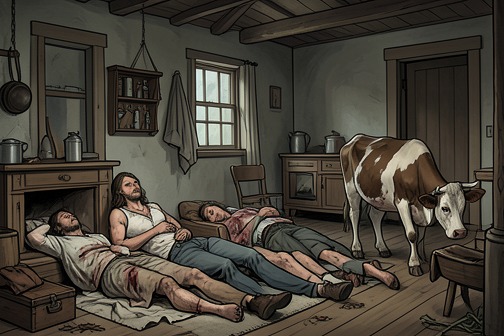
[Plague and urban riots](entity:event-recall-event-f70417271e2b) reshape [Goldmund](entity:character-recall-character-goldmund-6408ea5ed221)’s wandering into an encounter with mass death and the collapse of communal order. The epidemic empties farms and villages, while fear breeds isolation, scapegoating, and violence. Through the murdered family he finds in a farmhouse, the persecution of Jews, and his meeting with [Rebekka](entity:character-recall-character-rebekka-ce4c68e68f99), the catastrophe becomes a sustained test of compassion and of any belief that the world is governed by justice.
## Outbreak and social disintegration
As the plague advances, some villages bar strangers while others leave their streets open. Goldmund and [Robert](entity:character-recall-character-robert-dcc9e88f1178) approach one settlement only to be driven away by armed peasants; the next morning, an isolated farm offers a more terrible explanation for the villagers’ fear. The cow is still calling to be milked, but the household is silent. Inside, Goldmund discovers that five people have died: three in bed, a boy across the threshold, and an old woman seated beside the hearth. The fire retains faint sparks, but no one remains to tend it.
Robert recognizes the plague and tries to flee, fearing that Goldmund has been exposed. Goldmund holds him back, arguing that they share the danger and should not leave one another to die alone. From then on, Robert obeys Goldmund’s lead. Their experience becomes a recurring pattern on the road: abandoned farms, unburied dead, hungry livestock, and communities whose responses range from shutting out outsiders to allowing them through.
The two travelers find food and drink in deserted places, milk cows and goats, and sometimes kill livestock for a meal. Such abundance does not make the journey carefree. Robert remains terrified, repeatedly suspecting infection and checking his body for signs of illness; Goldmund is less afraid, scolding and teasing him as he moves through the stricken country. Their contrasting reactions frame the epidemic as both a physical threat and a different kind of inward experience.
## Fear, violence, and the search for scapegoats
The devastation extends beyond disease itself. Goldmund encounters abandoned children, starving animals, unattended corpses, and survivors who have retreated into fear or frenzy. Some people avoid all contact; others gather to drink, dance, and pursue pleasure against the surrounding death. People accuse supposed enemies of deliberately spreading disease, and suspicion turns into lethal persecution. In one town, Goldmund watches the ghetto burn as a mob drives fleeing Jews back into the fire. Across the plague-stricken region, innocent people are murdered, tortured, and burned.
The cities, too, lose order. In [the bishop’s city](entity:location-recall-location-the-bishop-s-city-1a91fb8e7f27), the mob sets fire to a hospital and raids the houses of wealthy burghers. After the bishop flees, safety and authority falter until the Emperor sends [Count Heinrich](entity:character-recall-character-count-heinrich-1b062d5096f7) with soldiers to restore order. His rule brings its own grievances, and the citizens expect the bishop’s return. The account presents civic disorder not as a single riot but as a volatile succession of institutional retreat, emergency force, popular violence, and resentment.
Goldmund later tells [Narcissus](entity:character-recall-character-narcissus-8ac539c49d81) that he witnessed Jews being burned but did not prevent it. Narcissus uses this admission to press him on the limits of moral judgment: Goldmund had not stopped the atrocity, just as Narcissus says he himself might be forced to tolerate cruelty he lacked the power to prevent. The discussion keeps the violence concrete while exposing the painful gap between condemning injustice and possessing the means to intervene.
## Rebekka and the human cost of persecution
Outside a small town, Goldmund finds Rebekka grieving beside rubble. Her father and fourteen other Jews have been burned to death by order of the town authorities. She has escaped, then returned in despair, blaming herself for surviving. Goldmund helps her gather her father’s bones from the ashes and bury them in a place of concealment. This act of assistance brings them close, but it does not erase the danger or the injustice that made her a fugitive.
Goldmund offers to protect Rebekka and tries to persuade her to travel with him. She rejects his courtship, accusing Christians of helping a daughter bury the father their people murdered and then expecting the daughter to belong to them. Her rebuke exposes the moral presumption in Goldmund’s approach: his offer of protection is entangled with desire, while her grief cannot be hurried into consolation. Goldmund recognizes that he has misunderstood her and acknowledges that she may be right.
When he later recounts Rebekka’s story to Narcissus, Goldmund’s anger at the persecution broadens into a protest against a world in which mass death, abandoned children, and the killing of innocents coexist with religious claims about justice and salvation. The plague’s violence thus enters his friendship with Narcissus as an argument about responsibility and the nature of the world, not merely as a sequence of dangers endured on the road.
## Death, memory, and meaning
Goldmund does not understand plague death only as an enemy to resist. Having once faced a more immediate, resistible threat, he regards the epidemic as a force that cannot be fought in the same way. He continues through the devastated region with a grim curiosity, attentive to the ways people meet death and to the suffering around them. The catastrophe deepens his awareness of life’s transience without making him indifferent to those who suffer.
A painted [Dance of Death](entity:expression-recall-expression-dance-of-death-e0f8a577b1e0) gives Goldmund one image of the epidemic’s lesson: death leads people of every rank away while skeletal musicians play. He respects the painting, but feels it does not express what he has experienced. For him, death’s approach is not only stern and violent; it also carries a maternal, intimate call. This perception does not diminish the public horrors of plague and persecution. Rather, it reveals how the catastrophe enters his imagination, where mortality is bound to both grief and the pull of life.
The episode returns later as a moral and theological reckoning. Goldmund names the burned Jews, the mass burials, the bodies in streets and rooms, the looting, and the children left without care. Narcissus listens and distinguishes Goldmund’s anguished feelings from abstract arguments, while acknowledging that those feelings are real. The plague and riots therefore leave no easy resolution: they expose failures of compassion and order, shape Goldmund’s understanding of death, and remain a challenge to any claim that justice in the world is readily visible.
Event 16
Goldmund returns to the bishop’s city
[Goldmund returns to the bishop’s city](entity:event-recall-event-goldmund-971e91a1a5fb) after a long journey through plague-stricken lands, hoping to resume his artistic life with [Master Niklaus](entity:character-recall-character-master-niklaus-5e0a4b4d7e3f). The return brings him not the homecoming he imagined but a series of losses: the city has endured epidemic and unrest, Niklaus is dead, and the workshop that once embodied [Goldmund](entity:character-recall-character-goldmund-6408ea5ed221)’s artistic future stands empty. The episode tests whether memory, grief, and the desire to create can still bind the wanderer to a place.
## The road back through the plague
Goldmund’s return begins long before he reaches the city. On the road he and [Robert](entity:character-recall-character-robert-dcc9e88f1178) encounter a deserted farmhouse where the entire household has died. The discovery explains why armed peasants had tried to keep them away from a nearby village: the plague has made strangers dangerous in the eyes of frightened communities. Robert panics at the possibility of infection and tries to leave, but Goldmund insists that they remain together, reasoning that either might fall ill and should not be abandoned to die alone.
As they continue, the epidemic reshapes the countryside. Some villages bar entry; others let the travelers pass. Farms stand deserted, bodies remain unburied, livestock go untended, and survivors respond with fear, isolation, or desperate revelry. Goldmund and Robert make use of food and drink left behind, and at times tend animals, but abundance does not make the journey easy. Robert repeatedly fears that he has contracted the disease, while Goldmund watches the devastation with a grave, absorbed curiosity.
Goldmund’s response is not simple indifference. He remembers that he has known fear in other circumstances, but regards plague as a death that cannot be fought in the way he once fought physical danger. The journey therefore becomes an encounter with mortality: he keeps moving through the afflicted country, observing the dying and the dead, and is drawn toward the experience even as it weighs on him. His destination remains Master Niklaus’s city, the place toward which his heart directs him.
A painted [Dance of Death](entity:expression-recall-expression-dance-of-death-e0f8a577b1e0) in a cloister gives this experience a visual counterpoint. Its skeletons lead people from every station of life toward death, presenting the end as stern and unavoidable. Goldmund recognizes the force of the image but understands death differently: to him its call is also maternal and intimate, not only a threat or judgment. The contrast clarifies why the plague journey presses him toward art. He has seen death’s reach, and the city’s workshop represents the possibility of giving human lives a lasting form.
## A familiar city altered by time
Goldmund enters through the same gate by which he had first arrived in search of his master. The plague has subsided, though its aftermath remains part of the city’s recent history. The bishop had fled during the outbreak, and the Emperor had sent a governor to restore order and enforce emergency measures. By the time Goldmund returns, people are awaiting the bishop’s return and hoping to resume ordinary life.
The recognizable streets affect Goldmund like a homecoming. He sees the portals, fountains, cathedral tower, the newer tower of the church of St. Mary, the bells of St. Lawrence, and the marketplace still in their places. He had feared that buildings would have changed or fallen into ruin, so their survival moves him. He envies the burghers their secure houses and settled lives, though his own life has been shaped by wandering rather than belonging.
The city’s ordinary activity briefly seems to set the catastrophe aside. Goldmund watches butcher boys lead a calf while exchanging jokes with a maid above them. Their casual laughter makes the passage of time palpable: the plague fires and the work of disposing of the dead belong to the recent past, while daily life has resumed. Goldmund feels gladness and warmth toward the burghers, but that ease breaks when he approaches Niklaus’s house. The familiar route to the workshop turns anticipation into anxiety; he wants to know at once whether the master is still there and whether he can return to his work.
## News of Niklaus and [Lisbeth](entity:character-recall-character-lisbeth-d8cb11a053ea)
The locked door is the first sign that the house has changed. The old servant Margrit does not recognize Goldmund and tries to turn him away. When he identifies himself and demands to see Niklaus, she tells him that the master is dead. Goldmund pushes past her and hurries through the house, where the workshop is closed and the collected figures remain. Lisbeth appears, but the proud, beautiful woman he remembers has become a sickly, bent figure in a plain black dress.
Goldmund learns the circumstances from the people who receive him afterward. Niklaus did not die of plague. Lisbeth fell ill and remained gravely sick for a long time; her father nursed her and died a few weeks before she recovered. She survived, but her beauty was gone. The workshop now stands empty, and Goldmund’s former landlord suggests that he could make a home there as an image-carver, with work and money available. The offer points toward stability, but it comes alongside the loss of the master whose judgment and example had made that prospect meaningful.
The city’s broader crisis also becomes clearer through the account of the household that welcomes him. During the plague, a mob burned a hospital and attacked the homes of wealthy burghers. With the bishop gone, order and safety had broken down; the Emperor sent [Count Heinrich](entity:character-recall-character-count-heinrich-1b062d5096f7) and soldiers to restore control. The governor’s rule brought hardships, and the townspeople hoped it would soon end with the bishop’s return. Goldmund has come back to a city that looks familiar but has passed through a period of violence and disruption.
## [Marie](entity:character-recall-character-marie-38740b047e25), memory, and an uncertain stay
Marie recognizes Goldmund through a memory he has almost lost. She is the daughter of his former landlord, the lame, sickly child who had warmed milk for him on the morning he left the city years earlier. He remembers her sadness at his departure and the solemn kiss he gave her. Now grown, she still limps, but Goldmund notices her beautiful eyes and is relieved that someone in the city remembers and loves him.
Marie takes him home, where the family invites him to eat and stay. His old painting still hangs in the room, and his red ruby glass remains on the mantelpiece: small survivals that connect the returning traveler to an earlier version of himself. Marie’s affection comforts him, but he cannot return her love; he can offer only kindness and pity. His stay is therefore shaped by an imbalance between the welcome he receives and the feeling he can give back.
Although Goldmund says he will rest and then continue wandering, he stays for more than physical recovery. The city is dear to him because it contains memories of happier times, and Marie’s quiet admiration warms him. More decisive still is his need to become an artist again. Even without Niklaus, his workshop, or proper tools, he cannot simply leave the impulse to create behind. He begins drawing intensively, using the paper Marie finds for him to bring out the images accumulated within him.
The drawings return the losses of the road to view: [Lene](entity:character-recall-character-lene-ea80f5569793), the peasant boy, the carts carrying the dead, [Rebekka](entity:character-recall-character-rebekka-ce4c68e68f99), and Goldmund himself as wanderer, lover, fugitive, and participant in desperate celebrations. He also draws Lisbeth and Margrit as he remembers them, Niklaus, and the great mother figure that has recurred in his imagination. Art becomes an immediate way of working through experience, not a substitute for the people who have died or changed. The return thus ends without restoring Goldmund’s former life: the master is gone and the workshop is empty, but the desire to shape what he has witnessed has drawn him back to the city.
Event 17
Goldmund’s trysts with Agnes and his arrest
[Goldmund’s trysts with Agnes and his arrest](entity:event-recall-event-goldmund-agnes-75fa4ff9d540) transform a clandestine affair into a near-fatal collision between desire and the governor’s authority. [Goldmund](entity:character-recall-character-goldmund-6408ea5ed221) pursues [Agnes](entity:character-recall-character-agnes-a7e5e75ca8a8), the governor’s mistress, and accepts the danger of entering the castle to meet her; when the rendezvous is discovered, the count labels him a thief and condemns him to hang. The rescue comes through [Narcissus](entity:character-recall-character-narcissus-8ac539c49d81), whose intervention secures a pardon—but, as Goldmund later learns, at a political price.
## Pursuit and the secret invitation
Goldmund’s interest in Agnes begins as an open, wordless challenge. For two days he appears wherever she rides or goes in the city, meeting her gaze and making no secret of his admiration. Agnes answers with a smile that turns the pursuit into a contest between them. Goldmund also notices the governor, [Count Heinrich](entity:character-recall-character-count-heinrich-1b062d5096f7): imposing, but older and troubled-looking. The contrast feeds Goldmund’s sense that he can challenge the man who possesses the woman he desires.
Agnes makes the next move on the third morning. She sends her groom away, rides alone beyond the bridge, and waits for Goldmund on the road to the pilgrims’ shrine of St. Vitus. Once he has joined her, she gives him a chain and precise instructions for entering the castle that evening. He is to present himself as a beggar who has found it, keep it in his own hands, and insist on delivering it directly to her. She names the stable groom Max and her chambermaid Berta as the only servants she trusts, warns him to treat the others—including the count—as enemies, and makes clear that the plan could cost him his life.
The invitation renews Goldmund’s sense of being alive. His recent misery seems to fall away like a yellow leaf, and Agnes’s height and blond vitality recall the image of his mother that he carried as a boy at [Mariabronn](entity:location-recall-location-mariabronn-d697cde40052). The danger is not incidental to the attraction: Goldmund welcomes the prospect of staking his freedom and existence on this encounter.
## The rendezvous and discovery
At the castle, Goldmund waits until Agnes can come to him. She appears in a light blue dress edged with white fur and tells him that the count is occupied at dinner with church officials. In her brightly lit bedchamber, a meal has been laid out: bread and butter, meat, white wine in a bluish glass, and a shared chalice. Their first kiss gives way to intimacy; the prepared meal and the risk of discovery make the room both a private refuge and a precarious one.
Their mood changes when a nearby door slams and rapid footsteps approach. Agnes recognizes the danger and pushes Goldmund into a closet room, telling him to escape through it and not betray her. The way out proves to be locked from the corridor. Alone among the dresses in darkness, Goldmund understands that he may have been seen entering and that he is trapped. He steadies himself by resolving not to betray Agnes, even as the possibility of death becomes immediate.
The count confronts him and frames the encounter as theft. He asks whether Goldmund is a city burgher; Goldmund answers that he is homeless and poor. The count then dismisses the question of whether Goldmund has molested Agnes on the ground that he will be hanged anyway, declaring theft sufficient. When the door is opened, three footmen stand ready with drawn blades. The count orders them to bind the supposed vagrant, put him in the dungeon, and hang him the following morning.
## Condemnation, pardon, and political price
Goldmund makes no resistance as he is led through the castle and down to a cellar. Before he is confined, two visiting priests encounter the guards. On learning that the prisoner has been condemned to death without a confessor, one priest insists that Goldmund is still entitled to confession and the sacraments, and obtains the guards’ promise that he will not be taken away before the priest can see him. The episode places a basic religious entitlement against the count’s swift use of punitive authority: even a man branded a thief is not to be denied the rites due to a Christian.
Narcissus, now an abbot, arrives with the news that Goldmund has been pardoned and that he has come to take him away. Goldmund first tells his old friend that he has been sentenced to hang and has little time left, maintaining a cool, almost casual manner. Narcissus understands that this bravado protects Goldmund’s pride. Their long handshake carries the feeling their brittle banter avoids, and Goldmund agrees to leave with him for Mariabronn.
The pardon does not mean the affair was harmless or that the count simply relented. Narcissus explains that he had been in the governor’s palace as one of the delegates negotiating between the Emperor and the religious order, though the negotiations had achieved little. Goldmund is not told that Narcissus secured his life by conceding points to the ruthless count. When Goldmund explains that he had gone to meet the count’s mistress and wonders why the count let him go, Narcissus replies that the count was capable of bargaining. The rescue is therefore at once an act of friendship and a political transaction.
## Consequences and significance
Goldmund leaves the city in poor physical condition. He tires in the saddle, cannot keep hold of the reins, and spends a night in a village with a slight fever; his hands heal as he recovers. On the road, he returns to lively conversation, pressing Narcissus with questions. The movement from a locked closet and a death sentence to renewed travel with his friend closes the immediate crisis without erasing its cost: his survival depends on another person’s intervention and on negotiations conducted beyond his knowledge.
The episode’s central reversal is that a secret love affair is converted into a public criminal charge. The count uses the language of theft to justify a sentence that also neutralizes the danger of Goldmund’s encounter with Agnes. Against that authority, the priest’s insistence on sacramental rights offers a limited procedural safeguard, while Narcissus’s pardon demonstrates that formal judgment can be altered by political bargaining. Goldmund’s peril is thus not only romantic adventure: it exposes how desire, legal accusation, church privilege, and political power converge around a single vulnerable wanderer.
Event 18
Narcissus saves Goldmund
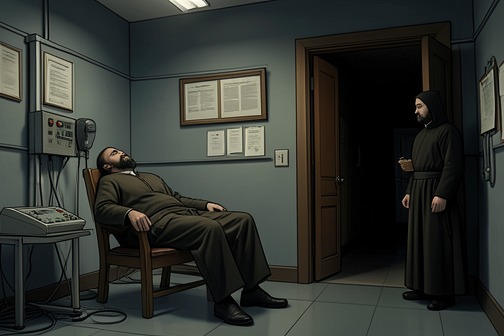
[Narcissus saves Goldmund](entity:event-recall-event-narcissus-goldmund-41beb7caa8b5) at the point when an accusation of theft has brought him to the dungeon and the gallows seem only hours away. The rescue begins as a startling recognition: the priest who enters the cell wears the habit of [Mariabronn](entity:location-recall-location-mariabronn-d697cde40052), but is also the Abbot John, formerly [Goldmund](entity:character-recall-character-goldmund-6408ea5ed221)’s friend [Narcissus](entity:character-recall-character-narcissus-8ac539c49d81). He has obtained Goldmund’s pardon through negotiations with the Count, and comes not merely to announce that the sentence has been lifted but to take him away. The episode joins friendship to institutional authority and political compromise, converting a threatened execution into a return to Mariabronn.
## Arrest and the threat of execution
Goldmund is caught in the Count’s castle and accused of theft. The Count dismisses his plea for mercy, insists that theft is enough to condemn him, and orders him bound and put in the dungeon so that he will hang the next morning. The accusation conceals the more compromising circumstance: Goldmund had been meeting the Count’s mistress. The threatened punishment is therefore both an immediate danger and the consequence of a situation the Count can exploit.
Before the prison door closes, a priest intervenes on a narrower point of justice. Learning that the prisoner has no confessor, he insists that even a thief condemned to death has the right to confession and the sacraments. He requires the guards to swear that Goldmund will not be led away beforehand and says he will speak to the Count that evening. The men accept his demand, recognizing his standing as a clerical dignitary and envoy. This intervention secures Goldmund a meeting with a priest before execution, but the subsequent pardon rests on a broader negotiation.
## Recognition in the dungeon
As morning approaches, Goldmund waits tensely for the priest, conscious that he needs help and that his own capacity to act may fail. The heavy door opens slowly. A solitary priest enters carrying a candlestick with two candles, and the familiar Mariabronn habit strikes Goldmund as a possible sign of safety. Yet the sight also sharpens his desperation: he has considered whether killing the visitor might be his only way out.
The priest bears the Abbot’s insignia. Goldmund recognizes the face and whispers Narcissus’s name. Narcissus explains that he has long since abandoned it: since taking vows, he has been called John. Goldmund has returned to the friend he knew, but that friend now stands before him as Abbot. The recognition breaks the isolation of the cell, even as the new title marks how much has changed during their separation.
## Pardon and political negotiation
Narcissus tells Goldmund that he has been pardoned and that he has come to take him away; Goldmund cannot remain in the city. The two shake hands and hold on to one another, while their speech remains playful and guarded. Goldmund maintains a show of casual pride, noting that he is still a vagrant and has been sentenced to hang. Narcissus understands the performance and reassures him without demanding that he abandon it. Their reunion restores intimacy through a gesture rather than an immediate confession of feeling.
The pardon has a political cost. Narcissus is in [the bishop’s city](entity:location-recall-location-the-bishop-s-city-1a91fb8e7f27) as one of the delegates sent to negotiate with the Count on behalf of the religious order, amid disputes between the Count, a favorite of the Emperor, and the order. He says the delegation’s success was limited. The narrative makes clear, however, that the negotiations over Goldmund’s life involved concessions to the ruthless Count. When Narcissus later remarks that the Count was not above bargaining, the rescue emerges as both a personal act and an exchange conducted within the unequal politics of secular and religious power.
## Departure and return to Mariabronn
Narcissus takes Goldmund from the dungeon to a guest chamber, where he is given food and his hands are washed and bandaged. Horses are soon brought out. Before leaving the city, Goldmund asks to pass the fish market so he can say farewell to [Marie](entity:character-recall-character-marie-38740b047e25) and her parents, who had worried about him. He looks toward the castle windows for the Count’s mistress but does not see her. The departure thus gathers up the immediate ties and unresolved encounters of the city without allowing Goldmund to stay.
The ride toward Mariabronn exposes the physical cost of Goldmund’s ordeal: he is exhausted, cannot initially manage the reins, and develops a slight fever. After a night’s rest and a day in bed, he recovers enough to ride. He then grows animated, races the groom, and bombards Narcissus with questions. The rescue therefore continues beyond the release itself: Narcissus carries Goldmund out of danger and back toward the place and friendship from which their lives had diverged.
## Friendship, authority, and the meaning of the rescue
The act recalls the earlier terms of their friendship. Narcissus had told Goldmund that their companionship had reached one goal: Goldmund had been awakened, but his own vocation remained uncertain, while Narcissus’s duty lay in the cloister. Now the former novice has become Abbot, and the former student returns as a homeless traveler whose life depends on the Abbot’s intervention. Their positions have changed, but the rescue demonstrates that Narcissus’s commitment to his friend has endured beyond their separation.
That change in status is visible again at Mariabronn. Goldmund sees the cloister not only as the familiar place of his student years but as an artistic and spiritual whole shaped over generations. Its buildings, images, and works seem joined by a common spirit. Within that order, Abbot John appears to him more imposing than Narcissus had seemed before, though he remains a cordial host and friend. Goldmund struggles with the distance between the Abbot’s responsibility and his own desire to work, eventually seeking a place in the cloister through confession and penance. The rescue thus brings Goldmund back not to his former life unchanged, but to a setting where friendship, religious order, and his artistic vocation must be negotiated anew.
Event 19
Goldmund carves the Mariabronn refectory lectern
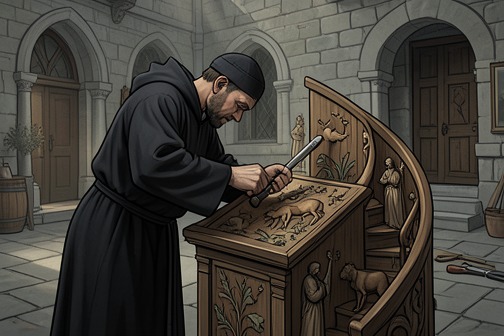
[Goldmund carves the Mariabronn refectory lectern](entity:event-recall-event-goldmund-mariabronn-40e538554d56) as his first major work after returning to the monastery, shaping an unornamented reading niche into a sculptural account of creation. Its spiral staircase, plants, animals, patriarchs, and apostles bring the natural world and religious teaching into one ordered design. Over two years, the work becomes both a practical gift to the cloister and a defining expression of [Goldmund](entity:character-recall-character-goldmund-6408ea5ed221)’s artistic vocation; when [Narcissus](entity:character-recall-character-narcissus-8ac539c49d81) sees one of its figures, he recognizes not only [Abbot Daniel](entity:character-recall-character-abbot-daniel-1b4be7de30d0) but also the friend whose inner life he had never fully understood.
## Setting and Purpose
After returning to [Mariabronn](entity:location-recall-location-mariabronn-d697cde40052), Goldmund found a suitable workshop in an empty shed beside the courtyard gate. He ordered a drawing board and tools, drew up plans, arranged for materials to be brought from nearby cities, selected timber, and built a roof over the wood he had set aside to dry. [Erich](entity:character-recall-character-erich-bfb886d1953e), the blacksmith’s son, helped him make the knives, chisels, drills, and planes his work required, and became his friend and assistant.
Goldmund wanted his first work for the cloister to belong to its architecture and daily life, rather than to be an unrelated object displayed merely for its novelty. An altar or pulpit would have suited his ambitions, but neither was needed or available. In the refectory he found a raised niche where a young brother read passages from the lives of the saints during meals. Because the niche was undecorated, Goldmund proposed carved panels for its steps and lectern, with figures in half-relief and others standing almost free of the wood. The Abbot approved the plan.
The choice of a reading place gave the commission a particular function: the carving would accompany communal meals and the reading of saints’ lives. Goldmund imagined the work not as an isolated sculpture but as part of the cloister’s fabric, joining its religious use to the surrounding architecture.
## Design and Making
Goldmund conceived the work in two parts: one representing the world, the other the word of God. The lower structure was a staircase winding around a sturdy oak trunk, its rising steps to carry images of creation, nature, and the simple lives of the patriarchs and prophets. Above it, the parapet would show the four apostles. Their identities would also carry personal memory: one evangelist would bear the traits of Abbot Daniel, another those of [Father Martin](entity:character-recall-character-father-martin-9cf710720e65), his successor, and Luke those of [Master Niklaus](entity:character-recall-character-master-niklaus-5e0a4b4d7e3f), Goldmund’s former teacher.
The design’s paired levels gave the lectern a legible upward movement, from the created world at its base to the apostles above. In execution, however, its lower portion became more than a collection of illustrative scenes. A small, lively world grew from the thick spiral of the stairs: plants, animals, people, and Noah among grape leaves and grapes. The resulting work was described as a picture book praising the creation and its beauty, freely expressed yet held together by an inner order and discipline.
Goldmund began only after the snow had fallen and Christmas had passed. Once work was underway, he seemed to withdraw from the ordinary routines of the cloister. He took his meals at the mill, allowed only Erich into the workshop, and sometimes worked in silence even when his assistant was present. He pursued the carving with alternating enchantment and discouragement, treating each difficulty as a demand that could teach him greater sensitivity. The work absorbed him so completely that he nearly forgot both the monastery and Narcissus.
Erich’s role grew alongside the carving. At first he was the only person allowed to see the developing work and was entrusted with small tasks; he hoped to become an artist himself. In the second year, he was formally given to Goldmund as an apprentice. Goldmund was pleased to have a committed learner, and, if the work succeeded, considered asking Erich’s father to release him for permanent training as his assistant.
## Figures and Relationships
The evangelists gave the design a way to hold relationships and memories within a religious ensemble. Goldmund’s most successful figure, in his own judgment, was the one modeled on Abbot Daniel. He loved it for the kindness and purity of its face. By contrast, the figure bearing Master Niklaus’s traits seemed to Goldmund less successful: it expressed discord and sadness, lofty creative ambition alongside awareness of the limits of creation, and grief for a lost unity and innocence. Erich admired this more troubled figure most of all, while Goldmund’s own affection rested especially on Abbot Daniel’s image.
Goldmund revealed the finished figure of Abbot Daniel to Narcissus before showing him the rest. He waited until his friend was available, then brought him to see the statue. Narcissus immediately recognized their former Abbot in the evangelist, but he also saw in the carving the dignity, kindness, and simplicity associated with their earlier years. He told Goldmund that the figure had restored Abbot Daniel to him and that, through the work, Goldmund had opened himself to Narcissus for the first time. The response transformed the viewing from an assessment of skill into an act of recognition between friends.
Their exchange also altered Narcissus’s view of art. He acknowledged that he had once regarded artistic work as less serious than thinking and science, because he had understood the senses as a pull toward the transitory and the mind as the route to the eternal. Goldmund’s work helped him recognize that knowledge has more than one path, and that the path of the mind is not necessarily the best one. Narcissus continued to regard intellectual life as his own way, but no longer treated it as the only serious way of knowing.
## Completion and Significance
Goldmund worked on the group for two years. The carved balustrade became a small paradise, with a luxuriant wilderness of trees, brush, and herbs, birds in the branches, and animal heads and bodies appearing among the growth. Scenes from the patriarchs’ lives occupied this fertile setting. When restlessness or boredom interrupted his work, Goldmund sometimes gave Erich a task and left for a day or two to walk in the countryside or return to the remembered freedom of the forest. He then came back to the workshop and resumed carving with renewed concentration. Narcissus often visited, and the workshop became one of his favorite places in the cloister.
Several weeks after the larger work was finished, it was installed in its place. As in earlier experience, the completed work passed into public possession: people looked at it, judged it, and praised it, while Goldmund found his workshop and heart empty and wondered whether the sacrifice had been worthwhile. At the unveiling, he was invited to the fathers’ table for a festive meal, where the oldest wine in the house was served. He enjoyed the meal, but the interest and pleasure Narcissus took in the work mattered more to him than its public honor.
The lectern’s importance lies in the way it unites functions that Goldmund’s life had often kept apart. It serves a communal religious setting while preserving the visible richness of plants, animals, and human life; its natural imagery rises through a disciplined structure toward the apostles. Its figures also carry personal histories into the cloister, making artistic creation a form of remembrance. Finally, Narcissus’s response marks a change in their friendship: the work lets him encounter Goldmund not as a subject to be explained by reason, but as an artist whose way of making reveals knowledge and feeling that argument alone had not reached.
Event 20
Goldmund’s final journey and sick return
[Goldmund’s final journey and sick return](entity:event-recall-event-goldmund-b9a7f646f3a9) begins as a chosen departure from [Mariabronn](entity:location-recall-location-mariabronn-d697cde40052) and ends with [Goldmund](entity:character-recall-character-goldmund-6408ea5ed221) gravely ill among the people he had left behind. The journey’s failure to fulfill his hopes becomes a turning point: Goldmund must confront physical pain, rejection by [Agnes](entity:character-recall-character-agnes-a7e5e75ca8a8), and the prospect of death, while [Narcissus](entity:character-recall-character-narcissus-8ac539c49d81) receives the fragments of his story and cares for his returned friend.
## Departure and the journey’s concealed purpose
Goldmund’s leave-taking from Narcissus was difficult for both men, though Goldmund concealed his feelings behind brusque indifference. He had made up his mind during the night and arrived in new clothes and a new cap to say goodbye and receive a blessing for the road. He had confessed and taken communion earlier. His departure followed a period of preparation, during which he had completed a figure of Mary with careful attention to its hands, face, and hair. The work’s lingering final adjustments had delayed him, but he now set out on his own terms.
The journey was not, as Goldmund initially let Narcissus believe, simply a decision to roam. He later admitted that he had heard a rumor that [Count Heinrich](entity:character-recall-character-count-heinrich-1b062d5096f7) had returned to the region and that Agnes was with him. The news had fixed his thoughts on Agnes, whom he remembered as the most beautiful woman he had known and loved. He rode in the hope of seeing her and being happy with her again. He found her after about a week and had the chance to speak with her, but she no longer wanted a relationship with him. She considered him too old, no longer attractive or amusing enough. Goldmund identified this rejection as the real end of the journey, though he continued onward rather than immediately returning to Narcissus.
## Injury, delay, and return
Goldmund’s reluctance to come home was bound up with shame. He felt that he had promised himself too much and did not want to appear ridiculous by returning almost as soon as he had left. He told Narcissus that he had fallen ill during the first days of the journey but kept going rather than turning back. In a forest, his horse fell with him into a brook, where he remained overnight in cold water. He believed he had broken several ribs, and chest pain continued afterward. When riding became too painful, he sold the horse and spent a long time in a hospital.
The full course of the journey remained incomplete: Goldmund offered only some details, and other parts had to be inferred. He sometimes lay listless or feverish and delirious, and at other times was lucid enough to speak with Narcissus. His explanations connect the physical setback to his earlier refusal to return: although the accident happened not far from Mariabronn, he kept traveling because he feared looking foolish. The journey thus became a prolonged departure from the simple possibility of turning back, until pain and exhaustion made that possibility unavoidable.
## Earlier encounters with pain, birth, and death
The journey’s significance reaches beyond its final illness. Earlier in his wandering, Goldmund had been present at a birth in a poor village, where the peasant family had only gruel and no bread. Woken from the straw to help, he held a light while the midwife worked. He watched the woman’s face and recognized a resemblance between the expression of labor and the expressions of women in the ecstasy of love. The experience gave him a new understanding of how closely pain and joy could appear to meet.
His attention to death also shaped the sensibility he carried into the last journey. In a plague-stricken farmhouse, he studied the bodies of five people, noticing the different expressions and postures preserved in death. He did not answer [Robert](entity:character-recall-character-robert-dcc9e88f1178)’s anxious calls from outside, giving himself instead to observing the scene with both compassion and the detached attention of an artist. The open, ordinary rooms made visible the physical process that graves usually conceal. For Goldmund, the sight was terrible but also compelling: it confronted him with suffering and fate in an uncompromising form.
During the later weeks of [Lene](entity:character-recall-character-lene-ea80f5569793)’s illness, Goldmund experienced care not as an abstraction but as a sustained obligation. He wanted to leave and resume wandering, yet could not abandon her while she was dying. He rarely went outside, gave her drops of water when she could no longer drink milk, and tended the goat that shared their shelter. When Lene died, he remained beside her, then burned the hut and left with only his flint. These earlier episodes make the final journey part of a longer history in which Goldmund encounters birth, suffering, death, and the limits of his ability to escape them.
## Agnes, the vision of his mother, and acceptance
Goldmund’s account of the fall gives it a meaning beyond injury. After Agnes rejected him, he continued riding, though he said that his strength, youth, and intelligence had already deserted him. When he fell into the stream, he felt something break in his chest and, in that moment, felt relief rather than resistance. He understood himself to be close to death, yet unlike his earlier experience in Count Heinrich’s prison, he no longer found death unbearable.
In the midst of the chest pain, Goldmund described a dream or vision of his mother. He heard her voice, which he had not heard since childhood, and saw her holding him in her lap. In the vision, she opened his chest and drew out his heart; Goldmund said that once he understood what was happening, the pain ceased to feel like an enemy. He later interpreted the recurring pain in the same maternal terms, as his mother’s fingers drawing his heart out. The vision links the physical wound of the journey to the maternal memory that Narcissus had helped awaken earlier in Goldmund’s life.
Back at Mariabronn, Goldmund told Narcissus that he was ill and confessed how soon the illness had begun. He explained that he had continued traveling because he was ashamed to return after such a short time and because the journey had not gone as he had expected. He now said he would stay and would never ride away again: no more wandering, dancing, or women. He acknowledged that he would otherwise have remained away much longer, but when he found no joy in the world outside, he wanted to draw and make a few more figures while he still could. His return is therefore neither a triumphant completion of his travels nor a simple restoration of his former life; it is a weary decision to stop roaming and turn again to art and friendship.
## Narrative significance
The journey’s ending gathers together experiences that had long marked Goldmund’s life: attraction to movement and new encounters, a deep responsiveness to the body, artistic attention to faces, and the recurring presence of death. His earlier reluctance to leave Lene alone shows that wandering can yield to an immediate responsibility; his continued travel after Agnes rejects him, by contrast, reveals how shame delayed his return. The fall finally makes the body’s limits impossible to ignore.
The account also changes the meaning of the departure scene. Goldmund’s promise that he would see Narcissus again becomes a return under radically altered circumstances: he comes back sick, diminished, and conscious that he cannot resume his former life unchanged. The story is not fully preserved in a continuous account. Goldmund speaks in fragments, sometimes feverish and sometimes lucid, and Narcissus records only parts of what he says. That partial transmission suits a final journey whose significance lies less in a complete itinerary than in what Goldmund discloses at its end: the failed hope of finding Agnes, his changed relation to pain and death, and his wish to make art before his remaining strength is gone.
Event 21
Goldmund’s death
[Goldmund’s death](entity:event-recall-event-goldmund-80694472b05d) closes his life of wandering and creation by turning his final illness into a last conversation about love, art, and the mother he has sought in memory and imagination. His body fails after a journey marked by hardship, but the decisive movement is inward: he gives up the hope of completing his long-imagined maternal statue and understands himself as being shaped, at the end, by the mother-image he once hoped to shape in wood. Beside him, [Narcissus](entity:character-recall-character-narcissus-8ac539c49d81) at last speaks openly of his love, making their friendship part of the death scene rather than merely its witness.
## Return and Final Illness
[Goldmund](entity:character-recall-character-goldmund-6408ea5ed221) returns to [Mariabronn](entity:location-recall-location-mariabronn-d697cde40052) sick after a journey whose full story is never known. He tells Narcissus that his chest pains began when he fell with his horse into a brook and lay there through the night. He believes he broke several ribs, but initially refused to turn back because he feared that doing so would make him look foolish. When the pain eventually made riding impossible, he sold the horse and spent a long period in a hospital. His account makes the illness a consequence not only of physical hardship but also of his determination to continue outward, even when his body had already given him reason to stop.
Back at Mariabronn, Goldmund resumes drawing and making figures, but his strength is spent. While speaking with Narcissus, he stops, closes his eyes, and falls peacefully asleep at the drawing table. The Abbot fetches Father Anton, who finds him hopelessly ill; Goldmund is carried to a sick room, where [Erich](entity:character-recall-character-erich-bfb886d1953e) keeps watch. His condition alternates between listlessness, fever and delirium, and periods of lucidity. Narcissus is summoned during those lucid intervals, and their conversations become increasingly important to him. The narrative does not provide a complete record of Goldmund’s last journey or all that he says: Narcissus preserves fragments of his reports and confessions, while Erich supplies other details.
## Narcissus and the Last Reconciliation
The final illness brings a change in the intimacy of the two friends. When Narcissus puts a hand on Goldmund’s arm, Goldmund immediately falls quiet and closes his eyes. Later, as he sleeps at the drawing table, Narcissus bends down and kisses his hair and forehead—a gesture he had never made during their many years of friendship. Goldmund understands what the gesture means. Narcissus then admits how much Goldmund has meant to him and how poor his own life has been in love. He tells Goldmund that, among men, Goldmund alone has enabled him to love, and describes that love as a well in a desert and a blossoming tree in the wilderness.
Goldmund receives this declaration without shame. He recalls that, when Narcissus visited him in prison to save his life, he had felt ashamed in front of his friend; now, he says, that shame is gone. The exchange makes the deathbed a place of reciprocal recognition: Narcissus gives voice to a love he had left unspoken, while Goldmund meets that confession with the ease of someone who has known the love of many women but now recognizes the singular place Narcissus occupies in his life. Their parting does not erase their differences; it allows them, at last, to name what those differences have not prevented.
## Death, the Mother, and the Unfinished Statue
Goldmund speaks of dying without claiming faith in an afterlife. He says he does not expect the dead to return: a dried-up tree remains dead, a frozen bird does not come back to life, and a person’s memory eventually fades. What draws him toward death is instead the hope that he is traveling toward his mother. He imagines that she may come to take him back, not into another life, but into nonbeing and innocence, and hopes that this return may bring a happiness like fulfilled love.
That hope is inseparable from the artistic ambition he cannot fulfill. For years he has wanted to carve a statue of the mother, the most sacred image he carries within him. Earlier, the image had been connected to his own mother and her memory; it had continued to change as his experiences and encounters with women shaped it. Goldmund had once believed that his life would be useless if he died before making the statue. Now he describes the reversal: it is not his hands that shape the mother’s image, but her hands that shape him. The image of the great mother-Eve remains visible to him, and he believes he could carve it if his hands still had strength, yet he also believes that the mother does not want him to make her secret visible. The sculpture remains unrealized, while the act of dying becomes, in his understanding, the mother’s work upon him.
In his last exchange with Narcissus, Goldmund asks how Narcissus will die, since he has no mother. He tells his friend, [“Without a mother, one cannot love. Without a mother, one cannot die.”](entity:expression-recall-expression-without-a-mother-o-6bda59b09ebe) These words join the two subjects that have governed his final reflections: the maternal source of love and his own expectation that death will be a return to that source. What follows cannot be understood. For the last two days, Narcissus sits beside Goldmund’s bed as his life ebbs away, and Goldmund’s final words remain with him.
## The Death Scene’s Wider Echoes
Goldmund’s death gathers into a final scene the bodily and artistic experiences through which he has tried to understand mortality. As a young wanderer, he witnessed a birth and was struck by the resemblance between the expression of pain and that of ecstatic pleasure. Later, in a plague-stricken farmhouse, he studied the dead with both compassion and the artist’s exact attention, seeing how posture and gesture gave form to different experiences of death. During his journey through the plague region, a painted [Dance of Death](entity:expression-recall-expression-dance-of-death-e0f8a577b1e0) presented mortality as an unavoidable end shared by every social rank. Goldmund found that stern image incomplete beside his own sense that death could also be maternal and inviting. His final hope that death will lead him toward his mother brings that earlier understanding to its personal conclusion.
The unfinished maternal statue also stands against the completed religious works that mark Goldmund’s artistic life. He had been drawn to [Master Niklaus](entity:character-recall-character-master-niklaus-5e0a4b4d7e3f)’s wooden Madonna and later worked on a statue of Saint John, whose features he associated with Narcissus. Back at Mariabronn, he planned a refectory lectern whose lower section would represent creation and the lives of patriarchs and prophets, while its upper parapet would bear the four apostles. These works show his ability to give form to remembered people, religious figures, and the life around him. The mother, by contrast, remains the image he cannot make public. His death therefore ends not with artistic completion, but with a final recognition that the central image of his life exceeds the work his hands could finish.