Jean Pacome
NauseaJean Pacome is a deceased Bouville merchant whose portrait becomes the sharpest personal test of Antoine Roquentin’s sense that existence has no given justification. Presented among the city’s honored elite, Pacome appears to have embodied a life of rights secured by family, business, and duty. Roquentin sees in his composed, faultless image not merely a successful man but an entire social order that treats its privileges as deserved—and its right to exist as unquestionable.
Identity and Public Image
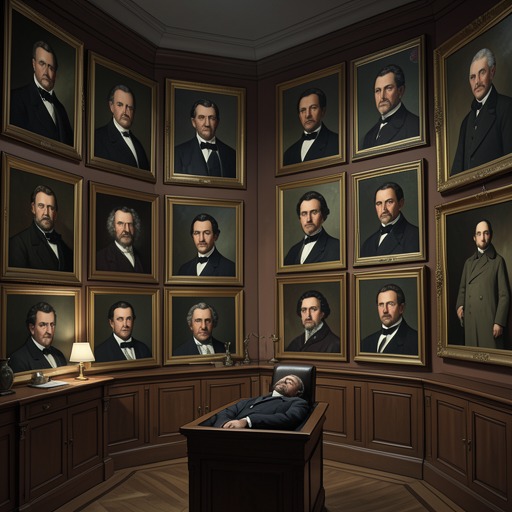
Pacome belongs to the Bouville elite commemorated in the municipal museum’s portrait gallery. The paintings document the men and women who shaped the city between 1875 and 1910, and Pacome’s image stands within that collective record of leadership and civic achievement. The gallery presents its subjects as figures whose authority has been ratified by history; their public distinction is part of the story the city tells about itself.
The novel also places Pacome in the social geography of Bouville before Roquentin studies his portrait. On Rue Tournebride, where families walk ceremonially and exchange greetings, Roquentin learns to distinguish the people of the Boulevard Maritime from those of Coteau Vert by their clothes and bearing. He associates the former with new overcoats, soft felt hats, and dazzling shirts, while the latter seem shabby and sunken. Pacome’s portrait belongs to the world of wealth and established standing that these street rituals make visible: class is expressed not only through money or office but through appearance, deference, and the confidence to occupy public space.
The Portrait and the Museum
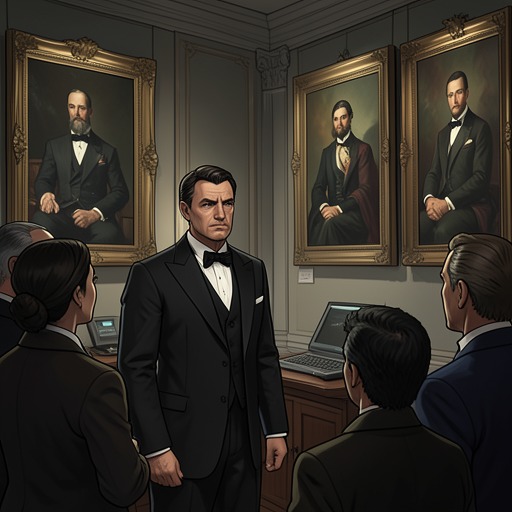
Roquentin encounters Pacome’s portrait while walking through the museum toward a portrait of Olivier Blevigne. Pacome seems to look down from the moulding and holds his gaze. He stands with his head slightly thrown back, top hat and gloves in one hand against pearl-grey trousers. Roquentin notices his small feet, slender hands, broad wrestler’s shoulders, and the hint of whimsy in his otherwise unwrinkled, courteous face. A shadow of a smile touches Pacome’s lips, but his grey eyes do not smile. Though around fifty, he appears as fresh as a man of thirty; Roquentin finds him beautiful and cannot make himself identify anything mediocre in him.
The admiration quickly turns into confrontation. Roquentin reads a calm, implacable judgment in Pacome’s eyes. He recognizes an unequal contest: his own opinion of Pacome cannot reach the dead man, because it belongs to the language of psychology, whereas the judgment Roquentin imagines in the portrait seems to question his very right to exist. Pacome’s image thus does more than preserve a likeness. It makes the museum’s polished representation of authority feel like a verdict directed at the living visitor.
The style of the gallery helps sustain that authority. Its portraits are dark in general tone, with lively colors excluded; the painters Renaudas and Bordurin render details with different emphases, Renaudas excelling at hands and Bordurin at collars. The painstaking finish gives the subjects a controlled, almost porcelain clarity. Roquentin finds that their painted faces have been stripped of the mysterious weakness that human faces possess. Pacome’s immaculate appearance is therefore part of a broader commemorative form: the portrait makes an individual legible as a dignified civic type while smoothing away the vulnerability of ordinary existence.
A Life Organized as Rights and Duties
Roquentin imagines Pacome’s life as a continuous exercise of entitlement. As son, he could expect an upbringing in a united family and the inheritance of a spotless name and prosperous business; as husband, care and tender affection; as father, veneration; and as leader, obedience without complaint. In this account, the rights are inseparable from duties. Pacome has done what the roles require, and the fulfillment of those duties appears to validate his claim to the corresponding privileges.
The family’s success reinforces that sense of inevitability. The Pacomes have become the richest family in Bouville, but Roquentin imagines that this result could never have surprised Jean. Pacome does not need to tell himself that he is happy; even pleasure is moderated and absorbed into the order of his life, treated as something to which he is entitled rather than as an unsettling discovery. Roquentin pictures him reading classics before sleep, perhaps Montaigne or Horace, and keeping abreast of contemporary writers such as Barrès and Bourget. In this conjectured routine, culture, moderation, and duty all fit within the same secure identity.
The portrait’s authority also belongs to a wider civic narrative. The elite represented in the gallery are credited with building Sainte-Cecile-de-la-Mer, founding the Federation of Shipowners and Merchants of Bouville in 1882, expanding the port and its quays, and supporting technical and professional education. Their memorial record presents public command as service and material success as evidence of civic merit. A speech attributed to Olivier Blevigne states the logic directly: ruling is not a right of the elite but its primary duty. Pacome’s imagined life makes that principle intimate: inherited position and practiced obligation become two sides of the same claim to rule.
Roquentin’s Existential Counterpoint
Against Pacome’s certainty, Roquentin places his own accidental existence. He thinks of himself as having appeared by chance, no more entitled to be than a stone, a plant, or a microbe; his life reaches toward small pleasures, sometimes sending out vague signals and sometimes amounting to no more than harmless buzzing. The contrast is not simply between a rich man and a poor observer. It is between a life narrated as the fulfillment of an established order and a life that cannot find a necessary reason for being there.
Pacome’s heart and bodily life, Roquentin imagines, take the form of rights that must be obeyed. The conviction has never been unsettled by doubt: Pacome has fulfilled his obligations as son, husband, father, and leader, and has never weakened in his demands for what those positions owe him. Roquentin’s imagined biography is therefore less a record of private feeling than a model of bourgeois self-justification. In it, social roles turn contingency into a sequence of apparent necessities, and privilege presents itself as the natural consequence of duty.
The dead man never speaks, and Roquentin’s portrait-based account is openly speculative: he imagines what Pacome read, thought, and felt. That uncertainty matters. The figure who judges Roquentin is not a recovered private person but an image made persuasive by the museum, the family name, and the stories attached to elite achievement. Roquentin’s inability to find a flaw in Pacome’s appearance coexists with his recognition that the portrait cannot answer back; the force of its judgment comes from the social world that has taught visitors to read such a figure as deserving.
Collective Memory and Significance
Pacome’s portrait stands among images through which Bouville’s elite secures a place in public memory. The gallery’s subjects are presented as leaders whose authority, family standing, and civic works have earned them a durable historical presence. Their cultivated appearances and the museum’s solemn setting convert social power into a visible heritage. To Roquentin, however, the portraits seem to offer a human order that has conquered both nature and doubt, while concealing the vulnerability that would link these celebrated figures to other forms of life.
Pacome is decisive because his apparent perfection makes the conflict unusually stark. Roquentin can admire the beauty of the portrait and still experience its implied standard as an accusation. The man’s imagined certainty cannot establish that anyone truly has a right to exist; instead, it reveals how a society can make inherited advantage look like moral desert by binding it to duty, leadership, and commemoration. In the encounter, the museum’s tribute to Pacome becomes a stage on which Roquentin’s sense of existence as contingent collides with Bouville’s confidence in its ruling class.