Antoine Roquentin
NauseaAntoine Roquentin is a solitary historian whose diary follows the collapse of his faith in historical research as a source of purpose and his effort to imagine another form of creation. In Bouville, the Marquis de Rollebon first gives him a life to reconstruct and a reason to turn away from his own; when that project becomes impossible, Roquentin confronts existence without the shelter of the past. His final thought is not a cure for that confrontation but a tentative choice: to try writing a novel whose created form might cast a different light on the life he has lived.
Identity and Background
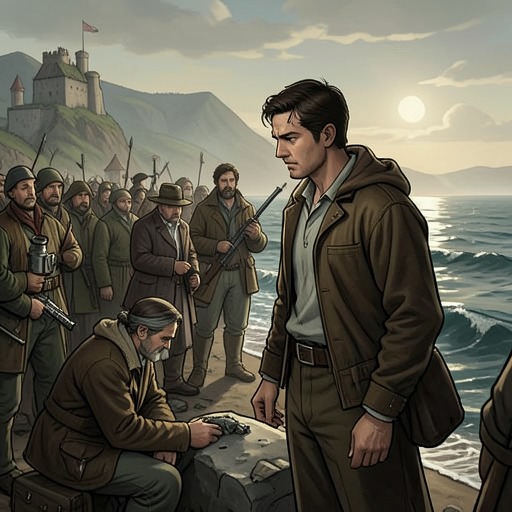
The editors present the notebooks as papers found among those of Antoine Roquentin and published without alteration. The opening sheet is undated and believed to precede the diary by some weeks, while the diary itself begins on Monday, 29 January 1932. At the time, Roquentin has settled in Bouville after travelling through Central Europe, North Africa, and the Far East; he has been there three years, working to complete historical research on the Marquis de Rollebon.
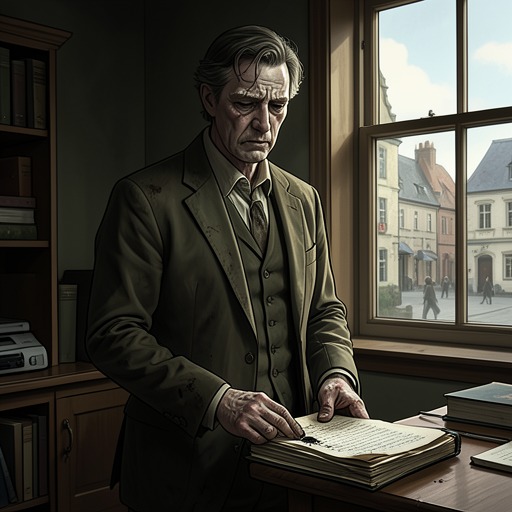
His profession sets him among documents, motives, and the retrospective explanations historians give human conduct. Yet the diary reveals a sharp limit to that method. Roquentin recognizes that historical work tends to sort sentiments into broad categories such as ambition and interest, while he himself lacks the self-knowledge that might help him understand what is happening to him. The notebook therefore records not only an inward crisis but a growing mismatch between the historian’s explanatory habits and an experience that will not stay within them.
Roquentin’s account is intensely first-person, but its framing matters: these are notebooks, rather than a later, impersonal biography of their author. The dated entries convey events as he tries to understand them, while the editors’ short introduction locates his papers and work in time. The form gives his discoveries the character of immediate self-observation rather than settled historical judgment.
Life in Bouville and the Emerging Crisis
At first Roquentin describes what is happening as a disturbance that has crept up on him. On 29 January he compares it to an illness: it arrives gradually, leaves him able for a time to persuade himself that nothing is wrong, and then begins to blossom. The image captures both the crisis’s slow onset and its resistance to a clean diagnosis. He cannot yet name its meaning, and the historian’s professional distance does not supply the introspection he needs.
His solitude becomes newly consequential in a café. A glass of beer is recognizably an ordinary object, and Roquentin can itemize its details: its bevelled edges, handle, small coat of arms, and the name “Spartenbrau.” But recognition does not make it harmless or fully intelligible. He has spent half an hour avoiding the glass, scanning the space around it instead; the other customers, with their happy, reasonable voices, cannot offer him refuge. An everyday object becomes the point at which familiar description fails to contain what he perceives.
That scene sharpens a contrast in Roquentin’s relation to other people. He had once remained close enough to them to take shelter among them if necessary, describing himself as an amateur at heart, only partly committed to solitude. Now he understands that this retreat may no longer be available: the other bachelors around him cannot help, and he cannot simply take sides with solitude as if it were a chosen position. The crisis turns isolation from a possible refuge into a condition he must face.
Rollebon and the Loss of a Vicarious Life
The research on the Marquis de Rollebon is more than Roquentin’s occupation. He describes himself and the dead historical figure as partners: Rollebon needs Roquentin in order to exist, while Roquentin needs Rollebon so as not to feel his own existence. Roquentin supplies the raw material of his own life; Rollebon supplies the imposing figure around which that material can be arranged. In working on the Marquis, Roquentin can treat his gestures and thoughts as belonging to a subject beyond himself, rather than confronting his own existence directly.
This arrangement also explains why the research once felt like a reason for living. Roquentin says that Rollebon had delivered him from himself: his eating, breathing, and movements seemed to take their sense from the man he was reconstructing. Historical work let him invest the past with a coherence and importance that displaced attention from the present. The relationship is not one of ordinary companionship—Rollebon is dead—but of dependence enacted through the historian’s labor.
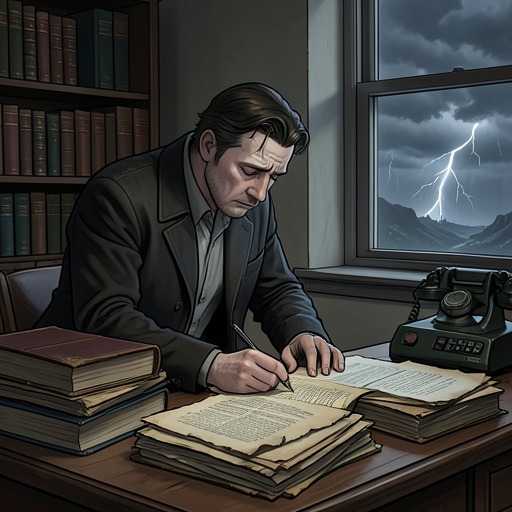
The break comes when Roquentin can no longer write the book. He announces that the Rollebon project is finished and asks what he is to do with his life. The physical scene gives that declaration weight: at three o’clock, he sits at his table with a file of letters he stole in Moscow, still composing a passage about rumours and a will made on 13 September. The work’s specific materials remain before him, but the act of interpretation no longer carries him forward.
He calls the end of the affair like the end of a great passion. The dramatic past that had animated his work—dreams of the Czar’s court, old palaces, ice carnivals, uniforms, and cool shoulders—has vanished, leaving him awake before a pad of white paper in a warm room. Most decisively, he recognizes that the biography had concealed rather than resolved his own condition: when the borrowed purpose falls away, he feels existence flood over him. The end of the research is therefore not just a change of subject. It removes the structure that had allowed him to live through someone else’s story.
The Nausea and the Chestnut-Root Recognition
Roquentin’s crisis culminates in a change of understanding rather than a simple recovery. At six in the evening, he says he has reached his goal and understood what has been happening since January, but he is crushed rather than relieved or satisfied. The Nausea has not left him, and he does not expect it to leave soon. What changes is its status: it is no longer an illness or a passing fit; it is he.
The recognition takes shape in the park, in front of the roots of a chestnut tree beneath his bench. He can no longer remember the mass as a root in the ordinary, settled sense: words, the significance of things, their practical uses, and the human reference points traced across them have fallen away. Alone and bent forward before the black, knotted mass, he experiences the collapse of the familiar classifications through which things had seemed manageable. His discovery is grounded in this encounter with an ordinary part of the world, not in the successful completion of his historical work.
The result is not that Roquentin gains a reassuring explanation for existence. Rather, the Nausea becomes the name for his own inseparability from the existence he had tried to avoid by living through Rollebon. The earlier glass of beer scene anticipates this shift: an object could be correctly described and still exceed the meanings assigned to it. In the park, the gap between a thing and its accustomed name becomes unmistakable, and Roquentin’s understanding of himself changes with it.
Other People, Solitude, and the Meaning of a Name
Roquentin’s solitude persists in the final movement of the diary. Between two cities, he wonders who remembers him and thinks of a woman in London, but even that possible memory seems uncertain: he questions whether she is really thinking of him. He does not describe himself as jealous of the Egyptian who may be with her. He believes he had her last living love, while recognizing that pleasure could still connect her to someone else. The thought concludes in a wider sense of erasure: she may have emptied herself of him, and other consciousnesses in the world may have done the same.
He then finds the word “I” hollow. Antoine Roquentin exists, but, as he puts it, for no one; even his name becomes an abstraction, and its reflection in consciousness pales and fades. The passage distinguishes the continuing fact of consciousness from a secure, socially sustained identity. He can know that he exists without feeling himself clearly or holding on to a durable sense of who that existence makes him.
A voice tells him that the train leaves in two hours; another thought registers that the Self-Taught Man is wandering through the city. These details place Roquentin’s inward isolation beside an ongoing world of streets, people, and departure. The Self-Taught Man’s presence does not resolve Roquentin’s solitude. Instead, it punctures the sealed quality of his consciousness with the awareness that another person continues to move through the city beyond it.
From Historical Account to the Possibility of a Novel
The final turn begins when Roquentin hears a Negress sing. He thinks of the singer and a Jewish man as, in a limited sense, saved: they seem to have washed themselves of the sin of existing as completely as anyone can. The experience brings him an unexpected, fragile joy, not a settled hope. He feels it like a man emerging from a trek through snow into a warm room, still frozen and motionless at the threshold. Art does not abolish the burden of existence, but the song briefly makes another relation to it imaginable.
Roquentin then asks whether he might try to make something in another medium. A history book will not do: history concerns what has existed, and one existing thing cannot justify the existence of another. He judges that his error was trying to resuscitate the Marquis de Rollebon. Instead he imagines a book, perhaps a story or an adventure, whose printed words would point toward something that does not exist in the same way as the facts it recounts. He wants it to be beautiful and hard as steel, capable of making readers ashamed of their existence.
This possibility immediately meets doubt. Roquentin has written many historical articles, but never a book of the kind he imagines, and he does not know whether he has the talent for it. He is not sure enough to make a decision without wavering. The imagined novel would also begin as troublesome, tiring work and would not stop him from existing or feeling that he exists. Its promise lies farther off: once written, it might cast some of its clarity over his past and let him remember his life without repugnance.
The ending holds that ambition at the level of possibility. Roquentin imagines that, looking back on the gloomy hour when he waited for the train, he might one day call it the hour when everything started and perhaps accept himself. Night falls; two windows on the second floor of the Hotel Printania light up, and the building site of the New Station smells of damp wood. Tomorrow, the diary notes, it will rain in Bouville. The train, the hotel, and the weather offer no proof that the novel will be written or that the Nausea will end. What changes is Roquentin’s direction: after abandoning the past as a borrowed reason for living, he considers making a work that might give his own past a different shape.