Olivier Blevigne
NauseaOlivier Blevigne is a Bouville businessman, deputy, and leading member of the local elite whose portrait reveals how public status is made and preserved. His career joined commercial wealth to political authority, while his image in the museum reshaped a short, vulnerable man into an imposing symbol of command. Through that contrast, his story shows how Bouville’s elite presents its advantages as duty and converts its own history into a monument to human mastery.
Identity and Background
Blevigne, whose full name is given as Olivier-Martial Blevigne, was born and died in Bouville, in 1849 and 1908. He studied law in Paris and passed the bar examinations in 1872. The biographical entry consulted by Antoine Roquentin presents him as a man whose political formation began in the upheavals of the Paris Commune: after the insurrection, he took refuge in Versailles under the National Assembly’s protection and vowed to devote his life to restoring order. The entry makes this pledge the key to his later public identity, though it is also a story about how a political commitment becomes a credential for authority.
In 1880 Blevigne married Marie-Louise Pacome, the younger daughter of businessman Charles Pacome. After his father-in-law’s death, he founded the firm Pacome-Blevigne & Son. This marriage and business formation connect his household directly to Bouville’s commercial establishment: he did not enter public life apart from the city’s wealth, but from within a family and business network that helped secure his standing.
Career and Political Role
Blevigne founded the Club de l'Ordre, an aristocratic circle that for years brought together Bouville’s principal businessmen and shipowners. The biographical account credits the club with exerting a salutary influence on the port’s destiny until Blevigne’s death. Its name and membership express the political ideal attached to his career: social authority should remain in the hands of those who considered themselves most qualified to exercise it.
Elected deputy on October 4, 1885, Blevigne was repeatedly returned to office. His celebrated argument was that the ruling class had become unwilling to rule, and that rule was not an elite privilege but its primary duty. He invoked heredity, education, and experience as the grounds for elite fitness, then called for the restoration of authority. The claim casts inherited position as an obligation rather than an advantage, but its practical conclusion is unmistakable: political power should remain with the class that defines itself as best suited to wield it.
The biography describes Blevigne as an energetic, forceful speaker and lists collections of speeches titled Moral Forces, The Duty to Punish, and Will-power. The account associates The Duty to Punish with speeches about the Dreyfus Case. These titles present a consistent public vocabulary of discipline and moral authority, linking his political reputation to the idea that order must be actively maintained.
During the 1898 strike, Blevigne returned immediately from Paris and became the guiding spirit of resistance. He also took the initiative in negotiating with the strikers, in what the biographical entry describes as an attempt at conciliation. Those talks were interrupted by an uprising in Jouxtebouville; the entry then credits military intervention with restoring calm. The episode thus combines negotiation with resistance and military force, showing the limits of the conciliatory image that accompanied his political standing.
Private Loss and Public Memory
Blevigne’s son Octave entered the École Polytechnique at a very young age. His father wanted to make him a leader, a wish that extended Blevigne’s ambitions into the next generation. Octave’s premature death was, according to the biographical account, a terrible blow from which Blevigne never recovered; Blevigne died two years later, in February 1908. The account places this personal loss beside a career organized around authority and public service, revealing a private rupture that official reputation cannot absorb.
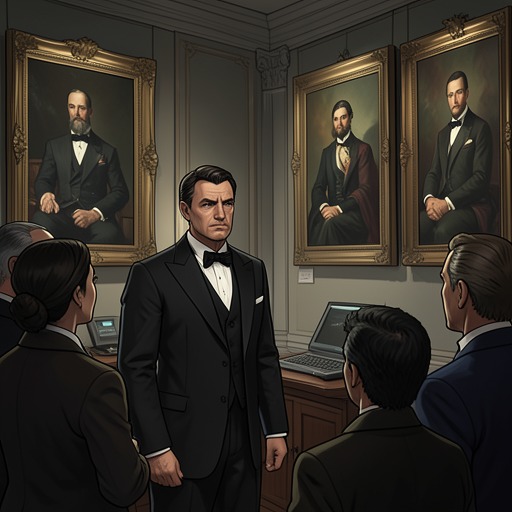
His posthumous public image was shaped by portraitist Bordurin. Roquentin finds Blevigne’s portrait in the Bouville museum and recognizes how its arrangement controls the viewer’s sense of scale: although Blevigne was only five feet tall, the portrait gives him the same stature as his neighbor Jean Parrottin. Small furnishings—a hassock, a low armchair, a shelf of little books, and a small Persian table—do not resolve the distortion; the equal-sized canvases instead encourage comparisons between the men and the objects around them. Roquentin’s earlier discomfort with the painting gives way to recognition of how deliberately the composition prevents Blevigne’s height from diminishing his authority.
The portrait also selects what will survive. Bordurin’s image preserves a threatening expression, a commanding gesture, and bloodshot eyes, rather than the full contradictions of Blevigne’s life as a man formed by political fear, a deputy, and a notably short figure. In Roquentin’s reading, the museum image grants immortality to the public persona—the president of the Club de l'Ordre and the orator—by separating it from the inconvenient circumstances that might have reduced its grandeur.
Class, Portraiture, and the Bouville Elite
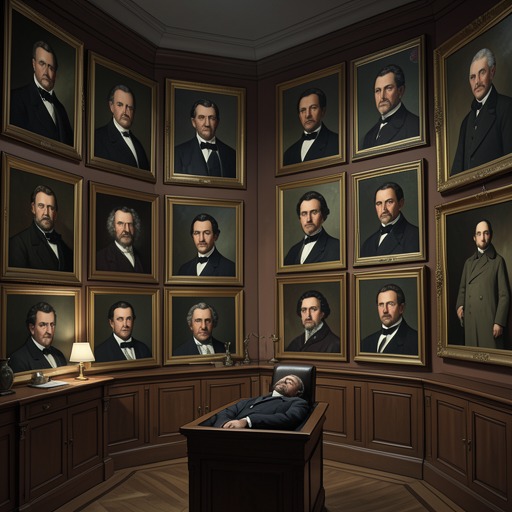
Blevigne’s image belongs to a larger system of elite self-representation. In the museum, more than 150 portraits gather men and women who belonged to Bouville’s elite between 1875 and 1910. Roquentin first encounters them as people who seem to possess a right to life, work, wealth, command, respect, and ultimately immortality. Their canvases present social advantages as rightful possessions, while the museum gives those claims a durable, public form.
The city’s class distinctions also appear in ordinary encounters. On Rue Tournebride, the Sunday ritual of greeting and raising hats separates people associated with the Boulevard Maritime from those of Coteau Vert. The narrator learns to read new coats, soft felt hats, and polished shirts as signs of one group, and worn clothing and a shabby appearance as signs of the other. These outward markers make social rank visible as if it were simply a matter of personal bearing. Blevigne’s portrait performs a related operation on a grander scale: it turns class authority into a composed appearance that can be admired and inherited.
Roquentin initially admires the museum’s reign of humanity, but his later scrutiny of Blevigne’s canvas exposes the work required to sustain that ideal. The portraits’ polished faces and controlled settings detach the elite from the natural world even as their subjects are credited with having transformed the land and sea around Bouville. The paintings make human command appear complete by excluding the dependence, vulnerability, and contingency that would complicate it. Blevigne’s carefully magnified public stature is therefore both an individual memorial and a miniature of the elite’s wider effort to make its power look permanent and deserved.