Archdeacon Brabazon
NemesisArchdeacon Brabazon is an elderly Anglican cleric and a long-standing friend of Elizabeth Temple. Though he appears only after Elizabeth Temple’s death, his testimony becomes decisive: he confirms that Verity Hunt and Michael Rafiel had been in love, had arranged to marry secretly, and had vanished before the wedding could take place. His memory turns an apparently isolated disappearance into a concealed history that Jane Marple can investigate.
Identity and Introduction
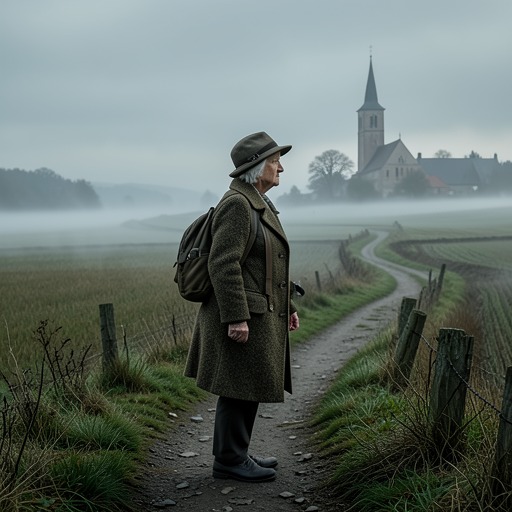
Archdeacon Brabazon is first seen by Jane Marple at the memorial service for Elizabeth Temple. He is described as an elderly, broad-shouldered man with a noble mane of white hair, wearing gaiters and moving with some difficulty because he is slightly crippled. Kneeling and standing are difficult for him, yet his presence at the service shows the depth of his connection with Elizabeth Temple and the seriousness with which he regards her death. He is not one of the tour’s ordinary passengers or a merely curious local spectator; he is an old friend who has come to honor her and who possesses knowledge she had been seeking shortly before she died.
He later has Jane Marple brought to him in the television lounge because he is anxious to speak with her before the tour moves on. Their meeting immediately changes his position in the narrative. He is not introduced as a suspect or an investigator, but as a witness carrying an unfinished conversation. His authority comes from personal memory and pastoral involvement rather than from official power, and the information he supplies is valuable precisely because it has remained private for so long.
Relationship with Elizabeth Temple
Archdeacon Brabazon describes Elizabeth Temple as a very old friend and recalls her as a remarkable teacher. He had conducted religious services during Lent, at Easter, and on other occasions at her school, Fallowfield. In his account, Elizabeth Temple understood each girl’s particular capabilities: she encouraged careers for pupils who would relish them, while not forcing girls toward academic or professional paths for which they were unsuited. His admiration is therefore both personal and intellectual. He sees her as a great woman, a fine educator, and a dear friend rather than simply as the head of a school.
Elizabeth Temple had intended to visit him at Fillminster, where he lived, while the tour was due to stop there. She wanted to discuss matters on which she believed he might help her. Jane Marple concludes that Elizabeth Temple was seeking information from him, not merely paying a social call. The link between them thus extends beyond friendship: Elizabeth Temple was following a trail of knowledge about Verity Hunt, and Archdeacon Brabazon unknowingly held one of the missing pieces.
Verity Hunt and the Failed Wedding
Archdeacon Brabazon had known Verity Hunt from her youth. He had prepared her for confirmation and had held services at Fallowfield, and he remembers her as beautiful in mind, heart, and appearance. Verity Hunt lost both parents before she was fully adult when they were killed in a charter plane traveling on holiday to Italy. After leaving school, she went to live with Clotilde Bradbury-Scott at The Old Manor House, where Clotilde, a close friend of Verity Hunt’s mother, cared for her, took her abroad, and arranged art lessons in Italy. Verity Hunt became deeply dependent on and attached to Clotilde Bradbury-Scott, who occupied a maternal place in her life.
When Verity Hunt was a fully grown young woman, she came to Archdeacon Brabazon with Michael Rafiel. He knew Michael Rafiel slightly, and the pair sought him out because they were in love and wanted to marry. Archdeacon Brabazon agreed to perform the ceremony. He understood that the marriage was being kept secret and suspected that Clotilde Bradbury-Scott had tried to discourage the relationship. In his candid assessment, Michael Rafiel was not an obviously suitable husband: he had been involved with juvenile courts, unsuitable companions, gangster activities, sabotage of buildings and telephone boxes, and relationships that had resulted in maintenance claims. Yet Archdeacon Brabazon also recognized Michael Rafiel’s considerable attractiveness and the effect he had on women.
The wedding was arranged for a definite day, hour, and place. Archdeacon Brabazon waited for both bride and bridegroom, but neither appeared. They sent no message, explanation, apology, or even a scrawled line. The absence was not simply a cancelled ceremony; it was a baffling rupture in the expected order of events. He could imagine reasons why they might not have come, but he could not understand why two people who had made arrangements would provide no word at all. For years he had not known what had happened.
Testimony and the Mystery’s Reconstruction
Jane Marple tells Archdeacon Brabazon that she is involved because of the dying wishes of Michael Rafiel’s father. This disclosure persuades him that he can speak freely. He explains that Jane Marple’s questions are effectively the questions Elizabeth Temple had been asking, though he himself does not know the answer. He had hoped Elizabeth Temple might have learned something before her death and might have brought him a message explaining why the wedding never occurred.
Jane Marple supplies the information Elizabeth Temple had given her: Elizabeth Temple knew a girl called Verity Hunt who was going to marry Michael Rafiel, and when Jane Marple asked why the marriage had not taken place, Elizabeth Temple answered that Verity Hunt had died. Archdeacon Brabazon can add only two corresponding facts of his own: he knew that Verity Hunt and Michael Rafiel had arranged to marry, and he knew that they had failed to appear without sending any word. Their accounts meet at the point where the mystery begins, but neither initially explains the disappearance.
Archdeacon Brabazon does not believe that Verity Hunt and Michael Rafiel simply parted or voluntarily broke off their relationship. His uncertainty is important because it resists the easiest explanation. The failed ceremony, the secret romance, Elizabeth Temple’s late inquiries, and the statement that Verity Hunt died all point toward an event that had been hidden rather than a love affair that had ended normally. His testimony therefore helps Jane Marple distinguish between a romantic disappointment and a crime concealed behind silence.
Narrative and Thematic Significance
Archdeacon Brabazon’s role is shaped by interrupted ritual. He was prepared to unite Verity Hunt and Michael Rafiel in marriage, but the bride and bridegroom never came; later, he attends the memorial service for Elizabeth Temple, another ceremony taking place after violence has already interrupted ordinary life. His religious office gives him a natural connection with confirmation, Easter and Lenten services, marriage, and memorial observance, while the mystery repeatedly shows how secrecy and death can empty such ceremonies of their expected function.
He also serves as a trustworthy bridge between past and present. Jane Marple’s investigation depends on scattered memories, altered identities, and information withheld by people who knew Verity Hunt at different stages of her life. Archdeacon Brabazon preserves an earlier Verity Hunt: the girl he taught, the young woman who loved Michael Rafiel, and the intended bride who never reached the appointed place. His account supplies emotional and chronological continuity where the surviving evidence has been broken apart.
As a character, Archdeacon Brabazon is less an active detective than a moral witness. He does not solve the case, but he refuses to convert uncertainty into a convenient story. His recollection of the empty appointment keeps the missing marriage, the missing explanation, and Verity Hunt’s fate visibly connected. Through him, Jane Marple learns that the past was not merely obscure; it had been deliberately interrupted, and the search for Justice must recover the truth that the failed ceremony concealed.