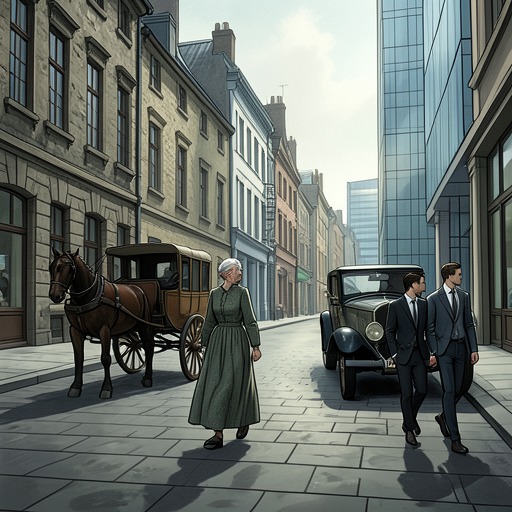
Joanna Crawford
NemesisJoanna Crawford is the attractive, competent niece of Mrs Riseley-Porter and one of the younger people on the organized coach tour investigated by Jane Marple. Initially observed chiefly through her relationship with her domineering aunt, she becomes important when her excursion away from the main path places her and Emlyn Price above the route taken by Elizabeth Temple. From that elevated position, Joanna sees a figure apparently setting a boulder in motion, making her testimony central to the question of whether Elizabeth Temple’s death was an accident or a deliberate attack.
Identity and Introduction
Joanna travels with Mrs Riseley-Porter, a socially forceful woman whose niece has evidently become practiced at managing her aunt’s bossiness. Although only about eighteen or nineteen, Joanna is described as competent as well as attractive. The description establishes a contrast between her youth and her practical self-command: she is not merely an appendage of Mrs Riseley-Porter, even though the older woman’s authority governs their public relationship.
As the passengers become acquainted, Joanna is paired socially with Emlyn Price. They discover that they share definite opinions about economics, art, politics, and general dislikes. Their intellectual and temperamental accord gives them a natural companionship within the party, and it later explains why they are together when the crucial hillside incident occurs. Their shared account also gives the investigation two witnesses rather than one, although Joanna remains the more fully examined observer.
The Hillside Observation
Joanna and Emlyn leave the main path and climb somewhat higher around the hill. They follow a rough track that curves around the slope, while Elizabeth Temple walks below on the main route. Joanna recalls seeing Elizabeth ahead of the rest of the party before the hill’s contour hid her from view. The altered position is decisive: Joanna is not looking at the accident from the same level as the other tourists but from among the higher boulders.
From there Joanna sees someone among a group of large stones. The figure appears to be pushing an outer boulder near the edge. The stone seems impossibly heavy, yet it is balanced like a rocking stone and can be moved. Joanna watches as it begins to roll, slowly at first and then with increasing speed down the hillside. Elizabeth Temple reaches the point beneath it just as the boulder descends, and the impact is therefore capable of being read as an intentional attack rather than a random fall.
Joanna cannot identify the figure’s sex with certainty. Her first impression is that it is a man, but she repeatedly qualifies that impression as an inference rather than a secure recognition. The person wears trousers and a man’s-style polo-neck jumper, has longish hair visible behind something like a beret, and is dressed in a vivid red-and-black check pattern. The clothing is more memorable than the face. Joanna does not claim to have recognized a person; she reports a conspicuous silhouette and garment, then tries to determine what those details mean.
Testimony and Uncertainty
After the boulder strikes Elizabeth Temple, Joanna looks toward the hillside but sees no one. She explains that the contours are numerous and that a person could disappear from view easily among them. She is certain that the figure is not one of the coach-party members, because she believes the distinctive red-and-black jumper would have made the person recognizable as a fellow passenger. This confidence about clothing contrasts with her uncertainty about identity, gender, and motive.
Joanna’s account becomes more definite concerning the nature of the act. She first says that she had the impression someone was on the hillside and that the boulder may have been deliberately rolled. As she thinks the matter over, she becomes increasingly convinced that the person was attempting to kill the woman below; Emlyn Price agrees with her interpretation. The distinction between what she saw and what she concludes from it is important. She directly observed the figure pushing the stone and the stone striking Elizabeth, but deliberate intention remains an interpretation formed from the sequence.
At the inquest, Joanna is called after the circumstances of the accident have already been established. She confirms that she and Emlyn had left the path and gone higher up the slope. She confirms seeing Elizabeth ahead, then describes the person among the boulders and the red-and-black checked polo-neck. When asked whether the person was a man or a woman, she again says that she supposed it was a man without actually having been certain at the time. Her evidence is substantially repeated by Emlyn Price, but it does not identify the attacker. The coroner consequently finds insufficient evidence to show how Elizabeth Temple came by her death and adjourns the inquest for a fortnight.
Narrative Function and Significance
Joanna occupies the difficult position of the useful but imperfect witness. Her age, competence, and presence beside Emlyn make her an apparently credible observer, while the changing force of her language exposes the limits of perception under sudden and horrifying conditions. She remembers the clothing, the movement of the boulder, and the location with considerable specificity, yet cannot supply the face or even the sex of the person involved. The evidence therefore advances the investigation without resolving it.
Her testimony also converts the hillside into a space of concealed agency. The boulders can appear part of the natural landscape, but Joanna’s observation gives them a human purpose: one has been selected, pushed, and made into a weapon. At the same time, the landscape defeats certainty, since its contours allow the figure to vanish almost immediately. Joanna’s role lies precisely in this tension between revelation and concealment. She shows that Elizabeth Temple’s death may have been engineered, but her inability to name the figure leaves the central mystery alive for Jane Marple’s further investigation.