Clotilde Bradbury-Scott
NemesisClotilde Bradbury-Scott is the central force behind the tragedy at The Old Manor House: a handsome, accomplished woman whose devotion to Verity Hunt becomes so possessive that she kills the young woman rather than allow her to leave. Her public identity is that of a cultivated guardian and grieving benefactor, but beneath it lies a sustained campaign of emotional control, deception, and finally murder. By arranging for Nora Broad’s body to be mistaken for Verity’s, she also turns her private loss into a deliberate attempt to destroy Michael Rafiel.
Identity and Background
Clotilde Bradbury-Scott lives at The Old Manor House with her sisters Anthea Bradbury-Scott and Lavinia Glynne. The property is a family inheritance: it belonged first to her great-uncle and then to her uncle, whose only son was killed in the war. The three sisters are consequently presented as the last members of the family apart from distant cousins. Clotilde is described as handsome, while Lavinia is plain but pleasant-looking and Anthea has a twitching eyelid, large grey eyes, and a persistent habit of looking behind her as if someone were watching her.
Miss Marple immediately reads Clotilde as a woman of formidable force. Her appearance suggests the tragic heroine Clytemnestra rather than Ophelia: not a passive or fragile figure, but someone whom Miss Marple can imagine wielding violence with exultation. The comparison is an early warning that Clotilde’s cultivated exterior contains an intensity capable of becoming destructive. Yet Miss Marple also recognizes that Clotilde’s tears when Verity’s death is mentioned are genuine. The danger lies not in an absence of feeling, but in feeling that refuses to accept separation.
Clotilde’s household is marked by strain. She says that Lavinia wants to leave England and return to Taormina, where she had once been happy with her husband, and admits that Lavinia is afraid of Anthea. She minimizes Anthea’s nervous temper, sudden dislikes, jealousy, and strange ideas, while also confessing that the sisters sometimes consider selling the house and leaving it altogether. The family therefore appears to be held together by silence, dependence, and fear rather than by domestic peace.
Verity Hunt and the Formation of Possessive Love
Verity Hunt had lived at The Old Manor House after the deaths of her parents in a plane accident. Clotilde describes Verity as a girl for whom the sisters cared deeply and says that she was especially fond of her. Verity was intelligent, a good artist, and progressing in art training and design; Clotilde was proud of her accomplishments and treated her as a daughter. The relationship gave Verity an intellectually stimulating and apparently happy home, but it also made Clotilde the emotional center of her life.
The relationship was reciprocal but unequal. Clotilde was exceptionally good to Verity, and Verity responded with a devotion resembling hero-worship. She admired Clotilde as handsome, accomplished, interesting, and powerful; Clotilde, in turn, came to love Verity as though she were her own child. Miss Marple interprets Verity’s later desire to leave not as evidence that the earlier affection was false, but as the emergence of an adult need that Clotilde could not accommodate. Verity wanted a life in which a man and a woman could marry, have children, and enter what Miss Marple calls the normal next stage of living.
Michael Rafiel’s arrival exposes the possessive structure of the bond. Clotilde had tried to keep him away from the house because of his history: he had been a delinquent, had been imprisoned twice, and had a bad record with women. She regarded Verity’s attachment as infatuation and insisted that Michael’s past proved him unworthy of her. Her judgment about him was not wholly mistaken—Miss Marple later agrees that he was not a suitable husband—but Clotilde converts concern into authority over Verity’s choices.
When Clotilde forbids Michael to visit, the relationship does not end; it moves into secrecy. Verity meets him away from the house, and he collects her by car from agreed places, sometimes bringing her home late at night or not until the following day. Clotilde knows that her prohibition has merely driven them beyond her supervision, yet she continues trying to stop them. Her control therefore produces the secrecy that later enables the catastrophe.
The Murders and the Substitution of Bodies
Miss Marple finally identifies Clotilde as the woman who killed Verity. The decisive motive is not simple hatred but an inability to bear the loss of the person she loved most. Verity had fallen in love with Michael and wanted to escape the bond of adoration that had defined her life with Clotilde. Clotilde experienced this change as the theft of everything that mattered to her and regarded Michael as a degraded delinquent who had no right to possess Verity’s affection.
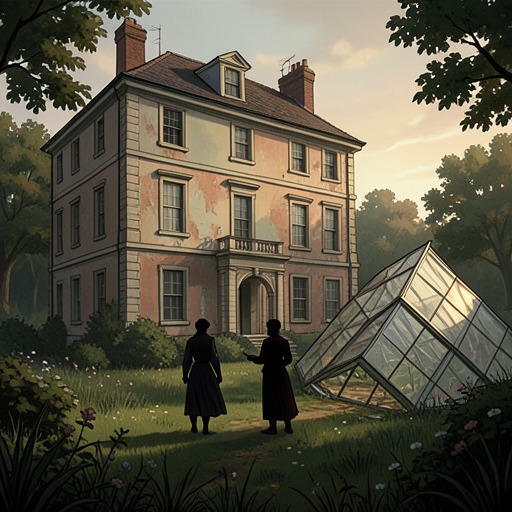
Clotilde did not strangle or beat Verity. Miss Marple reconstructs a quieter method: Clotilde gave her a drink of coffee or milk containing a painless overdose of sleeping medication. After Verity died, Clotilde carried her into the garden, pulled aside the fallen bricks of the greenhouse, and made a vault beneath the floor. The body was covered with bricks, earth, and turf, while Polygonum baldschuanicum was planted above it. The plant’s continuing growth concealed the grave and turned the garden into a living monument to Clotilde’s refusal to let Verity go.
The concealment alone did not satisfy Clotilde. She also needed Michael to lose the woman he loved and to be punished for having taken her away. Another girl, Nora Broad, disappeared at approximately the same time. Clotilde killed Nora by strangling her, disfigured her face, and hid her body under turned earth, leaves, and branches in a location some thirty or forty miles away. She dressed the body in Verity’s clothes and placed Verity’s handbag and personal objects with it, including a letter or two, a bangle, and a little cross on a chain.
The substitution depended on Clotilde’s authority as the person who knew Verity best. When the body was found, she identified it as Verity’s, despite knowing that the dead girl was Nora Broad. The disfigurement made independent recognition difficult, while the clothing and belongings supplied a manufactured identity. Clotilde then encouraged the belief that Nora had been seen with Michael in his car and may have spread a story that Verity had broken off an engagement because of his infidelity with Nora. The false identity and accompanying rumors created the circumstances in which Michael could be tried for Verity’s murder.
The Sisters and the House of Secrecy
Clotilde’s crimes are embedded in the structure of the three-sister household. Miss Marple senses an atmosphere of deep unhappiness at The Old Manor House and repeatedly associates it with the sisters as a group. Anthea’s fearful glances suggest that she knows something is wrong, while Lavinia’s wish to leave and her fear of Anthea show how knowledge and anxiety circulate through the family without becoming open speech.
Anthea was present when the murder and burial of Verity took place, although she may not have understood at first that Verity was dead. She noticed Clotilde creating a mound at the end of the garden and covering it with flowering shrubs as a place of beauty. The truth, Miss Marple believes, came to Anthea gradually. Clotilde’s control of the household thus extended beyond Verity: it also created an environment in which a sister could suspect the truth yet remain frightened, confused, or unable to challenge her.
Lavinia was abroad with her husband when Verity died, so she was not present at the first burial. Her later desire to leave the house becomes significant because the home preserves the history that Clotilde has concealed. The sisters’ relationships form a closed emotional system in which one woman controls the narrative, another fears what she may know, and another longs to escape. The garden, the ruined greenhouse, and the flowering cover above Verity’s remains make that system physically visible.
Exposure and Narrative Significance
Clotilde’s exposure comes through the contrast between the two murders. Miss Marple reasons that the woman who loved Verity could not have borne to strangle and disfigure her. The mutilated body must therefore belong to someone else, while Verity herself remains hidden at The Old Manor House. This distinction breaks through the official story: Nora Broad was made to stand in for Verity so that Michael Rafiel would be treated as a murderer, while the real Verity remained beside the woman who claimed to love her.
When Miss Marple confronts Clotilde, she names the crime directly and explains its emotional logic. Clotilde admits that she was devoted to Verity and that Verity loved her, but she cannot accept that Verity’s love for Michael was different rather than lesser. She describes the prospect of losing Verity to a man she considered miserable and depraved as agony and insists that she had to stop it. Her language reveals the transformation of care into coercion: Verity’s happiness becomes irrelevant once it threatens Clotilde’s possession.
Clotilde’s own defense depends on separating love from violence. She challenges the idea that she could strangle or crush the head of the girl she loved, associating such brutality with a vicious and depraved man. Miss Marple turns that objection into the key to the solution: Clotilde did not inflict those injuries on Verity because her love made such violence unbearable, but she still killed Verity through poisoning and then killed Nora to construct the story she needed. Love does not prevent the crime; it determines its method and expands its consequences.
Clotilde’s final significance lies in the way she converts a domestic attachment into a system of imprisonment. She attempts to stop Verity’s meetings, obstructs her movement toward marriage, controls the interpretation of her death, and preserves her body beneath the garden so that separation never has to be endured. Her tragedy is therefore not merely that she loved too much. It is that she treated love as a right of possession, and when Verity sought an adult life beyond that possession, Clotilde accepted evil, planned further violence, and made the entire household serve the lie.