Anthea Bradbury-Scott
NemesisAnthea Bradbury-Scott is the youngest of the three sisters connected with The Old Manor House, and the sister whose behavior most visibly registers the pressure of the household’s concealed history. Her twitching eyelid, wandering eyes, and repeated glances over her shoulder make her seem unstable or uncanny, yet those same details suggest that she is living under fear rather than exercising simple malice. Through Anthea, the house’s atmosphere becomes legible as a system of secrecy, guilt, and coercive family loyalty.
Identity and Place in the Family
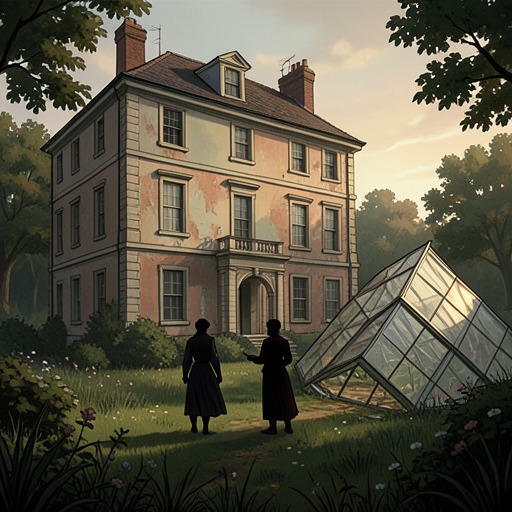
Anthea Bradbury-Scott lives at the family house with Clotilde Bradbury-Scott and Lavinia Glynne. The property passed through their great-uncle and uncle before coming to the three sisters, who regard themselves as nearly the last of the family after the uncle’s only son was killed in the war. Clotilde presents the house as a hereditary refuge, but its continuity also traps the sisters together: the building preserves not only family possessions and routines but the consequences of what happened there.
Physically, Anthea is described as thin, with grey hair that had once been fair, hanging untidily over her shoulders. Her large grey eyes move to the right, then to the left, and suddenly behind her, as though she believes that someone is continually watching her. Jane Marple compares her appearance to a mature Ophelia, a figure associated with vulnerability, disorientation, and a mind overwhelmed by forces it cannot master. The comparison distinguishes Anthea sharply from Clotilde, whose commanding presence suggests deliberate strength and theatrical control.
Behavior and the Garden
Anthea’s connection with the garden is one of the first concrete signs that she occupies a dangerous and compromised space within the household. She is the sister who takes a cardboard box to the post office, and later comes to fetch Jane Marple. She also appears in connection with the collapsed greenhouse, once associated with a prized grapevine of three vines: a Black Hamburg, a small sweet white grape, and a muscat. These domestic and horticultural details give the garden an apparently innocent surface, but the garden is also where the family’s concealed history has been physically preserved.
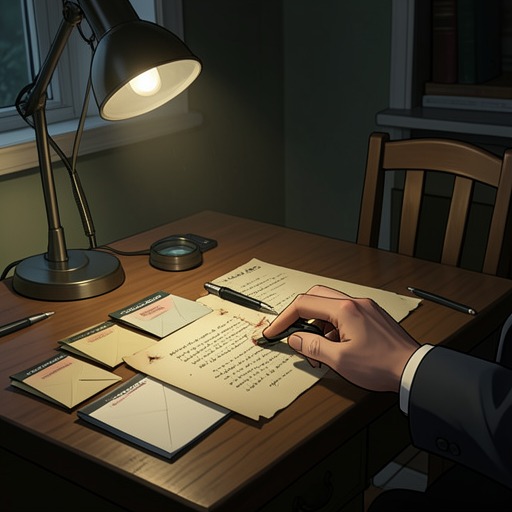
Jane Marple notices that Anthea brought the box to the post office on the relevant Tuesday, while Clotilde or Lavinia had suggested that one of them would post it. The detail becomes significant because the parcel contained a brand-new red-and-black check polo-neck jumper, clothing sufficiently vivid to identify the figure seen by witnesses and sufficiently conspicuous to require disposal. Anthea’s practical role in carrying the parcel therefore places her close to the concealment of evidence, even though it does not by itself establish that she understood the whole crime or chose its purpose.
Fear, Knowledge, and Family Pressure
Jane Marple reads Anthea as frightened. Her eyes seem to perceive things other people cannot see, and Marple wonders whether she may have spent time in an institution or may fear being returned to one. She also considers whether Clotilde and Lavinia are uncertain what Anthea might say or do, and whether their concern about keeping her at liberty forms part of the household’s internal pressure. Anthea’s apparent eccentricity thus has a double function: it makes her easy to dismiss, while also suggesting that she has been exposed to something she cannot safely articulate.
Clotilde confirms that Lavinia is afraid of Anthea. She describes Anthea as silly at times, given to queer ideas and sudden dislikes, nervous fits of temper, and intense jealousy when attention is directed toward other people. Clotilde insists that there has never been any dangerous incident, yet her evasive account reveals how carefully the family manages Anthea’s reputation. The sisters’ responses create a pattern in which Anthea is treated as the unstable member whose behavior must be contained, while the deeper source of fear remains unspoken.
Jane Marple’s first impression of the house is not merely that it is sinister but that it is saturated with deep unhappiness. Anthea, looking fearfully over her shoulder, seems to embody that atmosphere. The recurring image of an unseen presence behind her turns private anxiety into a spatial metaphor: the past is not finished but stands behind the family, demanding recognition. Anthea’s fear is therefore both psychological and evidentiary. It indicates that she knows, or has gradually come to know, more than the household can safely admit.
Connection with Verity Hunt’s Death
Anthea is implicated in the aftermath of Verity Hunt’s death because she was present in the house when Clotilde began raising a mound at the end of the garden. The mound was presented as a future place of beauty, covered with flowering shrubs, but Jane Marple concludes that Anthea gradually understood that it concealed something far darker. Anthea may not have recognized the fact of death immediately; her knowledge developed slowly as the visible work in the garden acquired its true meaning.
According to Marple’s reconstruction, Clotilde killed Verity Hunt after the young woman attempted to escape the possessive bond between them and pursue a conventional life with Michael Rafiel. Clotilde then buried Verity in the garden, covering the site with bricks, earth, and turf. Anthea’s position was not that of the principal murderer, but neither was it that of an entirely innocent outsider. She knew something of what had happened, and her fear reflects the burden of living beside a secret that the family could neither confess nor erase.
Clotilde’s later account of Verity is marked by complete devotion: she loved Verity, believed Verity loved her, and experienced the young woman’s desire for another life as a devastating abandonment. Anthea’s relation to this emotional catastrophe is indirect but important. She belongs to the family system that absorbs Clotilde’s obsession, Lavinia’s fear, and Anthea’s frightened awareness. The sisters’ silence helps the hidden crime remain attached to the house for years.
Narrative Function and Ending
Anthea serves as an ambiguous figure in Jane Marple’s investigation. The number of passengers on the coach tour, the disguised identities among them, and the possibility that one person may be connected with a murder or a legal case lead Marple to observe everyone as a potential source of information. Anthea is especially valuable because her behavior does not fit a simple category. She may appear mentally troubled, but her unusual glances can also be the involuntary expression of knowledge; she may have handled evidence, but fear rather than predatory intent seems to govern her.
Her significance lies in this unresolved boundary between culpability and victimhood. Anthea’s presence exposes how a concealed crime can deform an entire family, not only the person who commits it. She is made to seem ridiculous, unreliable, and potentially dangerous, while the more powerful will of Clotilde remains concealed behind authority, grief, and apparent devotion. In the end, Anthea is best understood as a frightened witness formed by the secret she helped preserve: her behavior does not solve the mystery, but it gives the house its most persistent human sign of buried guilt.