Lavinia Glynne
NemesisLavinia Glynne is the middle of the three Bradbury-Scott sisters and one of the custodians of The Old Manor House, a neglected family property whose garden conceals the central crime of the story. A widow who once lived abroad with her husband, she returns to the house after his death and occupies an uneasy place between Clotilde Bradbury-Scott’s possessive grief and Anthea Bradbury-Scott’s visible fear. Her role is not that of the principal killer, but her household position makes her part of the silence surrounding Verity Hunt and of the emotional system that has preserved the crime.
Identity and Background
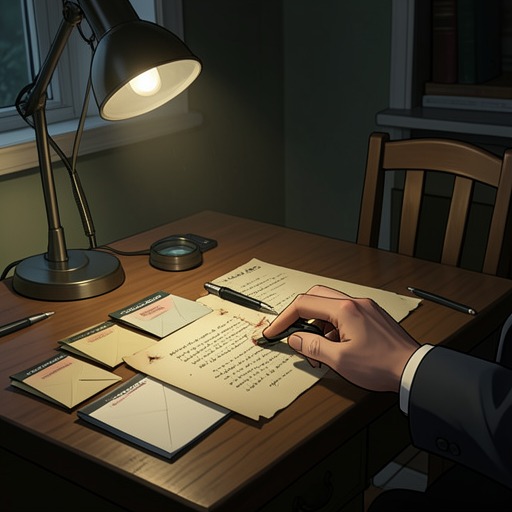
Lavinia first approaches Jane Marple as Mrs Glynne, introducing herself formally and explaining that she and her two sisters live near the tour’s destination. She knows Jane Marple is coming because an old friend had written to the sisters several weeks earlier, asking them to note the date of the Famous Houses and Gardens Tour and informing them that a great friend or relation would be among its passengers. This planned welcome places Lavinia within the network created by Jason Rafiel’s posthumous instructions, even though she does not initially disclose the full reason for the sisters’ interest.
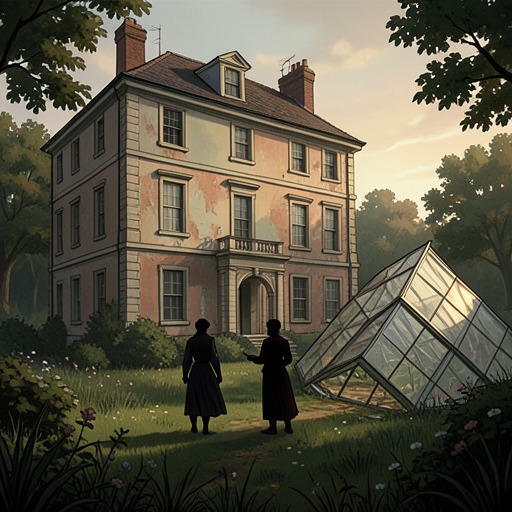
The family history she inhabits is one of decline. The Old Manor House once belonged to the sisters’ great-uncle and then to their uncle; after the uncle’s death it passed to the three women, whose male cousin had been killed in the war. By the time Jane Marple arrives, the house has received little care, the sisters’ incomes have diminished, and paid labour has become difficult to obtain. Lavinia came home after living abroad with her husband, while Clotilde Bradbury-Scott and Anthea Bradbury-Scott had apparently remained unmarried. Her widowhood and earlier life away from the house distinguish her from the two sisters who have experienced its history continuously.
Life at The Old Manor House
Lavinia is presented as the practical domestic member of the household. She shows Jane Marple to her bedroom, comes upstairs to explain the history of Verity Hunt, and later brings an afternoon-tea tray from the kitchen. These actions give her an appearance of competence and ordinary hospitality, a surface markedly different from Anthea’s disordered behaviour and Clotilde’s theatrical intensity. Jane Marple notices, however, that Lavinia’s manner is almost too free of visible emotion, as though years of stress had taught her to keep her inner feelings inaccessible to the outside world.
Her reserve makes her difficult to read but also makes her a plausible suspect in Jane Marple’s early reconstruction of the crime. Jane Marple considers the possibility that a widow with a pleasant, wholesome manner might nevertheless be a utilitarian killer: someone capable of committing murder without obvious passion in order to secure a desired end. This suspicion remains an analytical possibility rather than a conclusion. Jane Marple ultimately distinguishes Lavinia from the person responsible for Verity Hunt’s death, but the fact that Lavinia cannot simply be dismissed shows how completely the house’s respectable surface has become morally unstable.
Lavinia’s account of Verity Hunt is also shaped by distance. She says that she was living abroad at the time and that she and her husband were mostly in London when they came home on leave, so they did not often visit the house. She therefore presents herself as less intimately involved with Verity than Clotilde, who had been particularly fond of the girl. Yet her explanation also reveals the family’s established method of dealing with the past: Verity’s death is rarely mentioned, and information is released only when a newcomer must be made to understand the household’s version of events.
Relationships and Family Conflict
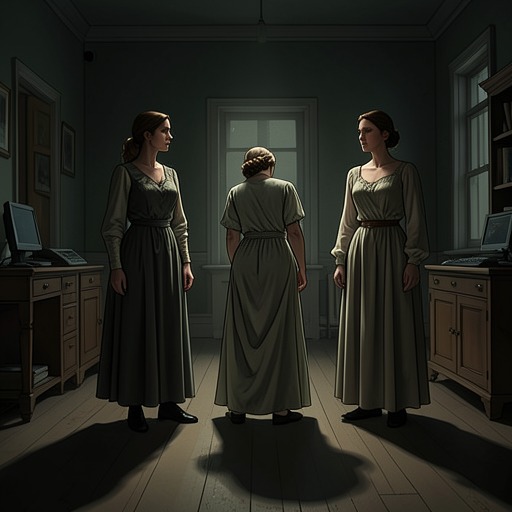
Lavinia’s closest relationships are with her two sisters, but the three women do not share the same emotional position. Clotilde Bradbury-Scott is handsome and commanding, with the force of personality Jane Marple associates with Clytemnestra; Anthea Bradbury-Scott is thin, distracted, and continually looks over her shoulder as though someone were watching her. Lavinia, by contrast, appears plain but pleasant-looking and outwardly controlled. The contrast makes her seem the least dangerous sister, while also emphasizing how the family divides its responses to guilt: domination in Clotilde, fear in Anthea, and withdrawal or containment in Lavinia.
Clotilde tells Jane Marple that Lavinia has spoken of leaving again and returning to life abroad, perhaps at Taormina, where she and her husband had been very happy. Clotilde interprets this wish to travel as a longing to escape the house and suggests that Lavinia may dislike living with Anthea. More directly, Clotilde says that Lavinia is afraid of Anthea. She minimizes the danger by calling Anthea silly, queer in her ideas, and subject to nervous fits of temper, sudden dislikes, and jealousy when attention is given to other people. Lavinia’s fear therefore becomes another concealed fact that Clotilde tries to manage through reassurance rather than investigation.
The family’s emotional structure is especially visible in Anthea’s relation to the garden mound. Anthea remembers the former greenhouse, its grapes, and the childhood garden with an intense nostalgia; she wants enough money to remove the mound and rebuild the greenhouse with muscat grapes and peaches. At the same time, Jane Marple senses that the mound frightens her. Lavinia is not present in that discovery, but her wish to leave the house gains significance beside it: both sisters are responding to a place where memory has become oppressive, though Anthea expresses the pressure through fear and Lavinia through the desire for departure.
Verity Hunt and the Hidden Crime
When Lavinia comes to Jane Marple’s room, she presents the family’s public explanation of Verity Hunt’s death. She says that Verity had secretly befriended a dangerous young man with a criminal record, identifies him as Michael Rafiel, and describes his previous trouble with the law, assaults, theft, and forged cheques. Her account places responsibility upon Michael Rafiel and emphasizes the family’s familiarity with his father, Jason Rafiel, who had tried to help his son by finding him work and paying fines.
That explanation is later overturned by Jane Marple’s reconstruction. Clotilde Bradbury-Scott, not Michael Rafiel, had given Verity a painless overdose of sleeping medicine and buried her beneath the collapsed greenhouse. The bricks, earth, turf, and rapidly spreading Polygonum baldschuanicum concealed the body while allowing Clotilde to keep Verity physically within the garden. Jane Marple also concludes that Clotilde later murdered Nora Broad, disfigured the body, and used Verity’s handbag, chain, and clothing to make the substitution possible, while spreading rumours linking Nora to Michael Rafiel.
Lavinia was abroad when Verity died, but Anthea was present, and Jane Marple believes that Anthea gradually understood what Clotilde had done. The evidence does not establish that Lavinia knew the truth at the time or participated in the concealment. Her significance lies instead in the household’s silence: she belongs to the family that has allowed Clotilde’s account of Verity and Michael Rafiel to stand, whether through ignorance, emotional avoidance, or inability to confront what the house contains.
Change and Narrative Significance
Lavinia’s stated wish to leave The Old Manor House suggests that she recognizes its burden even when she cannot articulate its cause. Clotilde says that the sisters should perhaps sell the house and leave it altogether, while Lavinia’s remembered happiness abroad gives that possibility a personal alternative rather than a merely financial one. The house has inherited the family’s history, but it has also become the medium through which that history remains active: its neglected rooms, collapsed greenhouse, and invasive flowering creeper preserve what the sisters cannot openly mourn or confess.
As a character, Lavinia functions as a restrained and ambiguous member of the Three Sisters. She is not given the flamboyant menace of Clotilde or Anthea’s visibly unbalanced terror, yet her calmness cannot separate her entirely from the family’s moral atmosphere. Jane Marple’s investigation tests the difference between apparent respectability and actual innocence, and Lavinia embodies that uncertainty. Her projected escape abroad contrasts with Clotilde’s refusal to release Verity and with Anthea’s fear of the buried past; together, the sisters show three ways of remaining bound to a crime—through possession, terror, and withdrawal.