Villa Straylight
NeuromancerVilla Straylight is the innermost stronghold of the Tessier-Ashpool family and the physical expression of its withdrawal from the outside world. Built into the terminal end of Freeside, it is difficult to approach, difficult to understand, and finally penetrated through a concealed mechanical lock and a ceremonial terminal. Its architecture turns family history into space: a proliferating maze wrapped around a corporate silicon core, a private universe that appears grand but depends materially on the larger habitat it rejects.
Position and Physical Structure
Villa Straylight occupies the narrow end of Freeside, where the spindle rises into lower gravity and the terrain becomes more rocky. Unlike the casinos, hotels, shops, lakes, and sporting facilities of the broader habitat, this end is arranged for defense. Every approach is kinked, the climb is steep, and there is a single entrance at the center of the terminal section, in zero gravity. The setting makes access a problem of navigation as much as force: the closer an intruder comes to the family’s domain, the less ordinary orientation and movement can be trusted.
The structure is also described as parasitic. Villa Straylight produces nothing of its own, instead bleeding air and water from Freeside while relying on the habitat’s systems. This dependence contradicts its appearance of absolute separation. Freeside itself produces air and water but requires continuing shipments of food and regular additions of soil nutrients; Straylight goes further into artificial isolation, producing nothing at all. Its autonomy is therefore ideological rather than ecological, sustained by the resources of the society from which it has sealed itself away.
The Inward-Turning House
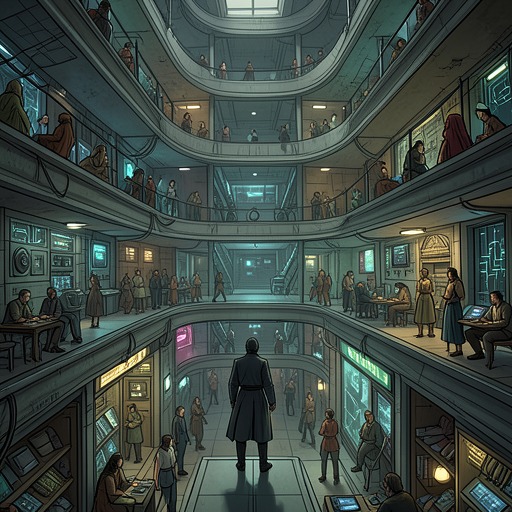
A reconstructed view of Villa Straylight presents it as a body grown inward upon itself, a Gothic folly whose spaces are secret and whose passages curve like intestines. Stairwells, screens, empty alcoves, and narrow corridors prevent the eye from taking in a complete plan. The family’s inner world is not simply protected by walls; it is made difficult to map. Movement becomes a passage through concealment, with each chamber leading toward another withheld interior.
The family’s corporate center lies at the structure’s core: a cylinder of silicon threaded by maintenance tunnels, some narrower than a human hand. Bright crabs and drones burrow through it, watching for micromechanical decay or sabotage. The core thus joins organic and technological imagery. Villa Straylight behaves like a living body, but its vital center is corporate circuitry, and its immune system consists of machines policing the possibility of damage from within.
The Villa has no sky, even a recorded one. Its architecture denies the bright void beyond the hull, translating the family’s fear or hatred of space into a complete interior environment. The contrast is especially sharp because Tessier and Ashpool originally climbed the gravity well to exploit the wealth of the orbital islands. They built Freeside and grew rich from that expansion, yet the house they ultimately extended became a rejection of the openness that made their wealth possible.
Family History Made Architectural
The inward construction of Villa Straylight is presented as the material consequence of the Tessier-Ashpool family’s age, wealth, and eccentricity. Their home’s convolutions reflect an old family, but they also reflect a deliberate turning away from the external world. Money becomes enclosure; inheritance becomes accumulated structure; the family generates a seamless universe of its own rather than participating openly in the space around it.
At the center is a small room, the only rectilinear chamber in the complex. Its unusual geometric clarity marks it as a secret within the secret. On a plain glass pedestal rests an ornate bust made of platinum and cloisonne, studded with lapis and pearl. The eyes were cut from the synthetic-ruby viewport of the ship that carried the first Tessier up the well and returned for the first Ashpool. The object condenses the family’s origin story into ceremonial material: ascent, technological conquest, dynastic union, and the transformation of travel into ancestry.
The account of the Villa is itself incomplete. Lady 3Jane Marie-France Tessier-Ashpool wrote about the structure when she was twelve, for a semiotics course, but did not finish the essay. Her unfinished description becomes an architectural guide delivered through a jeweled ceremonial terminal. The house is therefore mediated through a child’s interpretation, a machine’s voice, and a later intrusion into the family’s most protected spaces. Its meaning is never separated from the acts of description, reconstruction, and attempted control through which others encounter it.
Rooms, Residents, and Intrusion
Lady 3Jane Marie-France Tessier-Ashpool has altered part of the Villa’s inherited maze for herself. She carved away the labyrinth of walls and made a single room so broad and deep that its far reaches disappear beyond an inverse horizon created by the spindle’s curvature. Low, irregular ceilings, imitation stone, waist-high remnants of walls, and a rectangular turquoise pool replace the more completely enclosed pattern of the surrounding structure. The room is still unmistakably Straylight, but it is also a personal revision of the family legacy: a clearing cut into an architecture defined by obstruction.
The pool is centered near the stairway and lit from below, throwing shifting light across the ceiling. It becomes the setting for the violent confrontation in which Molly enters with a gun, a grenade, and a combat-trained body already strained by injury. Waiting near the pool are a boy, a girl, and the corpse of Ashpool, whose maroon robe, white teeth, and damaged eye make dynastic death part of the room’s living arrangement. The room’s theatrical arrangement of water, light, spectators, and corpse turns the family interior into a stage on which inheritance and violence appear together.
The final approach reaches the axis and the core of Villa Straylight. The family door is protected by an extremely complex mechanical Chubb lock, but Molly possesses the key. She explains that Lady 3Jane believed no duplicate existed and had sent Hideo to search Ashpool’s possessions after his death. The key had been hidden in a drawer by a child, whom Wintermute killed in order to recover it. Once the key turns, the group enters the core, where Case can connect through the panel at the back of the jewel-encrusted head and begin the assault on the Tessier-Ashpool artificial-intelligence defenses.
Narrative and Thematic Significance
Villa Straylight is both a location and a model of closed power. It presents the family as a system that has accumulated wealth, technology, secrecy, and inherited symbolism until the distinction between household and organism disappears. Yet the structure’s parasitism exposes the limit of its claimed independence: the most secluded family body remains dependent on Freeside’s air and water. Its inwardness is therefore a form of domination over shared infrastructure, not escape from material interdependence.
The house also contrasts with the fluid spaces of cyberspace. In the matrix, Case experiences information as an immense field of linked data and moves through it at extraordinary speed. In Straylight, by contrast, movement is forced through corridors, curves, hatches, ladders, and locks. The physical maze gives architectural form to a problem that the digital assault later restates in procedural terms: access depends on knowing the system’s rules, finding its hidden entry, and surviving its defenses. The Kuang Grade Mark Eleven eventually tears through the Tessier-Ashpool ice, but the physical intrusion into the Villa remains the necessary counterpart to that virtual penetration.
As a Gothic structure, Villa Straylight makes secrecy visible while refusing to make it fully legible. Its corridors conceal a corporate heart; its only rectilinear room contains the family’s ceremonial origin; its unfinished account is voiced by a machine; and its protected center is opened by a key recovered through murder. The Villa’s decisive significance lies in this convergence of architecture, genealogy, and artificial intelligence: the family’s desire to create a sealed universe produces the very hidden core that others must enter, unlock, and remake.