Memory Lane
NeuromancerMemory Lane is a software-rental district in the Sprawl, defined by its dubious storefronts, young clientele, and the intimate traffic between bodies and data. Its decisive narrative importance lies in making memory and perception into things that can be rented, transmitted, or occupied: Molly passes through it as a professional operator, while Case experiences her movement as a one-way passenger inside her sensorium.
Setting and Commercial Function
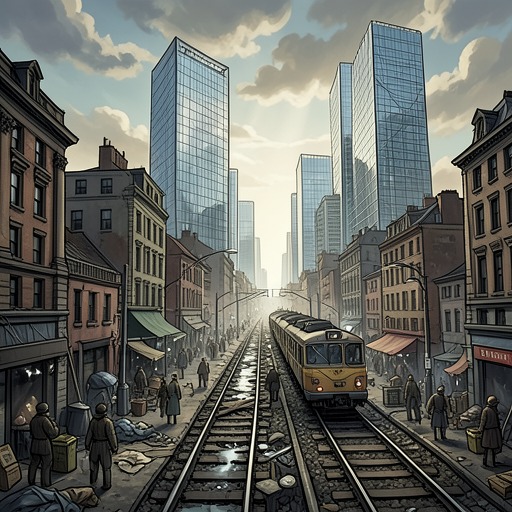
Memory Lane is lined with software-rental complexes whose booths open onto a central hall. The clientele are mostly teenagers, many of them fitted with carbon sockets behind the left ear. Hundreds of microsoft chips are displayed under transparent bubbles on squares of white cardboard, turning information into small, brightly packaged commodities. The district is therefore neither a purely physical shopping street nor a cyberspace construct; it is an interface where bodily modification, youth culture, and the exchange of executable knowledge meet.
The district belongs to the Sprawl's rapidly changing cultural economy. Case learns that entire subcultures can appear, flourish for a few weeks, and disappear at the speed of light. Memory Lane embodies that volatility: its shops sell not only software but access to temporary identities, technical capacities, and social networks. The atmosphere of consumption is inseparable from the hardware implanted in its customers, so the market's products are already lodged in the body before they are used.
Molly's Visit and Case's Simstim Perspective
Molly leads Case through Memory Lane while he is connected to her by the new switch patched into his Sendai. The connection does not place him in cyberspace; it throws him into her flesh, giving him her sights, sounds, smells, and movements while leaving him unable to answer. For several frightened seconds he struggles to control her body before accepting the position of a passenger behind her eyes. The experience exposes a form of access more intimate and more restrictive than ordinary netrunning: Case can inhabit sensation, but he cannot direct the person who supplies it.
Molly moves through the crowded street with a style Case finds disorienting. People seem continually about to collide with her, yet they melt out of her way, and she moves through the crowd with practiced assurance. Case feels her hand slide into her jacket and registers the deliberately provocative gesture she makes while knowing that the link is one-way. The sequence turns professional observation into bodily trespass: he knows little about Molly beyond her work, her black coffee, and their sexual encounter, yet Simstim gives him an involuntary knowledge of her physical presence that ordinary intimacy does not provide.
Two blocks later, Molly threads the outskirts of Memory Lane. Case tries to pull her eyes toward landmarks he would have used himself, but the attempt only sharpens his irritation at his passivity. He can leave her sensorium instantly by striking the switch and return to cyberspace, then re-enter the flow of her muscles and senses just as quickly. The district thus becomes a testing ground for competing modes of agency: the matrix offers Case an environment he can navigate as a console cowboy, while Molly's body remains an environment he can only undergo.
The Moderns Encounter
Molly's destination is the seventh booth along the south wall of one of the software complexes. Behind the counter, Larry is a young man with a shaven head and a dozen microsoft spikes protruding from his socket. He removes a bright magenta splinter, selects a longer glossy black chip, and inserts it into his head before recognizing that Molly has a rider using her eyes. The encounter makes the body's status as a network node explicit: the black chip detects Case's presence even though he is not physically in the room.
Molly tells Larry that she is looking for the Moderns and has work for some of his friends. When he objects to the rider, she identifies Case as her partner but ultimately orders Case to leave the connection. He returns at once to the matrix, where ghostly impressions of the software complex remain for a few seconds in the buzzing calm of cyberspace. The transition leaves Memory Lane suspended between locations, showing how quickly a physical site can become a residual image inside a digital environment.
The information obtained there points Case toward the Panther Moderns, a subculture unfamiliar to him because he has been absent from the Sprawl's changing scene. His request for a precis from the Hosaka turns the district's social encounter into an intelligence-gathering operation. Memory Lane is consequently both marketplace and threshold: a place where Molly's contacts convert subcultural knowledge into the next stage of the job.
Spatial and Thematic Significance
Memory Lane's name acquires an ironic force from the way the scene handles memory. The district is not a quiet repository of the past but a place where memory-like experiences are packaged as software, transmitted through sockets, and shared without reciprocal consent. Case's passage through Molly's sensorium makes recollection inseparable from mediation; what he knows of her is filtered through an interface that supplies sensation while withholding her interior response.
The district also clarifies the novel's game-like logic of movement and access. Its rules are concrete: chips are selected and inserted, sockets identify unauthorized riders, and a switch determines whether Case is in Molly's sensorium or in cyberspace. Each mode supplies different feedback and different failure conditions. Case's expertise gives him freedom in the matrix, but the same technical apparatus reduces him to helpless spectatorship inside Molly. Memory Lane therefore dramatizes how technology can enlarge perception while narrowing agency, making the body itself another contested system of access.