Night City
NeuromancerNight City is the unofficial borderland between Chiba City's port and its corporate city, with Ninsei at its heart. It is the novel's first decisive social landscape: an outlaw playground where technology escapes supervision, identities are marked by language and bodily modification, and survival depends on moving through an intricate economy of information, drugs, sex, and violence. For Henry Dorsett Case, Night City is at once clinic, prison, marketplace, and stage—the place where his damaged body becomes an obstacle, his former expertise becomes a commodity, and his desire to return to cyberspace becomes inseparable from his drift toward death.
Setting and Social Geography
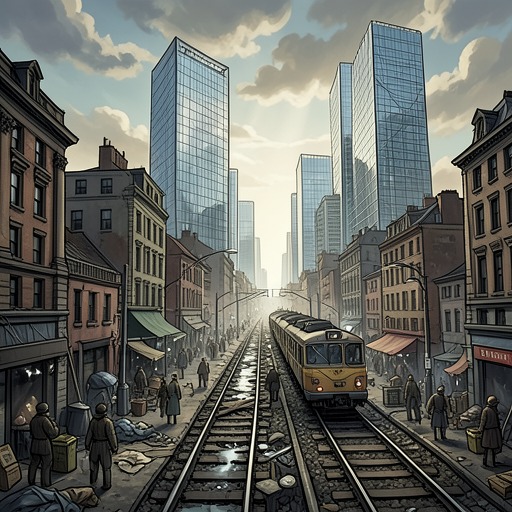
Night City lies behind the port, beyond the all-night quartz-halogen floods that illuminate the docks like vast theatrical stages. The glare is so intense that Tokyo's lights disappear, while Tokyo Bay remains a black expanse crossed by gulls and floating white styrofoam. Behind the port, factory domes and corporate arcologies dominate the city; between these industrial and corporate zones runs a narrow area without an official name. Night City occupies that borderland, and Ninsei functions as its living center.
By day, the bars along Ninsei are shuttered and featureless, their neon signs dead and their holograms inert beneath a poisoned silver sky. At night, the district reverses itself. Yakitori stands, massage parlors, arcade machines, coffee franchises, teahouses, and bars become nodes in a dense circulation of money and desire. The Chatsubo serves professional expatriates, while the Jarre de Thé offers mirrors framed in red neon and a setting for Case's drug use and isolation. The district's crowds include sailors from the port, tourists seeking pleasures absent from guidebooks, Sprawl criminals displaying grafts and implants, and many kinds of hustler.
Night City is therefore not simply a Japanese neighborhood inhabited by outsiders. Its crowd is described as a gaijin enclave, a place where English, Japanese, criminal slang, technical vocabulary, and other forms of speech overlap without producing a stable common identity. At the Chatsubo, one can drink for a week without hearing two words in Japanese, even while the surrounding city remains Chiba. Language becomes a portable badge of origin and affiliation, revealing how the district's social order is assembled from expatriate networks rather than civic belonging.
Technology and the Outlaw Economy
The district's apparent disorder has competing explanations. One view holds that the Yakuza preserve Ninsei as a kind of historical park, a reminder of humble origins. Another, more significant to Case, is that technological development requires outlaw zones: Night City exists not for its inhabitants but as a deliberately unsupervised playground for technology itself. This interpretation makes the district a social experiment in which new devices, illicit biologicals, implants, and data systems can circulate before official institutions absorb or regulate them.
The neighborhood's businesses reflect that function. The Mitsubishi-Genentech employee whose hand bears a corporate logo may carry implanted processors monitoring mutagen levels, yet such advanced equipment could make him a target for robbery and removal to a black clinic. Corporate technology and criminal technology are not opposites in Night City; they are adjacent forms of value, separated less by design than by ownership and legality. The same technical sophistication that protects an employee can make him profitable prey.
Case's own position in this economy is that of a middleman. He once moved contraband and negotiated access among suppliers, buyers, and fronts, but his usefulness depends on making himself a necessary evil. In Night City's criminal ecology, neither buyer nor seller truly needs the intermediary. His niche has been carved out through lies, betrayal, and delayed transactions, and he senses that its walls are beginning to collapse. The district thus turns social relations into exchangeable functions: trust becomes leverage, expertise becomes access, and a person's body may become a stock of organs or spare parts.
Case's Decline in Night City
Henry Dorsett Case reaches Night City after employers punish his theft by damaging his nervous system with a wartime Russian mycotoxin. The injury is minute, subtle, and completely effective: it leaves him unable to perform the work that once defined him. Because he has lived for the bodiless exhilaration of cyberspace, he experiences the injury as a fall into the prison of his own flesh. Chiba, famous for implants, nerve-splicing, and microbionics, appears to offer a cure, but his money disappears during two months of examinations and consultations. The black clinics admire the expertise with which he was maimed, then refuse him.
His failed search for repair establishes Night City's central contradiction. It is a magnet for the very technologies that might restore him, but access to those technologies is governed by money, criminal connections, and institutional secrecy. Case sleeps in the cheapest portside hotels beneath the lights of the docks, surrounded by the visible promise of a technological future that cannot be purchased by someone whose resources have already been exhausted.
In response, he enters what the narrative calls terminal overdrive. At the Jarre de Thé, after taking a potent Brazilian dex tablet, he remembers hustling with cold intensity, killing two men and a woman over sums that would previously have seemed ridiculous. Ninsei wears him down until the street itself appears to externalize a death wish. Its social Darwinism is accelerated: stop hustling and disappear, move too quickly and rupture the fragile surface of the black market. Either way, a person may leave only a vague memory in the mind of someone such as Ratz, while the person's heart, lungs, or kidneys continue in another body purchased with New Yen.
Case eventually stops carrying a weapon and abandons basic precautions. He runs fast, loose deals and cultivates a reputation for obtaining whatever clients want, even as customers become fewer. His self-destruction is not merely private despair; it is a form of participation in Night City's market logic. He knows that death is approaching and takes a grim satisfaction in that knowledge, yet the thought of Linda Lee remains the part of his life that his deathward impulse cannot fully absorb.
Violence, Memory, and Pursuit
Night City binds Case's present decline to his memories of Linda Lee. He first meets her in an arcade amid holograms of games and shifting laser light, and he remembers her face as a sequence of coded colors: red under a burning Wizard's Castle, blue when Munich falls in Tank War Europa, gold when a cursor crosses a skyscraper canyon. Their first night stretches into morning, travel across the Bay, rain along Harajuku, and the intimacy of her holding his hand in a pachinko parlor.
That relationship deteriorates under drugs and tension. Case watches Linda's personality fragment, then watches addiction reduce her to raw need and an obsessive search for the next hit. In a teahouse encounter, Linda warns him that Wage wants him dead and may use him as an example because of his debts and delayed dealings. Case gives her a crumpled fifty New Yen note, falsely claiming that more money is coming, and tells her to give it to Wage. Her warning, her sweat, and the white showing beneath her pupils make the exchange both practical and intimate: Night City's economy has entered the space between them, turning affection into emergency cash and a farewell shadowed by danger.
The district also converts pursuit into a game. When Case realizes that he is being followed, he feels an unexpected exhilaration as octagons and adrenaline mingle with the sensation of a run in the matrix. He begins to perceive Ninsei as a field of data, with information interacting through the mazes of black-market business. He deliberately draws his pursuers toward the arcade where he met Linda, bolts through the crowd, and breaks into offices above it. The escape is not a clean return to agency; it is a dangerous imitation of the cyberspace runs he has lost, with the street temporarily supplying the speed, abstraction, and separation from the body that the matrix once provided.
From Night City to Cyberspace
Night City's most important contrast is with cyberspace. A recorded explanation describes cyberspace as a consensual hallucination experienced daily by billions, a graphic representation of data abstracted from the world's computer systems, where lines of light form clusters and constellations. For Case, this abstraction is not entertainment but the condition in which his identity once felt complete. Returning to it after his recruitment becomes a moment of release: a gray disk rotates into a sphere, then unfolds into an infinite three-dimensional chessboard, the Eastern Seaboard Fission Authority and corporate systems rising as luminous structures beyond his reach.
The return does not erase Night City so much as reveal its underlying pattern. The district's crowds, transactions, and threats had already appeared to Case as data made flesh. Its social life is governed by rules resembling a game: speed and precision produce temporary survival, while hesitation, carelessness, or failure to read the protocol lead to disappearance. In this sense, Night City is the bodily and commercial counterpart of cyberspace. The matrix turns information into navigable architecture; Night City turns bodies, addictions, technical skills, and relationships into negotiable assets.
Later virtual scenes extend the district's logic into larger systems. The Kuang Grade Mark Eleven penetrates the Tessier-Ashpool ice at speeds beyond Case's previous experience, moving through an endless neon cityscape of corporate data. An artificial intelligence defense system becomes a spreading mass of darkness that obscures the city of cores, and Case and the Dixie Flatline construct respond by treating escape as an offensive maneuver. The imagery recalls Night City's own rule-bound danger: every apparent route is also a trap, and survival depends on converting vulnerability into motion.
Narrative Significance
Night City is the novel's model of a society shaped by technology without being stabilized by it. Corporate arcologies, black clinics, criminal suppliers, expatriate bars, street drugs, arcade simulations, and neural equipment all occupy the same compressed environment. The district is cosmopolitan because it is commercially connected, but that connectivity does not produce equality. It instead intensifies the extraction of value from attention, skill, information, and flesh.
Its deepest significance lies in the way it makes Case's bodily alienation social. The body is treated by the cowboy culture as meat, yet Night City demonstrates that meat is also inventory, collateral, labor, and evidence of failure. Case's damaged nervous system prevents him from entering cyberspace, while the district's clinics and markets continually display the technical means by which such a barrier might be overcome. The resulting pressure drives him toward reckless commerce, drug dependence, violence, and finally the job that offers restoration.
Night City therefore functions less as a place Case simply leaves than as the environment that forms the terms of his departure. Its neon streets teach him to see danger as information, people as temporary connections, and escape as a high-speed maneuver. When he returns to cyberspace, the apparent transcendence carries the memory of Ninsei with it: a world where freedom is promised through systems that also classify, monitor, commodify, and consume the people who enter them.