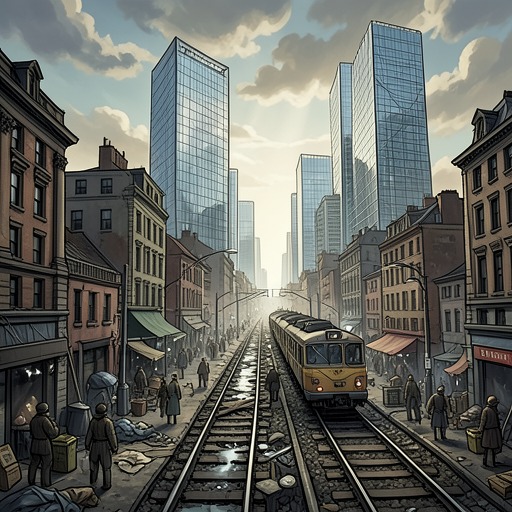
Ninsei
NeuromancerNinsei is the heart of Night City, an unnamed borderland between the port and the corporate city, where neon commerce and bodily danger become indistinguishable. For Case, it is simultaneously a market, a prison, a stage for self-destruction, and the location of his most persistent memory of Linda Lee. The district’s crowded arcades and bars embody the novel’s larger tension between disembodied technological freedom and the vulnerable body left behind.
Setting and Urban Character
Ninsei lies behind the port, beyond the docks’ quartz-halogen glare and before the factory domes and corporate arcologies that dominate the city. The port and city are separated by a narrow strip of older streets with no official name; Night City occupies this borderland, with Ninsei at its center. The district is therefore defined by adjacency rather than civic identity: it belongs fully neither to the formal city nor to the port, and its social order is governed by black-market exchange rather than official institutions.
By day, Ninsei’s bars are shuttered and featureless, their neon signs dead and their holograms inert beneath the poisoned silver sky. At night, the same streets become an intensely active field of hustlers, sailors, dealers, addicts, and transient customers. The contrast makes the district seem less like a stable neighborhood than a machine that powers up after dark, waiting for bodies and money to enter its circuitry.
Commerce, Violence, and Social Darwinism
Ninsei operates according to an unforgiving black-market protocol. Case experiences the street as a system in which stopping means sinking without a trace, while moving too quickly risks breaking the fragile balance on which transactions depend. Death is treated as the accepted penalty for laziness, carelessness, or lack of grace, and the consequences of failure are materially literal: a person’s heart, lungs, or kidneys may continue in the service of a stranger who can pay for clinic tanks.
The district intensifies Case’s economic and physical desperation after his nervous system has been damaged and his New Yen has disappeared through unsuccessful attempts to obtain a cure in Chiba. At first he responds by hustling with a cold intensity that seems to belong to someone else. During his first month, he kills two men and a woman over sums that would previously have seemed absurdly small. Ninsei gradually wears him down until the street appears to him as the external form of a death wish and an unknown poison he carries within himself.
This economy also clarifies the meaning of Case’s decision to stop protecting himself. He carries no weapon, abandons basic precautions, and takes the fastest, loosest deals available, building a reputation for obtaining whatever customers want while his clientele steadily dwindles. Ninsei rewards speed but punishes desperation; Case’s attempt to move beyond its rules becomes indistinguishable from his surrender to them.
Case, Linda Lee, and the Arcade
Ninsei is inseparable from Case’s relationship with Linda Lee. Ratz recalls seeing Linda and tells Case that he laughed more when he was with her, while Case denies having a girl. The exchange exposes the emotional vacancy produced by his life in the district: his relationship has become something he refuses to name even as others can see its absence.
Case first finds Linda in an arcade on Ninsei, where holograms of games and cities burn through a blue haze of cigarette smoke. She is absorbed in Wizard’s Castle, her gray eyes rimmed with smudged black paintstick, while the surrounding images cast shifting red, blue, and gold light across her face. Case approaches her after a successful drug deal, carrying the exhilaration of money already in his pocket; their meeting therefore joins intimacy to the district’s commerce from the beginning.
Their first night extends into morning and carries them across the Bay, through rain, boutiques, and a pachinko parlor where Linda holds Case’s hand like a child. Yet Ninsei’s pressures transform the relationship. Drugs and tension gradually turn her startled eyes into expressions of reflexive need. Case watches her personality fragment and her attention narrow toward the next hit, comparing her concentration to the mantises sold beside tanks of blue mutant carp and caged crickets along Shiga. The district does not merely surround their relationship; it supplies the market, speed, and addiction through which that relationship is damaged.
Memory, Return, and Narrative Significance
Ninsei becomes a recurring site of memory rather than only a physical location. After a violent interruption in his consciousness, Case wakes in an arcade alley among discarded fiberoptics, damp chipboard, and the dripping chassis of a gutted game console. He has no money, no jacket, and no clear sense of what has happened. On entering the arcade, he sees Linda playing Wizard’s Castle exactly as he remembers her, and she responds with practical concern, offering cigarettes, coffee, food, and a place to sleep.
The scene briefly reverses the district’s usual value system. In Ninsei, Case has expected exploitation, disappearance, or death; Linda instead takes his hand and offers care. His smile at her welcome is followed by a rupture in reality, so that the arcade freezes and vibrates. The moment makes Ninsei a threshold between external street life and unstable reconstructed experience, while also revealing how strongly Case’s desire for Linda is bound to the district’s visual and sensory pattern.
Later, technological memory reproduces Ninsei in altered forms. The charred wasps’ nest shown by the Finn is identified as an image extracted from Case’s memory, and it becomes a model for Straylight, linking the district’s remembered street life to the artificial architecture of the Tessier-Ashpool family. In the matrix, the scarlet pyramid and corporate systems extend the spatial logic of the city into infinite data structures. Ninsei is thus not merely left behind when Case enters cyberspace: its neon, markets, images, and bodily costs are transformed into the symbolic material of the worlds he seeks to penetrate.
Ninsei’s decisive significance lies in this doubleness. It is a place of technological glamour whose actual economy reduces people to disposable bodies and recoverable organs; it is where Case’s freedom as a console cowboy becomes imprisonment in damaged flesh; and it is where Linda’s image survives as both a personal memory and a recurring figure within constructed realities. The district’s neon does not overcome the meat. It makes the meat visible, vulnerable, and available for exchange.