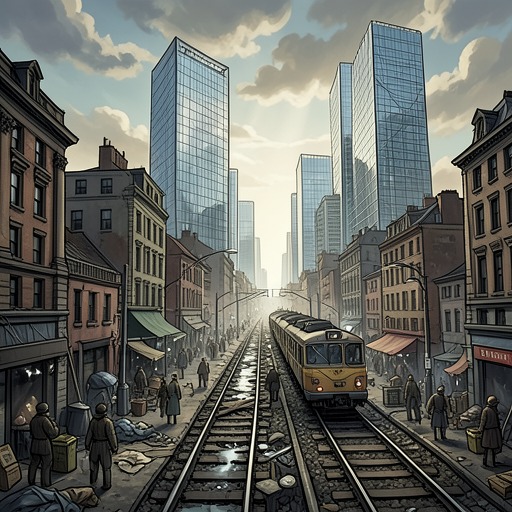
Rue Jules Verne
NeuromancerRue Jules Verne is the principal circumferential avenue around the midpoint of Freeside’s spindle. It first receives Henry Dorsett Case as a disorienting threshold into the station’s artificial world: a place of engineered skies, tiered vegetation, casinos, commercial franchises, and hidden surveillance. Its apparently open street is also a controlled environment, linking bodily disorientation and social spectacle to the larger dangers gathering around Villa Straylight.
Definition and Physical Setting
Rue Jules Verne loops around the spindle’s midpoint, while Desiderata Street runs lengthwise toward the supports of the Lado-Acheson light pumps. The two streets create a recurring point of orientation: turning right from Desiderata Street and following Rue Jules Verne far enough eventually brings a traveler back toward Desiderata Street from the opposite side. The avenue is therefore both a road and a ring, its geometry expressing the orbital habitat’s constructed, self-contained form.
When Henry Dorsett Case enters Freeside, Rue Jules Verne appears as a broad avenue occupying what seems like the floor of a deep slot or canyon. Shops and buildings rise as enclosing walls, their subtle angles concealing either end of the street. Green vegetation tumbles from overhanging tiers and balconies, while filtered illumination creates the impression of an outdoor terrestrial boulevard. The setting is lush but visibly fabricated: the landscape is assembled from architecture, vegetation, and controlled light rather than extending naturally beyond the station.
Artificial Sky and Bodily Disorientation
The avenue’s sky is a projection of environmental engineering. A Lado-Acheson system pumps sunlight through a two-millimeter armature running the length of the spindle and generates a rotating library of sky effects. Henry Dorsett Case can intellectually reconstruct the machinery: if the sky were switched off, he would see the armature and the curved surfaces of lakes, casino rooftops, and other streets beyond it. Yet this knowledge does not make the environment physically intelligible to him. The artificial blue, bright slash of simulated sunlight, and curved orientation of the spindle remain at odds with his body.
His reaction makes Rue Jules Verne a scene of threshold-crossing rather than simple arrival. He is already weakened after an episode in which his EEG appeared flat, and Molly leads him through customs and across the avenue while he struggles with the station’s rotating perspective. She tells him to look at his feet if he has trouble walking and explains that the perspective is difficult for newcomers. His complaint that he likes the environment less than space-adaptation syndrome identifies the street as an assault on ordinary bodily coordinates: Freeside offers comfort and spectacle, but not the stable horizon a body expects.
Commerce, Spectacle, and Movement
Rue Jules Verne combines transportation, tourism, and consumption. The first sight Henry Dorsett Case encounters on the inner surface of the spindle is a branch of the Beautiful Girl coffee franchise, and Molly guides him past a display window of Paris furs grown on a collagen base while retaining mink DNA. The scene makes the avenue’s commodities as artificial and hybrid as its weather. Nature is not absent; it has been redesigned as a product.
Later, Henry Dorsett Case walks along the avenue after leaving Bruce’s Honda. A vast illuminated newsstand displays glossy Japanese magazines featuring the month’s newest simstim stars. Above him, the nighted axis carries a hologram sky whose constellations resemble playing cards, dice, a top hat, and a martini glass. The imagery turns the station into a continuous casino emblem, where even the heavens have been formatted as entertainment and chance.
The intersection with Desiderata Street forms a kind of gulch between balconied terraces and the grassy tablelands of another casino complex. A pilotless microlight, built like a delicate biplane of gossamer polymer with wings silkscreened as a giant butterfly, banks in an updraft at the edge of an artificial mesa before disappearing beyond it. The graceful spectacle is not merely decorative: a flash of reflected neon suggests lenses or laser turrets, reminding Henry Dorsett Case that the drones belong to Freeside’s security system and are controlled by a central computer. Rue Jules Verne’s beauty is therefore inseparable from observation.
Social Threshold and Narrative Significance
Molly has prior experience of the avenue, having worked there for a month as a gambler’s bodyguard, and she treats its peculiarities as manageable conditions rather than marvels. Her familiarity contrasts with Henry Dorsett Case’s inability to make the place agree with his senses. She gets their keys, proposes a cab, and leads him onward while he remains numb and uncertain about what has happened to him. Rue Jules Verne thus briefly establishes Molly as the practical guide through an environment that Henry Dorsett Case can see but cannot yet inhabit comfortably.
The avenue also marks a transition from private mission to public exposure. After watching Bruce’s trike disappear, Henry Dorsett Case walks past bars including the Hi-Lo, the Paradise, le Monde, Cricketeer, Shozoku Smith’s, and Emergency. He chooses Emergency because it is small and crowded, only to recognize it as a tourist venue lacking the hum of legitimate business and filled instead with a glazed sexual tension. The street’s public life is stratified between commercial display, tourist consumption, and the concealed transactions that Henry Dorsett Case expects from less sanitized spaces.
At Emergency, he buys a mug of Carlsberg and sits against the wall, trying to locate the anger that has survived his drugged exhaustion. The avenue’s spectacle provides the setting for a private reckoning: the artificial casino landscape surrounds a man whose emotional crisis began when Wintermute withdrew the simstim image of Linda Lee. Rue Jules Verne is consequently not just a route through Freeside but a surface beneath which questions of memory, control, and deprivation continue to move.
Return and Imminent Arrest
After midnight, Henry Dorsett Case walks Rue Jules Verne and the surrounding Freeside spaces until morning. The drug high recedes, the artificial sensations give way to the ordinary weight of his body, and a recorded dawn travels along the Lado-Acheson system. He eats at a Desiderata cafe, drinks water, smokes his last cigarettes, and crosses the rooftop meadow of the Intercontinental as breakfast crowds gather beneath striped umbrellas. The avenue remains embedded in a cycle of manufactured night and dawn, while his exhaustion gives the passage a starkly physical rhythm.
He eventually returns to his level and approaches his room, using the Freeside credit chip as a key. The apparent movement toward sleep and blankness is interrupted by three people waiting inside in perfect white sports clothes and stenciled tans. A girl sits on a wicker sofa with an automatic pistol beside her and identifies the authorities before declaring Henry Dorsett Case under arrest by the Turing Registry. The route through Rue Jules Verne therefore ends not in refuge but in a reversal: the station’s open, looping avenue has carried him back to a private room that is already under surveillance and into the next stage of the conflict.