Freeside
NeuromancerFreeside is an orbital spindle whose apparent identity as a pleasure resort conceals a dense concentration of finance, property, security, and dynastic power. It is a place where tourists, criminals, corporations, and an ancient high-orbit family meet, and where the distinction between public infrastructure and private territory becomes increasingly unstable. Its decisive significance lies in the way it turns an entire artificial habitat into an instrument of social hierarchy: access is purchased, movement is regulated, and the most important destination within it, Villa Straylight, remains architecturally and politically withdrawn from ordinary view.
Definition and Setting
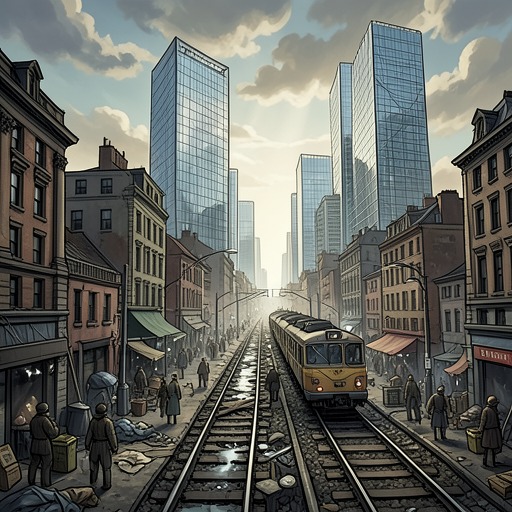
Freeside belongs to the orbital archipelago formed by toruses, spindles, and clusters, where human DNA has spread outward from Earth's gravity well. In the novel's compressed geographic imagination, it is represented as a massive red segment in a display of data exchange, a dominant node in the L-S archipelago rather than an isolated settlement. Its scale is therefore both physical and systemic: it is a place in orbit, but also a major junction in the circulation of information, money, bodies, and authority. Freeside is described through a deliberately contradictory catalogue of functions. It is a brothel and banking nexus, a pleasure dome and free port, a border town and a spa; it combines the attractions of Las Vegas and the hanging gardens of Babylon with the neutrality associated with an orbital Geneva. These identities do not replace one another. They coexist, allowing commerce, tourism, illicit activity, and elite seclusion to operate within the same engineered environment. The habitat's cosmopolitan surface is consequently inseparable from its economic purpose. Its physical form explains some of its social organization. Freeside is a spindle, a long artificial world that narrows toward its ends and produces a changing experience of gravity. Along its central circumferential avenue, Rue Jules Verne, visitors encounter a landscape that appears to be the floor of a deep canyon, with shops and buildings rising in angled walls and tiers. Vegetation spills from balconies above the street, while an artificial sky supplies the visual impression of ordinary daylight. The setting is not natural scenery but a carefully maintained sensory system, one that persuades the body to accept an environment it cannot intuitively understand.
Infrastructure and Everyday Experience
When Case reaches Freeside, customs consists largely of proving credit. The first conspicuous sign of arrival is a branch of the Beautiful Girl coffee franchise, followed by the broad green-lit environment of Rue Jules Verne. The scene is commercial and welcoming on its surface, yet the requirement to establish financial credibility makes clear that entry is mediated by economic status. Freeside presents itself as open space, but its openness is conditional and transactional. The habitat's artificiality repeatedly conflicts with the body's ordinary expectations. Sunlight is pumped through a Lado-Acheson system whose narrow armature runs the length of the spindle, while a rotating library of sky effects creates the appearance of changing heavens. If the system were switched off, a visitor would see the light armature and, beyond it, lakes, casino roofs, and other streets curving through the structure. The visual illusion is persuasive to the eye but alien to the body; Case finds the experience more disturbing than space-adaptation sickness. Freeside therefore turns perception itself into infrastructure, requiring visitors to learn how to inhabit a world whose gravity, horizon, and sky have been manufactured. Rue Jules Verne loops around the spindle's midpoint, while Desiderata runs lengthwise and ends at the supports of the Lado-Acheson light pumps. The intersection of the two avenues forms a gulch beneath balconied terraces and the grassy tablelands of another casino complex. This layered arrangement creates a vertical social geography: commercial streets, tourist venues, casino districts, and higher regions are connected, but not rendered socially equivalent. The architecture makes movement possible while also displaying the stratification of the habitat. Freeside's attractions include casinos, hotels, strata-title property, large shops, lakes, and a velodrome where bicycles race on high-traction tires at speeds exceeding one hundred kilometers per hour. Armitage's holographic model presents these features as elements of a plan that can be surveyed, divided, and targeted. The model's precision contrasts with the visitors' uncertainty, especially when the apparently blank end of the spindle is identified as Villa Straylight. Freeside can be mapped as a commercial environment, but its most consequential space resists ordinary description.
Ownership and the Tessier-Ashpool Domain
Freeside is the home of the Tessier-Ashpool family, an inbred and carefully refined industrial clan whose power is older and more private than the habitat's tourist economy suggests. The family owns nearly the whole spindle, and its corporate structure is unusually closed: although it is formally an S.A. into which outsiders might theoretically buy, no share of Tessier-Ashpool S.A. has traded publicly for more than a century. The family thus combines corporate form with dynastic possession, using legal structures without submitting to the ordinary circulation of ownership. The family is described as a first-generation high-orbit organization, wealthy, media-shy, and heavily invested in cloning. Its succession is difficult to follow because generations and combinations of generations may govern at different times. A private cryogenic system allows family members to alternate between active life and freezing; under orbital law, a person is legally dead during the duration of a freeze. This legal fiction gives the family a peculiar relationship to time, inheritance, and identity. Freeside is not merely the site of a rich household; it is the material environment of a regime that treats biological continuity as something to be stored, revised, and reactivated. The family history also reaches back across centuries. Ashpool tells Molly that, counting the time spent in the cold, he is more than two hundred years old. He says that he and the family built their secluded world to hide from an encroaching outside, while cryogenic sleep allowed memories and fears to persist beneath the promise that the frozen would not dream. His account turns Freeside's wealth into a Gothic structure: its gardens, rooms, and technological systems are the visible shell of a family history organized around cold storage, isolation, and accumulated authority. The family compound, Villa Straylight, occupies the tip of the spindle and is strictly private. Its approaches are sharply angled, and a single entrance lies at the center of a zero-gravity section. On Armitage's model, the interior of the villa is represented as blankness, an absence of usable detail at the very point where power is concentrated. The architecture therefore functions as a security system and as a symbol: Freeside can be publicly displayed, but the family keeps its core illegible.
Freeside as Operational Territory
Freeside becomes the staging ground for the expedition involving Case, Molly, Armitage, Peter Riviera, and the Finn. Armitage's briefing treats the spindle as a navigable operational environment. He identifies the casinos, hotels, shops, lakes, sporting areas, and streets, then separates them from the end that concerns the mission. Riviera is instructed to secure an invitation to Villa Straylight, after which Molly is to enter. Freeside's social world is thus converted into a sequence of access problems: invitation, route, entry, and penetration of a protected family domain. The earlier investigation into Tessier-Ashpool also depends on Freeside's ownership structure. A stolen artwork leads through a Japanese collector, a professional killer, legal records, and a family address before the investigators discover that the family controls almost the entire spindle. Their research does not produce a simple location but a network of corporate powers of attorney, cryogenic succession, cloning, orbital law, and private security. Freeside is where these systems become geographically legible, even though they remain difficult to penetrate. The spindle's public security reinforces that ambiguity. Pilotless microlights with gossamer polymer wings, patterned like giant butterflies, move through the artificial updrafts near the casino terraces. They appear graceful and decorative, but they are part of a security system controlled by a central computer, possibly connected to Straylight. Tourism and surveillance share the same visual field. The habitat's pleasures are not outside its mechanisms of control; they are among the forms through which those mechanisms become unobtrusive. Freeside also remains connected to the wider Sprawl through financial and informational channels. A holographic advertisement in the Sprawl presents the spindle as an immediately reachable destination, insisting that travel is unnecessary for someone with a deck because the banks can be accessed from cyberspace. Yet Case's mission makes physical presence unavoidable. The contrast between remote access and bodily travel exposes one of the novel's recurring tensions: data may cross distances effortlessly, while bodies remain subject to gravity, customs, sickness, injury, and the social protocols of particular places.
Narrative Significance
Freeside gathers the novel's major scales into one setting. The streets offer the speed and improvisation of black-market life; the banks and property systems embody orbital capital; the artificial sky and altered gravity make technology part of ordinary perception; and Villa Straylight contains the family history that stretches through cloning and centuries of cryogenic interruption. A single walk through the habitat can therefore move between tourist spectacle, commercial exchange, security infrastructure, and dynastic secrecy without leaving the spindle. Its spatial design also gives concrete form to the problem of orientation. Case can read maps, navigate data, and work within cyberspace, but Freeside repeatedly makes his body the measure of what he does not understand. The rotating sky, the shifting gravity, the curved streets, and the inaccessible villa all resist the fantasy that information alone produces mastery. Freeside is mappable, yet not transparent; open to commerce, yet closed at its center. The place's deepest irony is that its apparent freedom depends on concentrated ownership. As a free port and border town, Freeside promises movement beyond the constraints of terrestrial jurisdictions. As the private domain of Tessier-Ashpool S.A., however, it reveals how freedom can be organized by wealth, legal exceptionalism, and control of infrastructure. The spindle is both a crossroads and an enclosure, a public spectacle wrapped around a family fortress. That contradiction makes Freeside more than a backdrop for the plot: it is the novel's clearest architectural image of a future in which mobility expands while power becomes harder to see.