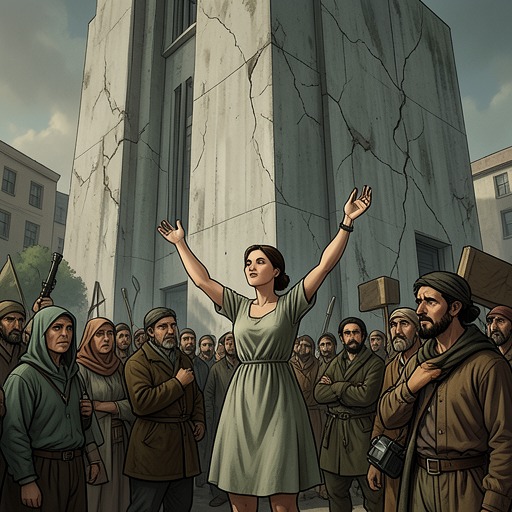
Abduction and Abuse of Women under Behrooz
NeverthelessAbduction and Abuse of Women under Behrooz is a pattern of coercion described in the account of Behrooz’s rule in Turilessa: his men take girls, families who ask after them may be killed, and the king’s authority is invoked to make the practice seem unanswerable. Mabel Peloponnese’s intervention against one of his guards brings that violence into view at court, where her questions challenge not only an individual’s conduct but the power that enables it.
The king and the pattern of abduction
Before Mabel encounters the violence directly, the commander accompanying Navi Spyridaki’s party describes Behrooz as a ruler with an extraordinary appetite for women. He says Behrooz married two women on the same day and later had more women than anyone in the country. The commander also recalls a feast that lasted thirty days, a detail that presents the king’s extravagance alongside his sexual appetite. These remarks establish the reputation surrounding Behrooz before the narrative shows what that reputation means for ordinary women.
The account distinguishes Behrooz’s method from the conquest of whole cities: his men take girls while they are dancing at festivals or returning home. Their families do not immediately understand who is responsible. When parents ask what has happened to their daughters, they may be killed. Girls who return carry the message that Behrooz is king and can take their daughters. The pattern thus works through more than the initial abduction: the danger to families discourages inquiry, while the king’s status is made to stand as the justification for what his men do.
Royal authority and fear
The account presents the victims’ families as unable to appeal effectively against the king. The message associated with the returned girls reduces the matter to Behrooz’s power: because he is king, he can claim their daughters. The narrative’s blunt statement that they could do nothing emphasizes the gulf between royal authority and ordinary people’s ability to resist it. It does not describe a formal law authorizing the abductions; instead, it shows a coercive practice protected by the ruler’s reach and by the threatened consequences of asking questions.
This abuse comes into focus during a diplomatic encounter. Navi Spyridaki introduces himself to Behrooz as Navon’s heir and army general, but Mabel Peloponnese’s actions soon disrupt the court’s expected attention to rank and negotiation. She has heard a scream and intervened while Behrooz’s guard was assaulting a woman. The king asks what the woman did to deserve such treatment; the guard answers that she interrupted one of his admonitions and insists that her behavior should be punished. Behrooz decides that the guard will not punish her that day. His response halts the immediate threat to Mabel, but it does not establish that the larger practice of taking girls has ended.
Mabel’s intervention and the court encounter
Mabel’s intervention begins before she knows the full account of Behrooz’s rule. In the darkness, after hearing a cry, she considers whether to leave but rejects the idea of pretending not to hear or see. She goes toward the sound and finds a large guard attacking a woman who is much smaller than he is. Mabel jumps onto the guard’s back and puts a knife to his neck. The action interrupts the assault and turns her from a witness into a direct obstacle to the guard’s violence.
When Behrooz asks what she was doing, Mabel explains that she heard a scream and could not hear someone calling out without acting. She does not reveal that the woman had tried to ask for help. Her account is therefore limited to what she herself heard and did, even as she turns the king’s attention back toward his guard by asking what he had been doing when she found him. The question forces the court to consider the guard’s conduct rather than treating Mabel’s intervention as the only disturbance.
Behrooz appears pleased by Mabel’s presence and invites her to stay, describing the incident as a misunderstanding. That invitation does not amount to a condemnation of the guard or a remedy for the woman. The immediate outcome is narrower: the guard releases Mabel when ordered, and the king allows her to remain. The account does not say what becomes of the woman after the confrontation, nor does it report a broader change in Behrooz’s treatment of women.
Significance and limits of the account
The episode links the general pattern of abduction to a single act of violence without suggesting that one confrontation resolves it. Behrooz’s reputation, his men’s conduct, the danger to families who inquire, and the guard’s expectation that he can punish a woman all point toward an environment in which force is backed by royal standing. At court, Behrooz can stop his guard, but his decision is discretionary: the narrative shows him ending punishment in this instance, not rejecting the authority or practice that places women at risk.
Mabel’s response supplies a counterpoint to that impunity. She acts before she has political standing in the court and speaks about what she witnessed rather than accepting the guard’s explanation as sufficient. Her intervention makes the woman’s peril impossible to treat as merely a private admonition, although the story leaves the victim’s later circumstances unstated. The episode’s force lies in that tension: the king’s authority can interrupt one assault, while the account of his rule shows how little protection that authority ordinarily affords the girls and families subjected to it.