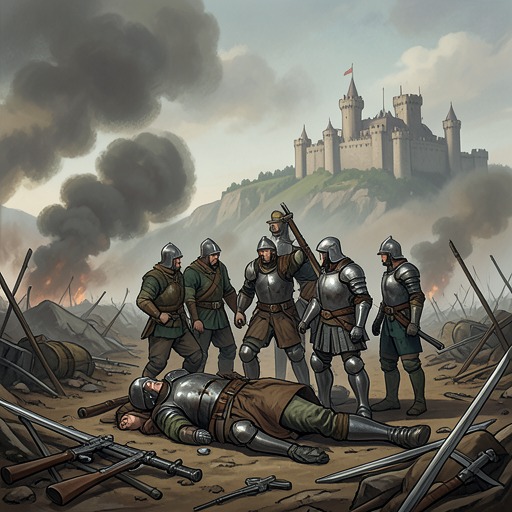
Navon’s war with Tzara
NeverthelessNavon’s war with Tzara turns a kingdom accustomed to fighting for other powers into a country forced to defend its own people and land. The invasion exposes the cost of Navon’s earlier alliances, tests whether the kingdom can build a coalition from those it has cast out, and brings the duties of ruler, soldier, exile, and civilian into direct conflict.
Causes and Navon’s Vulnerability
Navon had not previously faced a threat to its own territory. Its earlier battles were fought on behalf of other kingdoms, and Amyntas had served in such wars. The arrangement supplied allied powers with men to defend their lands, while Navon’s own people bore the fighting. Many deserted rather than continue in conflicts they believed did not belong to them. Under Navon’s severe punishment, deserters were banished beyond the kingdom and barred from returning; their absence compounded a military shortage just as Tzara turned its attention to Navon’s land and gold.
The kingdom’s predicament is therefore not simply that an enemy is stronger. Its former allies, fearful of Tzara’s retaliation, are no longer dependable, and Navon has neither the soldiers nor the security it once expected from those relationships. The narrative presents this vulnerability as partly self-made: a policy that had treated soldiers as resources for other rulers’ wars has left Navon poorly equipped to protect itself. In the castle’s council chamber, Navi Spyridaki favors offering Navon’s best products in exchange for political alliances. His counselors resist conditions that would disadvantage the kingdom over time. Navi also considers special privileges in return for protection unfair, but sees few alternatives. Diplomacy itself becomes another cost imposed by the military crisis.
From Exile to a Possible Coalition
The approaching war unsettles the distinction between Navon’s subjects and its exiles. At Shai’s encampment, Alastair objects when Mabel Peloponnese calls the men criminals: many are deserters and exiles who refused to fight wars that were not theirs. They value a life without taxes or obligations and insist that they owe Navon nothing. Mabel counters that this conflict is different because it threatens their home. Her challenge puts the central political question plainly: whether those expelled from the kingdom can be asked to defend the land from which they were banished.
The prospect of fighting for Navon first appears as a paid service. Shai describes his group as people who take on tasks others do not want to perform and says that joining Navon’s fight would require money. Later, when Navi asks what Shai’s band demands in return, Shai answers that they want nothing and are not doing it for money. The contrast marks a change in the terms of cooperation: the defense comes to rest on something other than a simple contract. Shai’s band and the exiles can help Navon, but their participation also forces the kingdom to recognize a claim to protection from people it has treated as permanently outside its society.
Fighting at the Mountain Refuge
The conflict reaches the mountain refuge when a boy arrives with news that Balthasar’s Army is advancing. Alastair initially suspects that Shai and his men have drawn the enemy to a place where the exiles had remained undiscovered for months; Shai denies that they caused the attack. Alastair rejects the call to hide and rallies the Expatriates' Order to resist. He tells Mabel she can take shelter, but she stays engaged with the defense rather than treating her safety as a reason to abandon the fight.
The defenders attack while Tzara’s soldiers climb the mountain, seeking to prevent them from reaching the summit. Archers fire from concealment among rocks and on rooftops, while fighters on the ground meet those who get through. The force sent by Tzara’s general is smaller than the defenders expected to face, and the combined resistance of Shai’s band and Alastair’s entourage turns the encounter against it. Mabel fights alongside them. Amid the apparent victory, an enemy soldier overpowers her; she takes his sword and kills him to escape. She had not left Navon intending to kill anyone, and the act leaves her unable to answer Shai when he asks whether she is hurt. The war’s necessity does not erase its personal cost: her first killing becomes a moment of shock as well as survival.
The Threat Reaches Navon
The mountain encounter is one sign of a larger danger, not the end of the conflict. Shai later warns Navi that Tzara will cross Navon’s borders and that there is little time before the invasion arrives. He brings his own men and says the expatriates will also come. Navi agrees to let them enter, a consequential reversal in a kingdom that has barred exiles from returning. Shai’s scouts and allies provide advance warning, giving the defense time to act rather than meet the invasion without preparation.
Navi’s first response is to move the whole village out of danger before calling the army and gathering the soldiers. Shai’s people go among the villagers at night, helping them leave their homes and reach the castle for shelter. The plan distinguishes civilian safety from military resistance: women and children are directed inside the castle walls, while men are told to stand and fight. Mabel understands the instructions but cannot accept leaving the soldiers after having stood with them. She puts on her trousers and armor, takes her sword, and goes to defend the city, although that is not formally her duty. Her decision makes the defense more than an order issued from the palace; it is also a choice about who is entitled to stand between danger and the people at risk.
Defense, Captivity, and Significance
When the defenders prepare to meet Tzara, the war’s outcome remains unresolved in the available events. Mabel nevertheless helps turn the city’s resistance into a concrete result: she subdues an enemy general and declares him her prisoner, intending to take him to the King's Army of Navon as a hostage. The reversal gives a woman who was excluded from military service authority over a captured commander, and makes her earlier decision to fight consequential beyond her own survival.
The war links military weakness to the political and human costs of Navon’s rules. The kingdom needs soldiers, allies, warning, and time, yet its former alliance system helped create the desertion that now leaves it exposed. The exiles’ return offers a practical defense while challenging the idea that banishment ends every obligation between people and their homeland. Meanwhile, Mabel’s choices expose the gap between official assignments and moral responsibility: civilians are to be sheltered, soldiers are to fight, but she refuses the assumption that safety for herself matters more than standing with those defending the city. Navon’s war is thus both an invasion and a test of who will be included in the effort to keep the kingdom alive.