Navon under invasion
NeverthelessNavon under invasion is a national emergency that exposes the cost of the kingdom’s dependence on other powers and forces its people to decide what defending home requires. What begins as a threat to Navon’s gold and land becomes an attack on its villages, a personal catastrophe for Mabel, and a test of whether Navi can organize soldiers, allies, and civilians into a defense.
Origins of the Crisis
Navon had not previously faced a threat to its own territory. Its earlier battles were fought on behalf of other kingdoms, often as the price of political alliances: Navon supplied men to defend lands belonging to more powerful rulers. The practice helped produce deserters unwilling to fight wars that were not theirs. Navon’s punishment for desertion was permanent exile, not simply imprisonment. Those banished were marked with a hot-iron D, barred from returning, and liable to death if caught on Navon’s soil. The system made the kingdom’s depleted military a political consequence as well as a battlefield problem.
The old arrangement fails when Tzara turns its attention to Navon’s gold and land. A kingdom accustomed to fighting elsewhere now has to defend itself, but its longstanding ally is too afraid of Tzara’s wrath to stand with it. The account presents this isolation not as an unforeseeable accident but as the consequence of choices made when Navon relied on alliances that sent its people to other rulers’ wars. Now it lacks both dependable allies and enough soldiers.
The shortage is compounded by the terms of diplomacy. In Navi’s council, he favors offering Navon’s best products to secure political alliances, while his counselors object that neighboring kingdoms are exploiting Navon’s vulnerability and demanding conditions that could burden it over the long term. Navi considers special privileges in return for protection unfair, but sees little room to refuse. The negotiations make the invasion a struggle over resources and sovereignty as well as military survival.
The Search for Help
A month before the attack, Navi had sent a letter to a neighboring kingdom seeking an alliance. When he reads the reply, he understands that the other kingdom fears losing its troops and becoming vulnerable to Tzara if it joins Navon. Its refusal leaves Navi facing the possibility that his kingdom will be abandoned precisely because it is in danger. He imagines the city burning, its people paying for decisions they did not make, and its walls falling while he can do nothing to save them.
The need is immediate and concrete: Navon’s remaining soldiers are too few, and most are young. Navi goes to Behrooz to ask for troops, offering Navon’s wood production and weapons, and, if that is not enough, a third of its crops. Behrooz hesitates because helping could cost him heavily. Navi argues that after Balthasar destroys Navon, the next target will be Behrooz’s own kingdom; refusal, in his view, does not remove the danger but postpones it. The deal remains unresolved, leaving Navi and his men with no assurance that anyone will help.
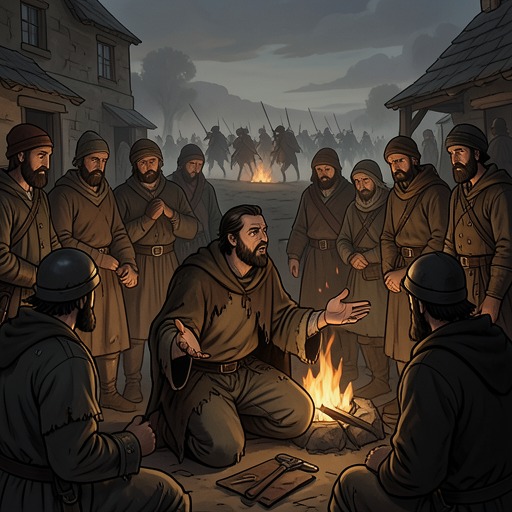
Other possible defenders stand outside the formal alliance system. A leader from a band of mercenaries describes their work as paid services, including rescuing people and capturing criminals, then proposes that they could fight for Navon in return for money. Later, when Navi asks what the group’s conditions are, Shai says they are not acting for money. The contrast suggests a different basis for assistance than the unequal bargains debated by the royal counselors, though the kingdom still faces the practical task of joining its defenders together.
Attack and the Cost to Civilians
The threat becomes real when a royal guard enters Navi’s office and reports that Navon is under attack. Navi takes a sword from a corner and runs without first collecting armor. His response shifts the crisis from correspondence and calculations to immediate defense: the city is already in danger, and there is no time to prepare as though battle were still only a possibility.
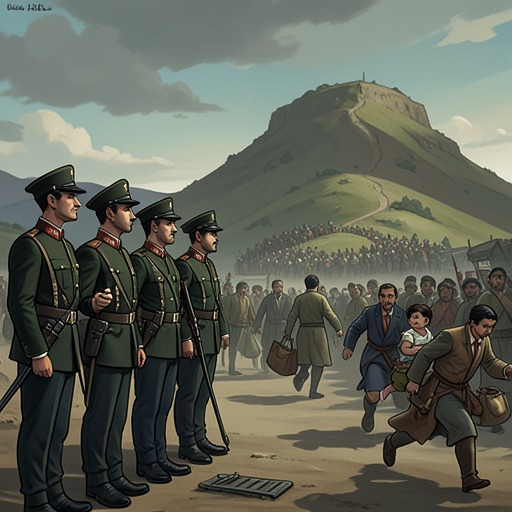
The invasion reaches Mabel’s village as well. She runs there barefoot, carrying a stolen sword, and finds attackers driving residents from their homes and beating them. She sees a woman shoved out of her house and an old man kicked in the ribs, but cannot stop to help because she is trying to reach her family. At home she finds her father dead beneath the wooden pot shed, killed after being beaten rather than in battle. Her mother is also lost to her; Mabel’s grief makes her recognize that she has become an orphan. The massacre thus gives the war a domestic scale: Navon’s failure to protect its territory is registered in homes, families, and people who never chose to fight.
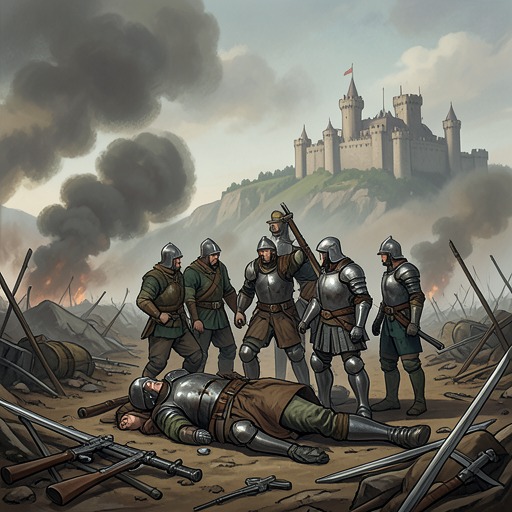
The kingdom’s geography shapes both its defenses and the movement between danger and shelter. Navon’s castle stands on a hill amid trees, with steep terrain and forest obstructing an approach; the stone bridge at the front is the passage into the castle. The village lies down the road and across the river valley from Mabel’s childhood home, a familiar route that she once chose to walk at length. During military travel, a very long bridge wide enough for three horses abreast or two carriages becomes another consequential crossing. These routes connect the protected seat of power to vulnerable settlements, while also making clear that movement through the landscape is part of the crisis.
Mobilization and the Meaning of Defense
As the danger gathers, the prospect of an alliance with Turilessa is treated as urgent: Mabel points out that the army is going there to establish one and asks how much Navon needs it. The effort to recruit help continues alongside the recognition that Navon cannot wait passively for an answer. Later, Shai and Navi discuss bringing the whole village to safety before calling the army and locating the soldiers. The order of priorities is explicit: move civilians out of the way before going to battle.
That plan becomes action in the middle of the night. Shai’s men wake the villagers, who first fear another attack, then leave their homes in sleeping clothes and find the band guiding them toward the castle. Women and children are directed inside the castle walls, while men are told to stand and fight. Mabel understands the safety instructions but questions what it would mean for her to leave the soldiers behind during the most frightening moment. Her hesitation exposes the unequal burden built into the evacuation plan: protection is offered according to gender, while her sense of duty is tied to the people who will remain exposed.
The invasion therefore tests more than the strength of Navon’s walls or the number of its troops. It reveals how vulnerable a kingdom becomes when its alliances are conditional, how the costs of political decisions fall on villages and families, and how defense requires both military resistance and the protection of civilians. Navi’s efforts to summon soldiers and prepare shelter, Shai’s men escorting villagers, and Mabel’s refusal to think of safety as a reason to abandon others all give the crisis its central tension: survival depends on building solidarity across a kingdom whose inherited systems have left it short of both allies and defenders.