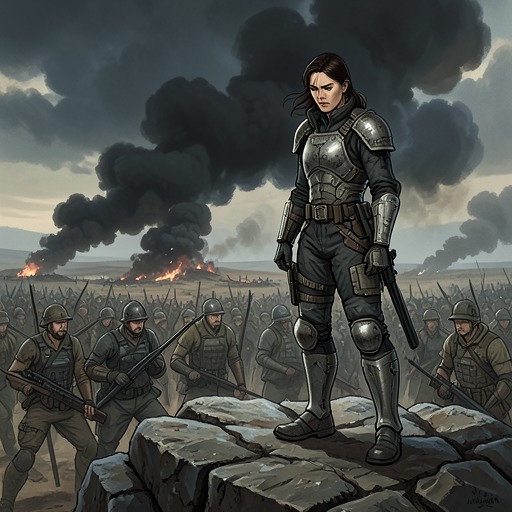
Mabel Held Captive in Tzara
NeverthelessMabel Held Captive in Tzara is the condition forced on Mabel after she is captured during Navon’s war and taken across the border under guard. The captivity begins before she reaches Tzara: she is held in the forest, recaptured when an attempted escape is interrupted, and transported in a barred carriage. At her destination, the King’s Winner pulls her toward the castle and the iron doors close behind her. The journey transforms her from a soldier trying to save her city into a prisoner whose presence is meant to draw Golnar, known to her as Shai, into Balthasar’s reach.
Capture and the failed attempt to call for help
The immediate turn comes when Shai’s voice reaches Mabel while she is in a feverish, confused state. She recognizes that he is nearby, but fears that calling back would expose him to the enemy. The choice leaves her isolated: she cannot safely use the possibility of rescue without putting the rescuer in danger. Her captor, meanwhile, is still bound to a tree. As the cloth tying his wrists loosens, Mabel and the soldier both realize that the situation is changing. When she begins to call for help, he frees himself and stops her. The escape does not become an exchange of control; instead, the King’s Winner recaptures her, and she is his prisoner.
This moment defines the captivity as more than physical restraint. Mabel has a chance to make herself heard, but the risk to Shai shapes what she can do. The scene also reverses the apparent balance between captor and captive: while the soldier is tied, Mabel can still hope to get away; once he is free, her brief opening closes. Her imprisonment is thus established through a failed escape rather than through an account of formal arrest or sentencing.
Transport and the purpose of her capture
Mabel wakes in a moving carriage, disoriented by the journey and initially unsure why she is no longer on dry land. Remembering the events that preceded her capture clarifies her immediate situation. She looks for a way out, but the carriage is barred, there is too little room to slip through, and Balthasar’s guards escort it. Its design and guard detail make the transfer unmistakably controlled: she is not travelling freely or being returned home.
The King’s Winner is also inside the carriage. He explains that Balthasar wants to speak with her. Mabel answers that she has no family who could pay a ransom and that no one is coming after her, but the stated purpose is not financial. The captor says that Golnar is attached to her and that they intend to exploit that connection to bring him to Balthasar. If Golnar does not come, Mabel is threatened with being killed. The captors therefore treat her as leverage in a conflict whose larger target is Golnar, not as someone whose own political standing or family resources could secure her release.
The explanation forces Mabel to reconsider Shai’s past actions. The King’s Winner asserts that Shai is actually Golnar, that he used Mabel to obtain an army and try to dethrone his brother, and that the exiles were manipulated as well. These are the captor’s claims, presented to a prisoner with reason to question his account; they do not become an unquestioned explanation simply because he voices them. Mabel connects the accusation to the King’s Winner’s earlier pursuit of Shai in Tenerife, but she still asks what Shai has to do with her and why she herself has been brought there. Her uncertainty remains central: she is given a proposed motive for her abduction, not a settled understanding of the whole political struggle.
Arrival in Tzara
When the carriage reaches Tzara, the landscape emphasizes the difference between crossing into the kingdom and gaining access to its center. A huge wall marks the border; from outside, Mabel can see desert, while only the tops of tall buildings rise beyond the wall. The city, villages, and plantations are protected behind its defenses. The narration presents entry into the royal city as harder than leaving it, and describes the place as impenetrable. For Mabel, this is not a distant strategic observation: the guarded route has delivered her to a territory from which escape already appears unlikely.
A large group of armored soldiers is waiting outside. Mabel wonders whether their presence means that she is considered dangerous or valuable, but rejects both descriptions as an account of who she is. She understands herself as a girl and a soldier who had wanted to help save her city. That self-definition contrasts with the role assigned to her by her captors: a person to be escorted, contained, and used to compel another person’s arrival. She is now days from home, separated from the place whose defense gave her military purpose.
Confinement and the unresolved ending
At the castle, the King’s Winner takes Mabel by the arm and assures her that she will go through the door. She sees no way to escape while surrounded, drawing a contrast with the earlier situation in which the captor had been in her territory. Here, the imbalance is reversed: she is inside his power, and she cannot identify an exit. The heavy iron doors shut behind her. The book ends not with a negotiation, release, or account of life inside the castle, but with Mabel’s recognition that her life will change from this point onward.
The boundary of what is known matters. The evidence establishes her capture, guarded transport, arrival in Tzara, and forced entry into the castle, but does not describe her subsequent treatment or whether Balthasar meets her. Her captivity remains unresolved at the close. Its immediate political purpose is clearer than its eventual outcome: the King’s Winner says Mabel is being held to draw Golnar to Balthasar, making her both a person in peril and the instrument through which the captors hope to reach someone else.
The ending also sharply reverses the practical work of defending Navon. During the wider crisis, Navi orders the village brought to safety and calls for the army to be assembled; Shai’s men help move villagers to the castle. Mabel’s own capture carries her in the opposite direction, away from home and into an enemy stronghold. Her story pauses at the threshold, with the effort to save her city replaced by confinement whose consequences have yet to unfold.