Dareh Withdraws from Day-to-Day Governance
NeverthelessDareh’s withdrawal from day-to-day governance makes Navi Spyridaki the working center of Navon’s royal administration before he has received every role he seeks. The king remains on the throne and continues to shape his son’s future, but he has largely stopped managing affairs himself. His retreat is personal as well as political: Navi is at once the heir expected to govern and the person Dareh cannot bear to lose.
A king receding from daily affairs
Dareh’s withdrawal is described as gradual. He becomes attached to familiar habits, including clothing he refuses to change even when it is dirty and torn. His possessiveness toward his belongings grows so pronounced that he can no longer manage ordinary dealings with people, apart from Navi and his personal servant. He also no longer wants to think through matters for himself and loses interest in what is happening around him. The resulting vacancy is practical, not ceremonial: Dareh is still king, but the work of the kingdom increasingly falls to his young son.
The account complicates any simple image of total incapacity. Dareh still appears on the throne, takes pleasure in Navi’s reaction to Mabel Peloponnese, and asks whether his son still wants command of Navon’s army. His withdrawal therefore means reduced participation in governing, not the disappearance of royal authority or of his relationship with Navi. The king can still frame a decision and set a test; what he increasingly cannot or will not do is carry the routine burden of rule himself.
Navi assumes political responsibility
The transfer is visible in Navi’s office, a crowded room of books that feels distinctly his within the castle. There, at a long rectangular table, he argues for offering Navon’s best products in return for political alliances. His counselors resist accepting terms that would disadvantage the kingdom over time, while neighboring kingdoms exploit Navon’s vulnerability. Navi recognizes the unfairness of exchanging special privileges for protection, but sees no viable alternative to securing allies.
A senior adviser challenges his authority directly, arguing that the king should be consulted because Navi is young and has spent two years abroad. Navi answers that he left when Navon still had allies, insists that the counselors follow his instructions, and requires them to report what they do and even what they intend to do. The men agree, though their obedience is reluctant and sharpened by the king’s absence. Navi is nearly a king in practical terms, the narration observes, though he has neither throne nor army. That formulation captures the unstable arrangement: he is already responsible for decisions whose consequences belong to the kingdom, while his formal position remains incomplete.
Delegation, protection, and succession
Dareh’s conduct toward his son is not simply indifference. He explains that Navi is busy and continually worried, and wonders whether he has burdened him with too much responsibility. He wants Navi to become accustomed to his future position as soon as possible, describing his own role as a parent preparing a child for what he is suited to do. In a conversation with Mabel, he acknowledges that he is not as good a tutor as her father, but says he wants Navi to be happy. His concern and his delegation coexist: he wants his son prepared to rule, even as he fears the cost of placing him in danger.
That tension is clearest around military command. Navi asks whether his marriage might be used as bargaining power to win allies, while Dareh objects to the language of treating him as a commodity. Navi reminds him that Dareh’s first lesson was that such situations could one day make him their victim. Yet although Navi has control over the castle’s political affairs, Dareh has not appointed him general. The king does not want his only natural heir on a battlefield, where a ruler might have to stand at the front and be the first to fall. His protection of Navi therefore limits the very public role that succession appears to demand.
Authority after the retreat
The king’s authority continues to organize decisions even when he is not conducting them himself. At the recruitment field, a commander assumes that a girl seeking enlistment may be acting from financial need and offers a hearing with the king, who could help her without her joining the army. The offer presents Dareh as an available source of royal judgment and assistance, even as the evidence elsewhere shows how much administration has shifted to Navi. Royal authority remains legible to subjects and officers; its day-to-day exercise is another matter.
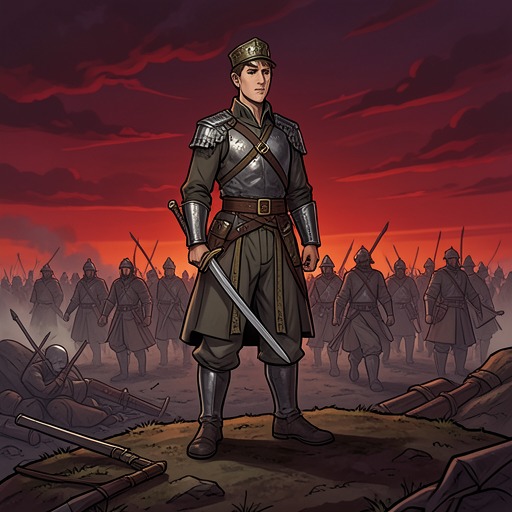
Later, when Navi stands before the army, its commander addresses him as prince and general and says that he has never seen a prince in front of an army. Navi replies that the times are hard and receives the commander’s readiness for orders. This scene does not establish that Dareh has formally surrendered his position. Instead, it shows how pressure draws Navi further into visible command, extending the practical succession already underway in the castle’s political affairs.
Dareh’s withdrawal thus creates a divided kingship: the father preserves the throne and worries over the heir, while the son takes on the decisions and public duties that make rule effective. The arrangement is affectionate but consequential. Navi’s authority grows because Dareh’s daily engagement recedes, yet Dareh’s continued control over his son’s military future demonstrates that the transfer is neither complete nor free of conflict.