Navonian expatriates’ exile
NeverthelessNavonian expatriates’ exile begins as Navon’s irrevocable punishment for desertion, but the story shows it becoming something more complicated: a life outside the kingdom’s law and protection, where people who reject its obligations build a community of their own. Their eventual decision to help defend Navon against Tzara turns that separation into a test of whether former outcasts can be recognized as allies.
Punishment and the Making of Exiles
Navon’s deserters are not merely dismissed from military service. The kingdom condemns them to permanent exile beyond its boundaries, where they must survive on their own. They are marked on the neck with a hot-iron D so they can be identified, and if they are caught on Navon soil, they face death. The mark makes their exclusion visible and difficult to reverse: even return to familiar territory carries the threat of execution. The narrative links this system to Navon’s history of fighting on behalf of other kingdoms. Before Tzara threatened Navon itself, the kingdom’s battles had been fought for others; men deserted because they did not want to fight wars that were not theirs. Those wars were also part of the bargain Navon made in its alliances, supplying men to defend the lands of powerful neighbors. When Tzara’s threat arrives and a longtime ally is too afraid to help, Navon discovers that it has neither enough soldiers nor reliable protection. The exiles’ history therefore reflects a wider political failure: the kingdom’s military arrangements helped create the very people it later treats as irredeemable offenders.
Life Beyond the Kingdom
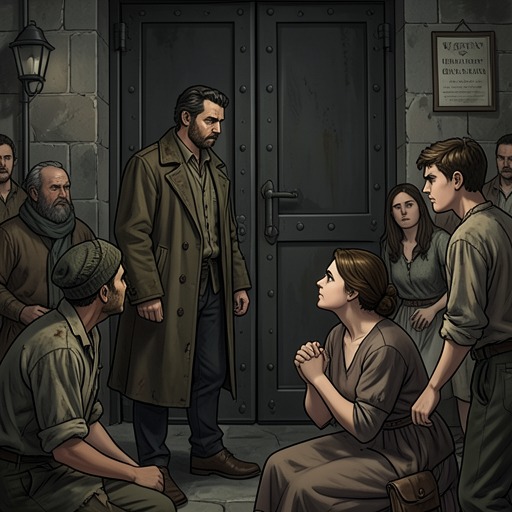
The exiles’ community in the forest offers a stark contrast to Navon’s system of punishment. Shai and his men live among trees and open air; they hunt in the morning and return with food for the group. Their small camp includes wives and children and maintains recurring patterns of shared meals and family relationships. Yet the narrative also describes these relationships as roles in a made-up society, a way of acting out a life that the exiles do not truly possess. Community gives their exposed existence a structure, but it cannot erase the rupture that brought them there. The group expands as others join, and the forest becomes a place with no formal rules, duties, obligations, or labels. Alastair objects to calling its members criminals simply because they refused to fight battles that were not theirs: most, he says, are Navonian deserters and exiles, or expatriates. His defense challenges the kingdom’s moral category of the criminal without denying the exiles’ history. For them, release from taxes and obligations is a hard-won alternative to a society that marked and expelled them. Alastair sums up that independence with the words, “Here, we don't owe anyone anything.” That freedom also has limits. The exiles are barred from returning to Navon, and the mark on their necks makes entry dangerous. When Shai and the others plan to approach the prince, Alastair points out that they cannot enter the kingdom openly. Mabel Peloponnese must carry their message. Shai is later permitted to enter the castle with her, while the rest of the group waits outside the city. Some hope to see their families and the past they left behind, but permission for one emissary does not undo the banishment of the community.
From Outsiders to Potential Allies
The prospect of Tzara’s invasion changes the meaning of distance from Navon. At first, the exiles reject the idea that the kingdom’s danger concerns them. Alastair insists they do not share the feelings that would draw them back into Navon’s cause. Mabel challenges that refusal: this time, she argues, the battle is about protecting their home. Her appeal exposes the tension between independence from obligation and attachment to a place worth defending. Shai’s band eventually proposes fighting for Navon, while recognizing that military service requires resources. The possibility of paid work is raised, but when Navi Spyridaki asks what the exiles’ conditions are, Shai answers that they want nothing and are not doing it for money. The shift matters: their offer is not simply a return to the old arrangement in which Navon supplied soldiers to protect other kingdoms. They would be defending a threatened home, and the prince must decide whether to accept men his government once expelled. Navi’s hesitation is bound to that history. He remembers the exiles as people who had already let Navon down, while Shai argues that the circumstances are different because their homes are threatened too. Shai recognizes, in the course of defending them, that he is responsible for the men. Their possible alliance thus alters both sides: the exiles cease to be only an absent population, and Shai becomes their spokesman in negotiations with the prince.
Return, Shelter, and Significance
Mabel’s return with Shai makes the changing relationship visible. For weeks she has lived in the forest community, sharing its daily routines; back in Navon, she recognizes that she has become part of something like the life the exiles made there. Shai enters the capital with her, but the rest remain outside. The scene preserves the distinction between an individual’s authorized passage and the group’s continuing exclusion even as contact with the kingdom resumes. When danger draws near, that contact becomes practical rather than ceremonial. Navi orders that the village be brought to the castle so its people will be out of the way during the battle. In the middle of the night, Shai’s men help villagers leave their homes and reach the castle for shelter. Their actions put the exiles’ strength at the service of people who might otherwise have regarded them only as criminals. Protection, once denied to the outcasts, is now something they help provide. The exile state therefore does not simply end when Navon needs soldiers. Its mark, its ban on return, and the memory of why men deserted remain part of the conflict. What changes is the exiles’ relation to responsibility: they can reject the kingdom’s old demands yet still choose to protect a threatened home and its people. The movement from expulsion to alliance gives their freedom a new dimension—not obedience restored, but solidarity chosen.