Mabel's Trauma and Guilt after Killing
NeverthelessMabel's Trauma and Guilt after Killing describes the cost of Mabel's first killing in Tenerife: she survives the encounter but is left questioning what violence may do to her humanity. The experience is not presented as a simple obstacle overcome through military service. It recurs in nightmares, makes it difficult for her to speak immediately afterward, and later intrudes on a quiet conversation about sleep. Her resolve to fight Balthasar therefore exists alongside a persistent fear that becoming a soldier may change her in ways she cannot accept.
Background: A Soldier Against Expectation
Mabel's distress follows a decision to enter a role that her society does not expect her to occupy. As a peasant girl, she had grown up outside the approved pattern of domestic preparation for women. Her preference for the fields and her disregard for conventional neatness marked her as an outsider even before she sought military service. That background matters to the later guilt: the army is not simply where she encounters violence, but a place she has struggled to enter despite assumptions about her gender and class.
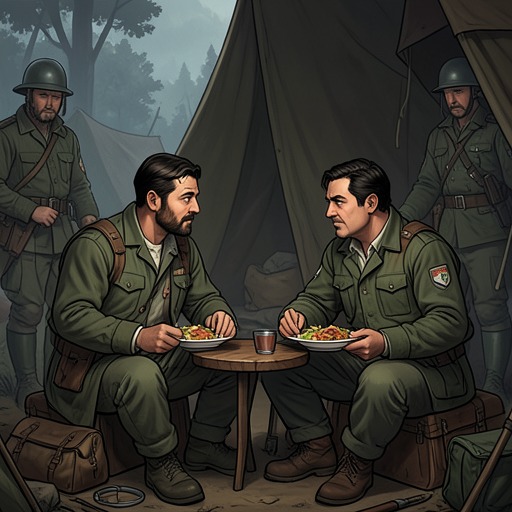
When Mabel presents herself for recruitment, she is among young people from across Navon who lack military training. The commander assumes financial hardship might explain her presence and offers other help, but she makes clear that she wants to be a soldier. The response that a soldier must be a man gives institutional form to the barrier she is challenging. Her subsequent place in the army remains precarious: she pays five silver coins for leather trousers and a vest, three times the price of a dress, partly to avoid inviting ridicule, yet she is not properly introduced to the troops. Instead, she is assigned support work, including maintaining weapons and checking equipment, while enduring hostile comments about her being a woman in the camp.
Navi later arranges a safe domestic job for her at a tailor's shop, far removed from weapons and military risk. That attempted redirection underscores the tension in Mabel's position: people around her can recognize her wish to serve and still steer her toward work deemed more suitable or less dangerous. Her eventual exposure to combat makes that tension immediate. She has sought the soldier's role, but the emotional consequences of carrying it out are not something she had anticipated.
The Killing and Immediate Aftermath
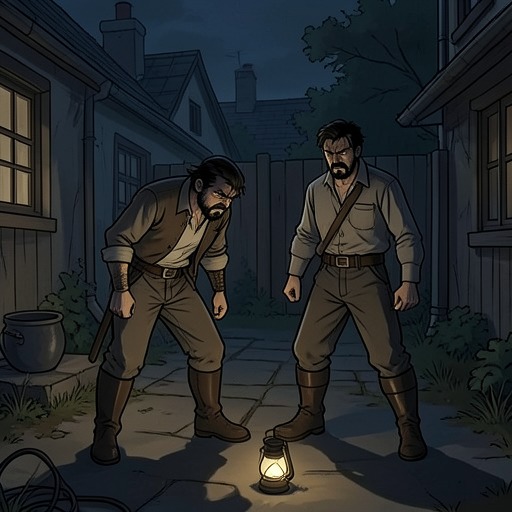
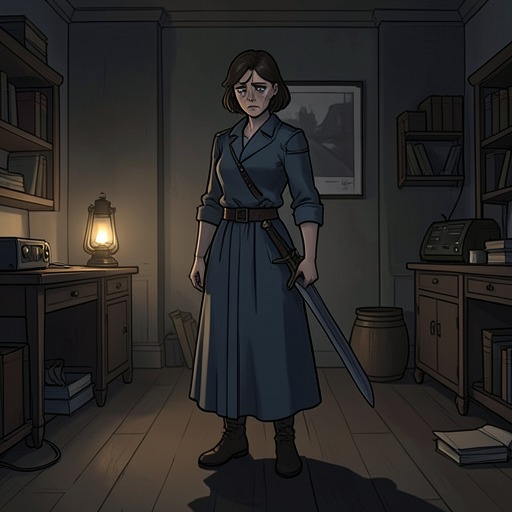
During an attack, a soldier is striking Mabel when she feels his sword at his waist and takes it. She later recognizes that, had she known what she was capable of doing, she would not have drawn it. She had left Navon with Shai without intending to kill anyone. The encounter changes that understanding in an instant: she kills a soldier serving Balthasar, and the act leaves her unable to respond when Shai asks whether she is hurt.
Shai takes her away from the scene, seats her, and gives her water. Mabel is motionless and cannot speak; her hands shake around the glass. When she eventually acknowledges what she has done, Shai does not deny it or tell her that it has no consequence. He recognizes her terror and tries to make room for a conversation. The sequence gives the killing an aftermath as well as an outcome: Mabel's immediate response is not triumph, but shock and an inability to absorb what has happened.
Her account also contains a moral distinction. Mabel does not describe herself as the soldier's victim or him as hers; she places responsibility for the war on Balthasar and insists that he must be stopped. That conviction helps explain how she can continue to regard resistance as necessary without treating her own act as emotionally harmless. The death serves her objective, but it does not release her from responsibility for having caused it.
Recurrence, Guilt, and Fear of Change
The killing returns after the immediate crisis. Mabel has nightmares in which the dead soldier's face appears, and she experiences them as a continuing punishment. At first, she had thought herself stronger than she proves to be. More troubling than the dreams is her fear that, after the guilt of this death has passed, later killings might cease to trouble her. She is afraid not only of what she has done, but of becoming accustomed to doing it.
That fear gives the trauma its central conflict. Mabel wants to oppose Balthasar, yet she does not want military necessity to erase her capacity to feel the human weight of killing. Her anxiety is not that she will fail to become an effective fighter; it is that success at surviving and fighting could come with a loss of humanity. The narrative keeps that concern distinct from the soldiers' mockery and intimidation. She learns to withstand their treatment, but that outward persistence does not end the private recurrence of the dead man's face.
Telling Navi and the Continuing Wound
Mabel later brings the killing into a conversation with Navi, explicitly raising the fact that she has killed someone. Navi listens closely and asks her to explain what happened. She describes the soldier as an animal and says that, despite his service under Balthasar, she felt like the worst person in the world. She does not want to kill again or experience the same feeling. In telling Navi, she gives words to a distress that had first left her unable to speak, though the account does not show the telling as an easy resolution.
Navi responds with grief and warns that military service will repeatedly put her where she must kill or risk being killed; he says that war cannot be survived without sacrifice. Mabel answers that she understands sacrifice. Sven, by contrast, questions whether she could have killed one of Balthasar's men, relying on his belief that a woman is too weak to do so. His disbelief echoes the gendered doubts that marked her entry into the army, but it does not undo the reality of her experience. The exchange places her trauma between two forms of response: Navi recognizes the grim demands of war, while Sven questions her capacity to have faced them.
The wound remains present later, when Mabel tells Navi that she has trouble sleeping. The narration connects the difficulty especially to the killing in Tenerife. His gentle suggestion that she close her eyes cannot make the memory disappear; Mabel indicates that simply deciding to think of nothing does not work. The recurrence across the immediate aftermath, nightmares, disclosure, and sleeplessness establishes the killing as an ongoing condition rather than a single scene that ends when the soldier dies. Mabel's fear of losing her humanity remains unresolved alongside her determination to act against Balthasar.