Navon's System of Banishment for Deserters
NeverthelessNavon's System of Banishment for Deserters makes military desertion a sentence of permanent exclusion rather than a temporary offense. It removes deserters from Navonian society, marks them so they can be identified, and makes their return punishable by death. The rule is presented as an effort to define loyalty and protect the kingdom, but its costs become harder to contain when Navon faces an invasion and the exiles are among the people who might help defend it.
The Sentence and Its Mark
In Navon, a deserter is not merely someone who abandons a military post and receives imprisonment. The sentence described in the novel is exile beyond the kingdom’s boundaries, imposed irrevocably and intended to detach the condemned person from society. The exile must attempt to survive outside Navon without the ordinary support of its community. The punishment therefore changes not only where a person may live but whether that person remains entitled to belong.
The system also makes the condemned status visible. A hot iron is used to mark the back of the neck with a D identifying a deserter, so guards and others can distinguish the exile from Navonians. If a marked person is caught on Navon’s soil, the stated penalty is death. The brand and the border work together: one carries the sentence on the body, while the other defines where the person may not go. Exiles remain subject to Navon’s power even after being cast beyond the society whose protection they have lost.
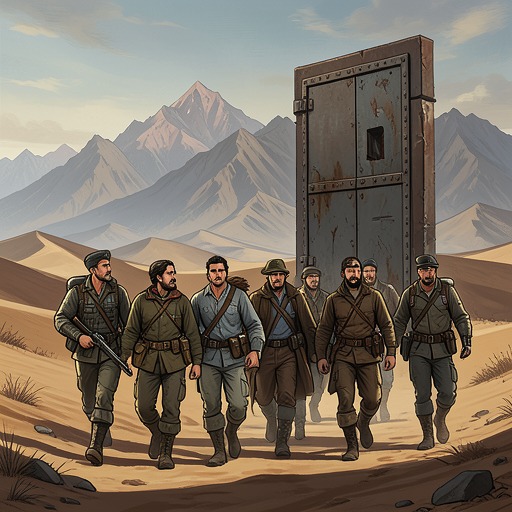
The sentence has practical consequences for survival as well as legal ones. The exiles’ principal means of obtaining food and other necessities is described as taking them from farms and houses outside Navon. The policy thus drives the condemned into precarious circumstances in which subsistence depends on resources beyond the kingdom. It declares them cut off from Navonian society, but does not make them self-sufficient or erase their dependence on the surrounding lands.
Desertion and Navon’s Military History
The rule carries particular weight because Navon’s earlier wars were fought on behalf of other kingdoms. Even Amyntas had fought in battles that were not Navon’s own. The account connects the resulting number of deserters to men who did not want to fight conflicts that they considered unrelated to their country. Alliances had offered the service of Navonian soldiers to defend the territories of more powerful rulers; desertion was one consequence of that arrangement.
That history complicates the official division between loyal soldiers and dishonorable deserters. The punishment treats departure from military service as a profound betrayal, while the exiles later explain that some had refused to fight battles that were not theirs. Their account does not erase the fact that they deserted, but it supplies a political context for the act: the kingdom’s military commitments could demand that men risk their lives for other rulers’ lands. The system makes the refusal legible as individual cowardice, while the history suggests that it also arose from the way Navon used its soldiers.
When Tzara turns its attention to Navon’s gold and land, the kingdom confronts a danger unlike the earlier wars. Navon has not previously been threatened in the same way, but it has also lost soldiers through the very history of warfare and desertion described in the novel. Its former ally is now too afraid of Tzara’s wrath to support it. The system’s exclusion of deserters therefore meets a military crisis in which the kingdom urgently needs more defenders. The narrative does not present the shortage as proof that the punishment alone caused Navon’s vulnerability; instead, it places the depleted army alongside the old policy that has made a large body of potential defenders outsiders.
Gael and the Search Across the Boundary
The system enters Mabel Peloponnese’s family life through her brother Gael, who was exiled from Navon long before she was old enough to understand what had happened. Their father, Amyntas, had served as the king’s commander and saved the king’s life more than once. When the king sought a way to honor his debt, Amyntas had asked for help for his son; by the time the promise was being fulfilled, Gael was already a deserter and only Mabel remained in the family to receive the king’s attention. The family’s connection to military service thus contains both honor and the lasting consequences of exclusion.
For Mabel, finding Gael is not an abstract inquiry into the law. She has not seen him since childhood and knows little that could help her recognize him: she tells a stranger that Gael may resemble her, is good with knives, and fights well. She asks because her father’s promise matters to her, and because locating a brother lost beyond Navon’s borders may offer the only possibility of meeting him again. The rule has separated members of a family not simply through distance but through a prohibition that makes return dangerous.
Shai urges Mabel to use her new position as a princess to seek Gael and help save Navon. In his appeal, the search for one exiled man and the kingdom’s survival become linked. Exile has removed people from the state’s count of its own community, but the political crisis makes their location, abilities, and possible allegiance newly important. Mabel’s attempt to find her brother gives that reversal a personal form: what Navon has declared irrecoverable is precisely what she is asked to recover.
Exile, Identity, and the Question of Return
Among the exiles, the official label does not go uncontested. Alastair objects when Mabel speaks of the group as criminals, distinguishing criminality from the status of men who deserted because they did not want to fight battles that were not theirs. He describes them instead as deserters, exiles, or expatriates. The competing names matter: Navon’s classification makes them offenders who have forfeited belonging, while their own account emphasizes displacement and refusal of obligations they did not accept as their own.
Their relationship to home is not uniform. Alastair says the group will defend its land, while Navon can defend its own; he rejects the idea that family ties alone should make the exiles seek reconciliation with the king who banished them. He describes their life as free from taxes and obligations, presenting release from Navonian duties as an advantage of exile. Yet the separation is not emotionally simple for everyone. When Alastair asks whether Shai’s family ever visited or brought him clothes, Shai says nothing, and Mabel notices his distress. His reaction exposes the personal cost beneath the group’s claims of independence: legal exclusion may end obligations imposed by the kingdom, but it cannot guarantee that old attachments have disappeared.
The exile community’s former preference for life outside Navon is also tested by changing circumstances. Mabel asks why men who chose exile over service in the army might now consider joining a defense. Shai answers that their world is threatened and corrects himself to include himself among those at risk. The difference, as he presents it, is that the danger now reaches the land they inhabit. The possibility of collective defense does not undo the original banishment; it reveals that the interests of the exiles and the kingdom may converge even when trust has not been restored.
The Ban and the Wartime Dilemma
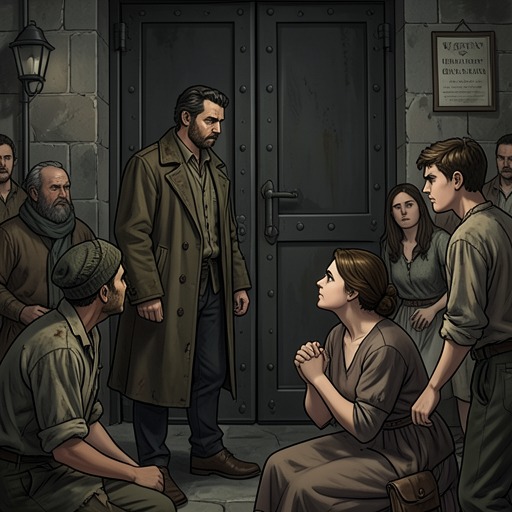
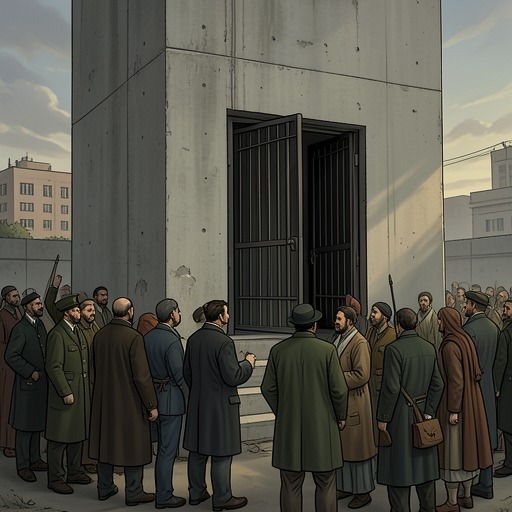
Navi Spyridaki initially resists opening Navon’s gates to Shai’s men. He fears that allowing them back would put the city’s residents, particularly its women, at risk, and that the population might no longer feel safe if former exiles were admitted. His objection shows that the ban functions not only as punishment but as a promise of protection to those inside Navon: exclusion is made part of the kingdom’s account of public safety.
Mabel challenges the description of the exiles as outlaws, arguing that they were condemned for cowardice rather than for the kind of criminality that would make them inherently dangerous. Navi counters that men who left Navon may not return unchanged. Mabel insists that Shai and his men are different, but Navi’s distrust remains a real obstacle. The policy has created a boundary that a military emergency cannot simply remove: even if the kingdom needs fighters, their admission raises questions about security, accountability, and what it means to trust people whom the state once expelled.
The exiles’ own arguments do not settle that dilemma. Alastair says they will defend their land, not return to serve the ruler who banished them; Shai, by contrast, works to bring them into cooperation with Navon against the threat. Their differing positions prevent exile from becoming a single shared political identity. The rule has grouped them under one punishment, but it has not made them equally willing to return, equally attached to Navon, or equally prepared to reconcile with its authorities.
As a result, the system’s central contradiction comes into view without being neatly resolved. Navon has treated deserters as so dangerous to its order that they must be permanently removed and killed if they cross back into the kingdom. Yet, when Navon itself is threatened, the exiles’ knowledge, numbers, and willingness to protect the lands where they live may matter to its survival. The ban’s force lies not only in the severity of its stated penalty but in the enduring social boundary it creates—and in the difficult negotiations required when those cast beyond that boundary may become necessary allies.