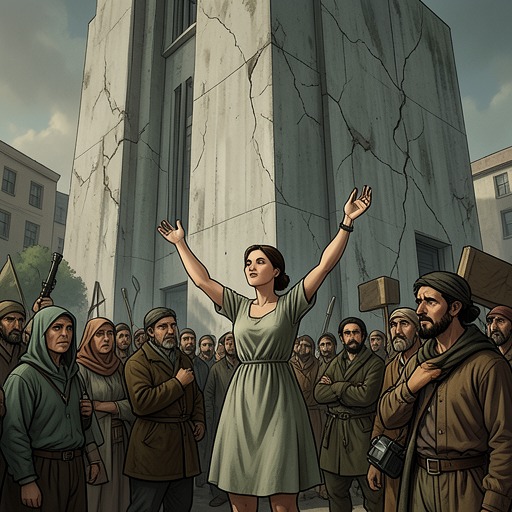
Women Excluded from Navon's Army
NeverthelessWomen Excluded from Navon's Army is a persistent military and social convention, not merely a single refusal at the recruitment gate. It defines soldiering as male, channels Mabel Peloponnese toward domestic work, and leaves her to claim a place in the army without the recognition or protection ordinarily attached to membership. The contradiction sharpens as Navon faces invasion: the kingdom needs fighters, yet its commanders initially insist that a woman is not one of them.
Identity and Social Background
The exclusion belongs to a society that prepares girls for domestic life and treats a woman in the fields as an eccentric exception. Mabel grows up working beside her father rather than learning sewing and cooking with other girls or accompanying them to fairs and traders’ stalls. Her clothes and hair are often disordered after a day in the fields, and her golden skin and wild, burnt hair set her apart from the other peasant girls. Her mother worries that Mabel would fare better by blending in; Mabel and her father do not share that concern. The contrast establishes that the limits on women’s military service begin within a wider expectation that girls should be made suitable wives, not trained for strenuous public work.
Mabel’s class position also shapes the alternatives offered to her. The royal servants must search for her in the fields, where a peasant girl would be expected to work, and the commander later assumes that financial hardship might explain her wish to enlist. He offers to arrange help from the king rather than accept her stated ambition. The offer is generous in its own terms, but it misreads her: she is not seeking a wage or family relief. She wants to become a soldier.
Recruitment and Refusal
The pressure of war makes the contradiction between military need and gender convention especially visible. Navon has not previously been threatened in this way; Tzara’s designs on its land and gold have left the kingdom facing danger without enough soldiers. Earlier alliances had drawn Navonian men into other kingdoms’ wars, contributing to desertions, while former allies now fear Tzara. In this crisis, young people from across Navon assemble for recruitment, many without the experience or training of soldiers. Mabel is the conspicuous exception in a different sense: among the recruits, she is the one person whom the institution says should not be there.
At the recruitment field, the commander first treats money as the likely reason for her presence and offers her a hearing with the king. Mabel declines that substitute and explains that she wants to serve. The commander answers that a soldier must be a man. He argues from physical strength and endurance, then makes his warning explicitly gendered: an inexperienced man, he claims, could overpower her and sexually abuse her. He frames exclusion as protection and as practical military judgment, insisting that Navon does not need her. Mabel counters that the kingdom needs every kind of help. The commander does not engage that claim; he orders a soldier to take her to the gate, and she is led away by the arm.
The rejection is therefore both verbal and physical. The commander asserts authority over who belongs in the army, while the escort turns that decision into enforced removal. Mabel is not evaluated as a recruit on equal terms; her sex is treated in advance as proof that she cannot serve. Her response contests the definition of usefulness itself: in a kingdom short of defenders, excluding a willing recruit is not self-evidently a military necessity.
Conditional Entry and Domestic Redirection
Navi Spyridaki also initially invokes Mabel’s gender. When she seeks army service, he tells her that she is a girl and warns that she may die. Yet he recognizes that no woman has served in Navon’s army before and, rather than simply barring her, permits her to try. His permission comes with a severe limitation: once she enters the field, she will be on her own, and he will not intervene if anyone acts against her. Access is granted, but protection and equal standing are withheld. The arrangement places the burden of overcoming the army’s hostility on Mabel herself.
Her first military role confirms how narrow that access is. She pays five silver coins for leather trousers and a vest—three times what a dress would cost—because she does not want to move around camp in the conspicuous dresses she owns or give the soldiers another reason to ridicule her. Clothing becomes a practical attempt to limit the attention that marks her as out of place. But changing what she wears does not make her a recognized member of the troop. She is not formally introduced to the soldiers or inserted into their ranks. Instead, as a squire, she polishes weapons, checks that they work and are sharp, inspects armor and cavalry outfits, and follows the commander so she can respond to his or the soldiers’ needs.
Those duties place Mabel near the machinery of war without granting her the status of a fighter. Soldiers continue to make nasty comments about her presence, and she sees that they underestimate her and that she has little opportunity to prove herself. The army can use her labor while keeping her at its margins. Her situation is not a simple reversal from exclusion to acceptance: she has entered the camp, but the work assigned to her and the way she is treated preserve the distinction between a woman who serves and a soldier who belongs.
Authority, Need, and Unequal Belonging
The army’s gender boundary is part of a larger struggle over who may decide what Navon needs. In Navi’s office, an adviser dismisses him as a child who has spent two years abroad and argues that the counselors should handle the kingdom’s affairs. Navi insists that, as the person placed in charge while the king is away, he has authority to direct them. His conflict with the adviser shows that military and political decisions are contested even among men who already occupy recognized positions of power. Mabel faces a more basic hurdle: she must first persuade the institution to recognize her as a possible participant at all.
As the invasion threat grows, practical arrangements continue to distinguish between kinds of people and the roles assigned to them. Shai’s band discusses fighting for Navon, with the question of payment raised in negotiations; the formation of a defense depends not only on who is willing to fight but also on how forces can be assembled. Later, when villagers are warned of an impending attack, women and children are directed inside the castle walls for safety while men are told to stand and fight. Mabel understands the recommendation but is unsure she can accept it. Having shown herself alongside the soldiers, she fears that withdrawing would leave them to die and make her a different kind of soldier than the one she has tried to become. Her hesitation exposes the strain between a protective category that groups women with children and her own claim to share the risks of defense.
Change and Significance
Mabel’s treatment shifts between outright rejection, conditional entry, marginal military labor, and an alternative domestic job. After Navi promises to find her work, Amir takes her to a village tailor. Mabel discovers that the position is tailoring, not work with weapons or in the kitchen. She objects that she is poor with needles, cannot stay still, and dislikes indoor work. The placement offers a safer occupation, but safety is not the same as recognition of her chosen capacity. It repeats the pattern in which others decide what is suitable for her before taking her own account of what she can do seriously.
The exclusion is thus maintained not only by saying no, but also by controlling the terms of a qualified yes: Mabel may enter the camp but remain outside the troop, perform useful work without being treated as a soldier, or be redirected toward civilian employment. Her persistence makes the distinction visible. Navon’s need for defenders does not automatically undo its assumptions about women; instead, the crisis reveals the cost of those assumptions and the labor Mabel must undertake to challenge them. When defense planning again separates women and children from the men expected to fight, her uncertain response shows that the conflict remains unresolved: she has claimed the name and obligations of a soldier, while the categories governing protection and military service still press her toward exclusion.