The Killing of the Cat
NightbitchThe Killing of the Cat is the novel's central eruption of violence, the moment when Nightbitch's accumulated mother-rage and her creeping canine transformation detonate in a single, wordless act. It is the event that converts her private, half-joking self-identification as a dog into something horrifyingly literal, and it forces her, for the first time, to confront the possibility that she has become a danger to her own son. The killing is not a calculated act but a pure, instinctive explosion, and its aftermath — the blood-soaked kitchen, the boy's fascinated horror, the solemn backyard burial — marks a turning point in her arc, the moment she resolves, yet again and with new desperation, to Get It Together.
The Morning of the Killing
The killing unfolds on a gray, dry morning when Nightbitch is already frayed past the point of endurance. She has forgotten to feed herself while remembering to feed everyone else in the house, and the rotting potatoes in the garbage smell atrocious. She tries listening to the news, but it only incites her blood-thirst, so she shuts it off and paces by the sink. Searching a cupboard for something to stop the throbbing in her head, she slams the door without finding so much as an ibuprofen. She picks up a knife to cut something, anything, and turns to search for an apple or carrot or goddamn beef jerky. It is at this precise, absurdly mundane moment that she steps on the stupid cat, which has just finished its second breakfast and come to hover, weirdly and silently, just behind her feet. Nightbitch trips, sprawls hard on the kitchen floor, and in doing so comes down hard on the cat, sending it skittering toward the living room, eyes wide and green, its body bobbing on spindly, cartoon-fast legs.
The Act Itself
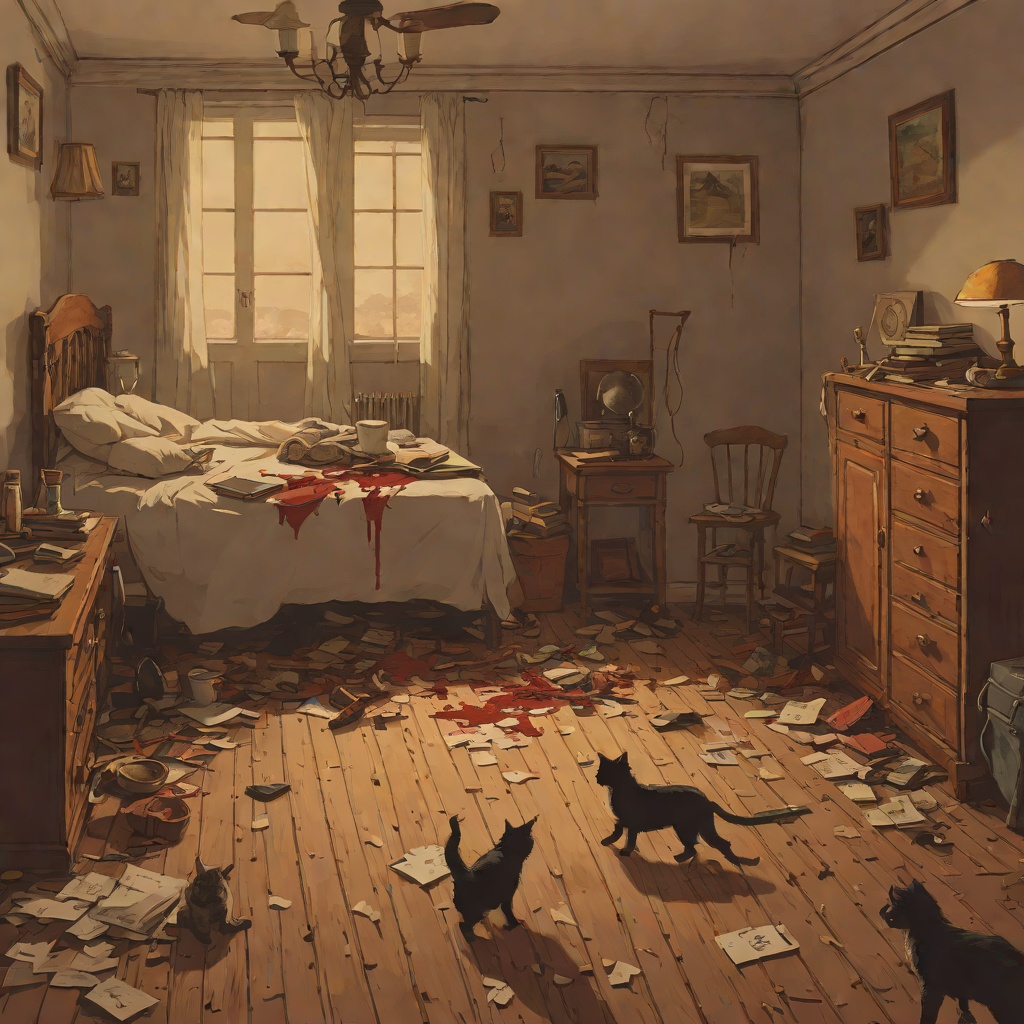
Nightbitch's knee pulses with pain, as does her haunch, and her eyes flare with silent rage as she lunges after the cat. She catches it by its back legs, pulls it across the hardwood floor, and plunges the knife into its chest. The cat's green eyes widen even more, revealing not a hint of intelligence, just dull instinct. She jerks the knife through the soft girth of its belly, and the animal splits open like a pair of tight pants. Nightbitch growls in her chest as she bends to wrap her teeth around the nape of the cat's neck. She rises in blind fury and shakes the body back and forth, the cat deflating — squeak by small, breathy squeak — with each fling, blood splattering on the white cabinets and across the worn wood floor. A loop of purple intestine slips from the wound and flips back and forth like a wet scarf. A thick warmth spreads down her chin and onto her chest, and in this ecstasy, she swings her head back and forth with even greater fervor, intestines and organs slapping her face and falling to the floor. She shakes harder, furiously, blood flung to every corner of the kitchen, until a sharp snap, and the body relaxes into ultimate resignation. She stops. Blood drips onto her bare feet and in between her toes. She drops the thing from her mouth into her hands and holds it there, to sniff it and nudge it with her nose, examine it with an animal curiosity, to watch it and in this strange reverie stand still inside a gripping and extraordinary chaos.
The Boy's Discovery
The boy enters the kitchen to find his mother's face covered in blood, her hands, too, a bloodstained robe sliding from her shoulder as she picks tufts of black fur from her mouth, a pile of black fur at her feet, motionless. Blood is on the cabinets, on the floor, on the ceiling. The boy freezes, eyes wide, looking from the pile to his mother, then back again. Then, instead of recoiling, he tentatively edges toward her, sniffs her robe, then sniffs the dead cat. He nudges the body with his nose, lifts the cat's paw, and watches as it falls. Get kitty! he screeches, his blood rising from the scent of death. Nightbitch, jolting back to the dry air of the gray day, is horrified by what this might mean. She does not want blood on his perfect skin, does not want him to involve himself in this insanity. It all must be shut down, must be cooled off, the doggy games and whatnot. She realizes she hadn't been thinking at all — she had been pure emotion, pure yearning and rage.
The Burial and the Terror
Nightbitch tries to undo the horror. Poor kitty, she says, stroking the animal, now a pile on the floor. She looks into its fixed, dead eyes, at the horrible wound down its belly, purple guts spilling out. She tries to push it all back in, grabs a towel from beneath the sink to wrap the creature, to try and dignify this undignified situation. When the boy asks if they will eat it, she tells him, Kitty isn't for eating. We must bury her in the backyard. Say goodbye, kitty. We loved you. Kitty was our friend. So the pair spends the afternoon digging in the backyard, first with shovels and then with their hands, spraying dirt behind them as they tunnel into the earth, deeper and deeper. It is, in a word, a delight — the smell of the loam, the wriggle of worms, thick tree roots in which to sink one's teeth and pull and pull and pull. When they finally have a hole deep enough, both mother and son are blackened with their work, faces muddy, with tender fingers, but still — it had been worth it, for the fun of it. They wrap the cat in an old baby blanket and lay her in the ground. The boy looks on solemnly. We should say some nice things to send her off, she says. Oh, cat. You were quite beautiful, and your meow used to be so sweet, like a bell. Thank you for being our kitty. Kitty soft, the boy says, then scampered into the hole to place the last remaining unopened can of cat food beside her.
Aftermath and Resolve
The burial is a moment of strange, almost tender communion, but it is immediately followed by terror. Nightbitch is scared now, really really scared, even more scared than after that first transformation and nighttime romp, and she does not turn from this emotion but instead falls all the way into it. It is the same scared she'd felt back in her twenties when she drank too much and, in the morning, was left with a vague sensation of dread. What had she done? Where had she been? She frantically decides, yet again, that it is high time she could not go on like this, with the unhappiness and this now uncontrollable rage, especially not around her son, her poor sweet little angel of a son, whom she would never harm, not ever. But still, look what she had done to the cat — it is terrifying and she is terrified, brought nearly to tears of ultimate terror when the thought of gripping the back of her son's neck in her teeth passes by her like a driverless school bus packed with hysterical children careening toward a cliff. She resolves to lean into setting goals and achieving outcomes, to get back on track in a real way, to take a deep, cleansing breath and set her sights on being sensible, as her mother had once, had always, commanded. She must maintain a placid disposition of motherly care even while the panic of the world whizzes around inside her. No coffee. More vegetables. Cook the meat. Clean the house. Go for walks. A consistent bedtime each night, and consistent getting-up time, too. Plenty of socialization. But she cannot bring herself to leave the house, and instead commits to a quiet week of crafts and trains and cooking and lawn care.
The Killing's Significance
The killing is the culmination of everything that has been building in Nightbitch since she first found the patch of coarse black hair sprouting from the base of her neck and thought, What the fuck. It is the physical enactment of the mother-rage that has been inflating her since she quit her job, the rage she directs against the system and capitalism and the patriarchy and then religion and gender roles and biology. It is also the brutal proof of her transformation: she does not merely feel like a dog, she kills like one, with her teeth, shaking the life out of a smaller creature. The cat, which she had once wanted to decorate with tiny ornaments because it resembled a Christmas tree, which she had called her ballerina, her baby, becomes the sacrifice that reveals the cost of her becoming. The event also echoes her own childhood, her grammy's world of wood-and-bone projects and quiet Appalachian skills, and her mother's command to be sensible — a command she now hears in her own voice as she tries to clean up the blood and bury the evidence of what she has become.