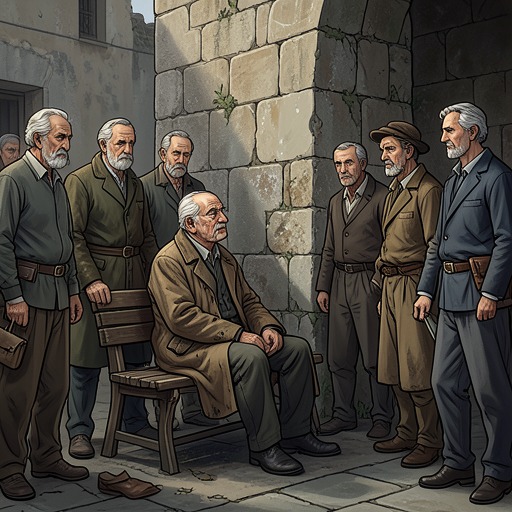
Passage of the U.S. Social Security Act
NomadlandPassage of the U.S. Social Security Act in 1935 turned retirement from a rare privilege into a federal policy commitment, responding to widespread old-age poverty while requiring workers to contribute to a shared fund. The book treats the Act as a consequential turning point, but not a guarantee of security: the system it helped establish would later be strained as pensions and savings weakened, leaving growing numbers of older Americans dependent on continued work and family support.
Depression-Era Need and the Townsend Plan
The Great Depression made retirement an urgent economic and political question. There were too many workers and too few jobs, while older Americans were increasingly unable to support themselves. By 1934, more than half lacked the means to do so. State pension systems existed, but their patchwork coverage reached only a fraction of elderly people in need.
Francis Townsend, a California physician whose earlier work had included farming hay and managing a failing dry-ice factory, proposed a more sweeping alternative. Under the Townsend Plan, a worker who retired at sixty would receive a federal monthly pension of as much as $200. The proposal quickly attracted a grassroots following: thousands of Townsend Clubs formed around the country. The book identifies this movement as part of the political pressure that preceded federal action, not as the policy Congress ultimately adopted.
The 1935 Act and Its First Payment
In 1935, President Franklin D. Roosevelt and a Democratic Congress passed the Social Security Act. Unlike the Townsend Plan, the Act required future retirees to contribute to a common fund throughout their working lives. It thus established a contributory structure for federal retirement benefits rather than the Townsend proposal’s pension for those retiring at sixty.
The first Social Security check went to Ida Mae Fuller, a sixty-five-year-old retired legal secretary in Vermont. Issued five years after the Act’s passage, it amounted to $22.54. The small first payment gives the reform a concrete human measure, while the contribution requirement marks a lasting design choice: retirement income would be linked to participation in a shared system across a person’s working life.
The Three-Legged Stool and Its Erosion
After the New Deal, economists described American retirement finance as a three-legged stool: Social Security, private pensions, and personal investments and savings. The model joined public provision to employer-based and individual resources. In the book’s account, however, two of those supports have since been weakened. The Great Recession destroyed many households’ assets, while saving had already declined for many people. Since the 1980s, employers have also replaced defined-benefit pensions—which promise a monthly payment—with 401(k) plans that often depend on employee contributions and may be depleted before the recipient dies.
The shift matters because the alternatives do not provide the same kind of security. A defined-benefit pension guarantees a continuing sum; a 401(k) makes the worker’s accumulated balance, and the risks attached to it, central to retirement income. The book connects that change to a broader transfer of economic risk away from collective arrangements and onto families. Social Security remains one leg of the model, but the weakened others help explain why the 1935 reform cannot be read as having settled the problem of retirement insecurity.
The Later Test of the Reform
The contemporary consequences appear in the lives of older workers. Many workers in the Amazon camps belonged to a rapidly growing group of downwardly mobile older Americans, whose circumstances would have seemed difficult to imagine in the era of stable jobs and pensions associated with Empire. In 2016, nearly nine million Americans aged sixty-five and older were still employed, 60 percent more than a decade earlier. Economists expected both that number and the share of seniors in the workforce to keep rising; only 17 percent of older Americans surveyed anticipated not working at all in later life.
David Roderick’s experience shows what continued employment can mean in practice. At seventy-seven, he recalled selling Christmas trees with his wife while living in their fifteen-year-old Lazy Daze RV. His work included carrying trees as tall as nine feet and lifting them onto customers’ vehicles for eight to ten hours a day, six days a week. A former community-college teacher whose pension had been cashed out during an earlier divorce, he described older workampers as dependable but also as effectively slave labor. At Adventureland, a seventy-seven-year-old former recruiter pointed to coworkers who were eighty and eighty-six, as well as employees with disabilities who performed assigned tasks; the ride operator at the Tornado rollercoaster was eighty-one.
These examples make the Act’s history more than a story of enactment and first payment. The law answered a crisis by creating a durable public institution, yet the book places its legacy beside retirement systems that have shifted risk back to individuals and a labor force in which older people increasingly continue working. The distance between a federal pension promise and the bodily demands of late-life employment is the central tension in that legacy.