Rubber Tramp Rendezvous
NomadlandThe Rubber Tramp Rendezvous is a winter gathering organized by Bob Wells for people who live in vehicles, and its importance lies in making a dispersed, often solitary way of life briefly communal. In Quartzsite, Arizona, practical teaching and informal generosity help newcomers find companionship, while the gathering’s growth and the limits on public-land camping expose the pressures that shape life on the road. For Linda May, who arrived craving a community after months of solitary seasonal work, the event became a place where survival could begin to feel like thriving.
A Gathering for People on the Move
Bob Wells presented the gathering as a chance for modern vehicle dwellers to learn and make friends: people might need to be alone and mobile, he explained, yet still need occasions to connect with others who understood their lives. That promise spoke directly to Linda May. Seven months after setting out in her RV, she had completed her first six months of workamping, including camp hosting and a seasonal job with Amazon CamperForce. She had established a frugal mobile routine, but the overnight warehouse shifts were strenuous and isolating, and cold weather had kept neighbors inside their vehicles. The Rendezvous offered something her work schedule had not: time and space to meet people.
Her arrival carried its own uncertainties. After driving from the Amazon warehouse in Fernley, Nevada, she stopped in Needles, California, to sleep in her twenty-eight-foot motorhome without attracting police attention. The following morning, while trying to renew her expired registration, she repeatedly followed her phone’s directions back to the same place before discovering that the DMV office was near the strip mall where she had parked overnight. Quartzsite was less than two hours farther south. Linda had never attended the gathering, did not know how to find its camp, and had not joined the online conversations through which some newcomers made contacts in advance. Silvianne Delmars was the only person she knew there; Jen and Ash would not arrive until well into the two-week event. Linda also wondered whether the predominantly minimalist vehicle dwellers would accept her large, fuel-hungry RV.
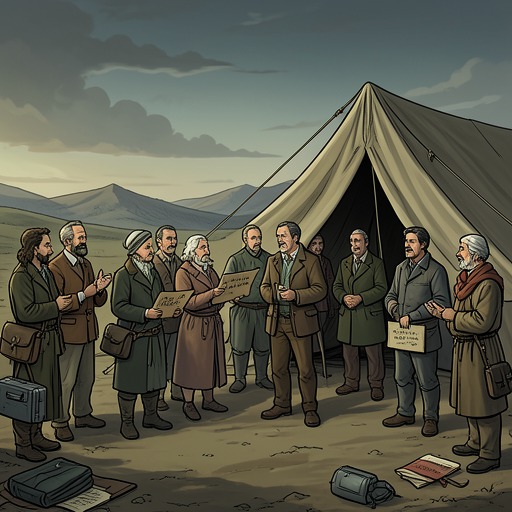
The Rendezvous answered some of that uncertainty through its ordinary arrangements. At the fourth winter gathering, Bob put up a sign on heavy-duty stakes, prepared a calendar of social activities and seminars, set out a tipi-style tent stocked with basic toilet supplies for newcomers, and laid a blue tarp on the ground as a free pile. The pile reflected a practical problem shared by people living in small spaces: possessions had to be shed to make room, and useful items could pass to someone who needed them. Books, clothes, auto parts, camping gear, and household odds and ends appeared there. Linda browsed for books and chose a paperback about the symbolism of the dollar bill.
Skills, Food, and Mutual Support
The gathering’s program extended beyond formal seminars. People contributed what they knew and had. A licensed cosmetologist offered haircuts for optional donations; mechanics taught basic repairs, while carpenters built beds and shelves sized for gutted vans. People with large solar panels shared excess electricity by leaving extension cords available for others to charge devices. A deaf attendee led an informal American Sign Language class. At a tire-repair demonstration, participants practiced plugging a leak in an old steel-belted tire and learned about portable twelve-volt air compressors. Linda valued these skills enough to draw on them later, when she used what she had learned to help forest rangers whose fire truck had a flat.
Generosity also made the gathering legible in daily rituals. Each morning, Lesa NeSmith started a campfire and made cowboy coffee for anyone who came by with a cup. The practice continued a habit she had formed in an earlier home: brewing coffee and leaving her apartment door open so neighbors could share it. Communal meals followed the same logic. At a baked-potato night, people brought their own toppings; at chili and soup dinners, everyone added ingredients to shared cooking pots. The meals recalled the communal stews associated with the Great Depression. After dark, someone lit a large bonfire, though people often drifted away by nine or ten as the evening cooled and sleepiness set in.
Specialized help could matter as much as food or instruction. Swankie demonstrated her solar oven by baking brownies, banana-nut bread, and blueberry muffins for the group. Later, during a cold spell near Quartzsite, Kat and Mike ran out of fuel while trying to keep warm in a vehicle with a broken fuel gauge. Vincent drove them to town the next morning to refill a fuel jug; they returned with food-bank provisions, including apples, sausages, and a large bag of salad. On another outing, Swankie led a caravan to see petroglyphs and then used her van and a nylon strap to pull a stranded vehicle out of a ditch. The acts were modest in scale but concrete in effect: shared knowledge, food, equipment, and labor helped people manage problems that would otherwise be faced alone.
Linda May’s First Rendezvous
After a budgeting seminar, the narrator met Linda May at her first gathering. She recalled a simple trip into town with Silvianne Delmars to find a place to leave their trash. In that ordinary errand, she recognized a life she had not expected to enjoy and described feeling joy for the first time in years. A few days later, she said she had moved beyond merely surviving and was beginning to thrive in old age. Her delight did not erase the financial insecurity that had brought her onto the road; instead, it marked a change in what the mobile life could contain. Work and exhaustion remained part of her experience, but so did friendship, humor, and a new sense of belonging.
The gathering also gave those bonds a visible form. When the event ended, Linda made coffee with the narrator before preparing to leave. She showed the narrator a new solenoid, installed with a friend’s help, that would let her charge the RV’s house battery from the overflow of her car battery while driving. Practical knowledge and practical assistance had become part of her developing network. She hugged Jen and Ash goodbye as they headed toward another adventure, then hurried to break camp and follow Bob Wells to Ehrenberg, Arizona.
Growth, Regulation, and Departure
The gathering’s community existed within limits set by its location. The fourteen-day public-land camping period was about to expire, and that year there was no way around the deadline. On the first day, a Bureau of Land Management ranger had issued permits and recorded license plate numbers; campers would soon have to move at least twenty-five miles. As the end approached, questions about work and destinations replaced the earlier ease. Some attendees left alone, others traveled in small groups, and possible routes included Slab City, the Yuma area, and destinations in Baja for those with passports and enough money for fuel. The departure dispersed people whom the gathering had temporarily brought together.
At the end, Bob took down the official sign. Silvianne packed up the unclaimed free-pile items, including a large straw sombrero, for a local thrift shop. Linda left with the new electrical knowledge and relationships she had gained, rather than with a permanent solution to her uncertain working life. In Ehrenberg, she later became ill with bronchitis and was too weak to cook. Neighbors brought her boiled eggs, tomatoes, and sausage. The care she received extended the Rendezvous’s ethic beyond its formal two weeks: a community built through recurring gatherings could continue to provide help after people moved on.
Later meetings showed both the event’s growing reach and the challenges that growth brought. When Linda returned in 2016, after missing the intervening gatherings, rain had slowed the start and kept people in their vehicles. Once the weather improved, the population was about four times larger than at her first visit in 2014; Bob Wells estimated that 250 people had attended. Some longtime attendees and introverts stayed away because the event had become so large. The program included a new session on living in small cars, presented by David Swanson, who described his salvaged Prius as a way to travel and meet his basic needs.
The event also addressed the administrative obstacles facing people without conventional homes. At a seminar, Bob Wells warned that REAL ID requirements were making it harder for nomads to use mail-forwarding services as residential addresses. Some motor-vehicle officials checked whether an address belonged to a business and demanded a residential one, leaving vehicle dwellers to seek alternatives such as using a relative’s address or claiming an address at a property for sale. The gathering offered information and solidarity, but it could not remove the systems that made mobile life harder to register and sustain.
Ritual and an Expanding Gathering
At the close of one Rendezvous, attendees made a small van from an Amazon shipping box, signed it, and threw it onto the bonfire in a new ritual called Burning Van. They sang newly written lyrics to the tune of Little Boxes, turning a discarded package into a communal farewell. The gesture joined humor with an awareness of the consumer economy that many attendees had left, or had been pushed away from, and gave the gathering a ritual ending before its participants scattered again.
By the time Bob Wells prepared the 2017 meeting, he expected hundreds of people. He introduced rules against loud music and unleashed dogs and removed traditional group meals from the schedule because feeding so many attendees would be difficult. More than five hundred mobile dwellings ultimately arrived, many drawn by his YouTube videos. David Swanson, then parked on Padre Island in Texas, asked whether the narrator would attend; after three consecutive Rendezvous gatherings, the narrator declined because the book was nearing completion. That absence marks a limit in the account as well as a change in the event: the gathering continued to grow after the narrator stepped away. Across these returns, the Rubber Tramp Rendezvous appears not as a permanent refuge but as a recurring meeting point, where practical help and chosen kinship make life on the move more possible without making its economic or regulatory constraints disappear.