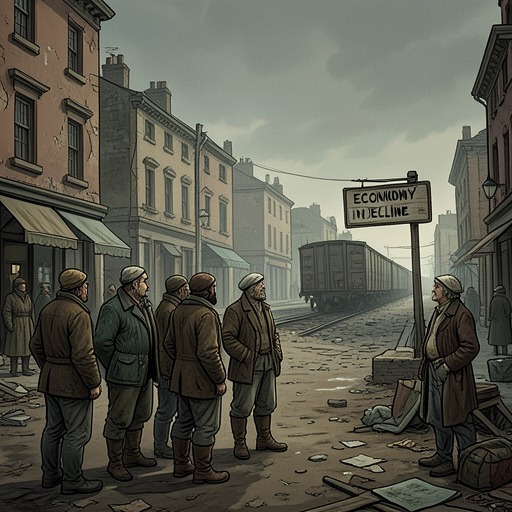
Closure of Empire, Nevada
NomadlandThe closure of Empire, Nevada ended not only a gypsum factory but an entire company-owned town, where steady industrial work had supported homes, services, and family life. Announced on December 2, 2010, the shutdown set a deadline for residents to leave and turned the loss of a job into the loss of a home. Its aftermath made visible the fragility beneath a community that had seemed insulated from the economic insecurity beyond it.
A Company Town at the Edge of the Desert
Empire was a factory village of roughly three hundred people in northwestern Nevada, clinging to the edge of the Black Rock Desert. United States Gypsum Company owned the town and made Sheetrock at its plant. Six miles north, the company’s open-pit mine cut into the Selenite mountain range. Miners used blasts of ammonium nitrate and fuel oil to break gypsum from five terraced pits; haul trucks carried loads of the ore to the factory, where it was pulverized, heated, and made into wallboard for homes across the American West.
The company town offered a material security that was increasingly uncommon elsewhere. Rents could be as low as $110 for an apartment or $250 for a house, while mechanics at the plant earned as much as $22 an hour. The company also paid for television, sewer, trash, and internet service. A worker could cover a month’s rent with a day or two of wages, and living paycheck to paycheck felt relatively foreign. Cottonwoods, elms, and silver poplars lined the residential streets; residents cultivated green lawns against the arid surroundings. Empire’s social life included neighborhood gatherings and excursions into the high desert to hunt deer, antelope, and chukar. In satellite images, the town appeared as a conspicuous patch of green amid the brown desert.
That relative stability had a history. Laborers established a tent colony at the site in 1923, and mining there had roots in a claim established in 1910. Yet the close-knit life of coworkers and neighbors also meant that people watched one another closely. Empire’s sense of permanence rested on a single industrial employer and a market for the material it produced.
The Announcement and Its Cause
At 7:30 on the morning of December 2, workers gathered in the community hall for a mandatory meeting, still wearing steel-toed shoes and hard hats. Plant manager Mike Spihlman announced that Empire was shutting down and that everyone had until June 20 to leave. The news first met silence, then tears. Spihlman later recalled having to tell ninety-two people, “Not only do you not have a job anymore, you don’t have a house anymore.” Employees were given the rest of the day off and returned to homes they knew they would soon have to surrender.
The closure followed sustained losses at United States Gypsum Company. The $4 billion company had lost $284 million by the end of the third quarter of 2010. Its chief executive cited weak market conditions and low shipping volumes; in practical terms, demand for Empire’s wallboard was no longer sufficient. Wallboard manufacturers depended on domestic construction, and the housing-market collapse had depressed that industry for too long. The recession had damaged many communities, but in Empire the company’s decision meant that the town itself would disappear.
Work Ends, and Residents Disperse
The closure became tangible in the factory as production stopped. In January 2011, the book’s narrator visited Empire and spoke with Calvin Ryle, who had started at the plant on July 1, 1971, and had worked there for thirty-nine years and seven months without missing a day or suffering an injury. As the employee with the longest continuous service, he was given the task of halting the production line. Standing beside a conveyor belt, with coworkers watching, he pressed the stop button and wept. His son also worked at the factory. For Ryle, the silence that followed the shutdown marked the loss of work he understood as participation in building America, as well as a place to raise children and earn a solid living.
The effects were uneven. More than a dozen former employees found jobs at nearby Barrick Gold Corporation mines, which were hiring as gold prices rose. Others struggled to find new work. Former supply-chain manager Dan Moran had sent out résumés without receiving offers and feared he might have to cut firewood for a living. Monica Baker, who had moved back to Empire from Oahu with two young children expecting factory work, was angered that the job she had been promised vanished. She considered the gold mines but worried about working near a toxic leach pond, and instead planned to look for work at Walmart or Lowe’s in Fernley, seventy miles south. Her choices registered a larger economic shift away from manufacturing and toward retail and service employment.
A Town Sealed Away
Families continued leaving through June. Once the last had departed, Empire was shut behind chained gates, security cameras, and no-trespassing signs. Its cottages, public pool, two churches, post office, and nine-hole golf course were left to decay; even the local zip code, 89405, was expunged. The company brought in two dozen goats to keep weeds down. At the factory office, unfinished cups of coffee remained on desks and calendars still showed the shutdown date, small traces of ordinary work interrupted rather than neatly concluded.
The town’s last image was not only one of abandonment. Years later, Google Maps Street View still showed Circle Drive as it had appeared in 2009, with parked cars, lawn furniture, and residents watering their yards. The frozen view preserved a living neighborhood after the actual community had been emptied and sealed away. Set against the temporary-worker settlement developing near Fernley, Empire’s closure marks the collapse of one model of company town: not a gradual decline in which residents could remain, but the severing of jobs, housing, and community together.