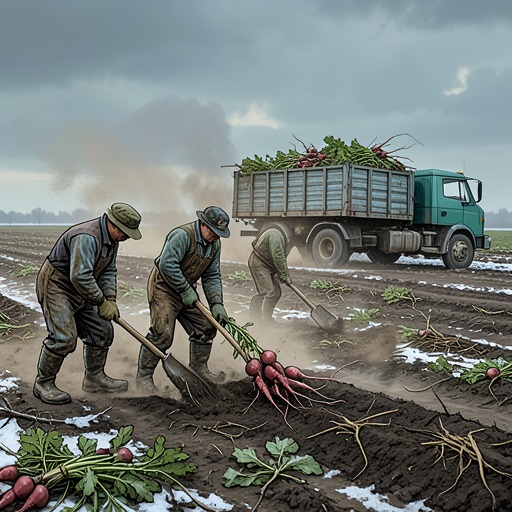
Red River Valley sugar beet harvest season
NomadlandThe Red River Valley sugar beet harvest season is an autumn labor campaign organized around an unforgiving deadline: moving beets from the fields before freezing ground and changing weather interrupt the harvest. At Drayton Yard, the narrator joins the ground crew at a storage and processing facility, where the scale of the operation depends on constant truck arrivals and sustained manual cleanup. The work reveals the physical demands and risks behind a regional industry that recruits people willing to travel with their homes to reach the harvest.
Regional Stakes and Recruitment
The narrator first encountered the harvest through a recruitment seminar for seasonal workers. Scott Lindgren, a managing partner at Express Employment Professionals, praised the work ethic and reliability of older RVers. Months later, the narrator’s application was accepted by the agency, which hires workers for American Crystal Sugar Company. The region’s reliance on itinerant labor has a practical cause: it has nearly full employment, making it difficult to recruit enough workers locally. American Crystal therefore seeks people who can travel from elsewhere, bringing their own homes, for the autumn season.
The crop is central to sugar production in the United States. Sugar beets account for 55 percent of the country’s manufactured sugar, and more than half of its beet acreage—about 680,000 planted acres—lies in the Red River Valley, across western Minnesota and eastern North Dakota. The harvest’s busiest period is treated as a campaign: the main push begins at midnight on October 1, as farmers try to lift the beets before the ground freezes and keep them cool enough to prevent rot. At the receiving stations, this agricultural deadline becomes a continuous flow of heavy vehicles and produce.
The narrator arrived during the last week of September at Drayton Yard, near the Canadian border, equipped with two pairs of heavy-duty gloves. The campaign’s scale was visible on the roads as well as at the plant. Semitrucks carried several tons per load to storage facilities around the clock, with some loads heaped above the sides and beets spilled along the highways. At peak, American Crystal’s more than three dozen receiving stations handled roughly 50,000 truckloads a day. Local criticism of rules allowing inexperienced farm workers to haul multi-ton loads without the commercial driver’s licenses required of most truckers adds another dimension to the rush: speed and volume brought transportation risks beyond the plant itself.
Work at Piler Number One
The narrator was assigned to twelve-hour shifts on the ground crew at Piler Number One, inside a refrigerated shed with a concrete floor. A pre-pile already stood there, estimated by the orientation trainer at about 20,000 tons. The season’s beets were reportedly larger than the previous year’s, some approaching the size of basketballs. The indoor station offered protection from rain and snow, but its enclosed setting meant greater exposure to machinery noise and fumes, alongside the mixture of dust and muddy produce.
Each truck was weighed at the scale house, then directed to the piler. This large, tracked machine received each load through a hopper secured behind the truck. Beets passed over a conveyor to a tumbler that removed excess dirt, which dropped back into the truck; further belts carried the cleaned crop up a long boom and onto the growing storage pile. The piler itself moved backward as the pile expanded. By the end of the harvest, the mound was expected to extend the length of two Boeing 747s parked end to end and to be about as wide as their wingspan. A forced-air system kept the stored beets near freezing while they awaited transport to a refinery. The sequence linked individual trucks, machinery, storage, and later processing in a single continuous operation.
Repetitive Labor and Safety Risks
The ground crew’s central task was to return spilled beets to the hoppers with pitchforks and agricultural scoops. When repeated lifting became difficult, workers gathered smaller loads by hand. They also cleared mud from the concrete with snow shovels, which could become stuck and require a forceful push to free. A sample-taking assignment required workers to hold open vinyl sacks beneath a chute and keep them steady as beets fell into them. The work was not simply waiting beside a machine: it involved repeated lifting, shoveling, cleanup, and close attention to loads moving through the equipment.
The pace was closely supervised. Workers were discouraged from standing idle, and if cleanup fell behind, the overseer sounded a horn from the elevated control booth and gestured for the crew to shovel faster. Cleaning the piler was especially compressed: after the supervisor shut down the machine, workers climbed inside to scrape the main chute, with fifteen minutes allowed for the task because downtime was costly. The time limit made the machinery’s productivity requirements immediate and tangible, shaping both the speed and the physical demands of the crew’s work.
One shift brought a more serious warning about what could enter the system unnoticed. A seven-foot metal pole from a broken harvester had arrived hidden in a beet load and traveled partway up the first conveyor, nearing the tumbler. The crew’s overseer called an emergency shutdown before it reached the machinery, averting potential damage and danger to workers nearby. Later that day, a coworker slipped on the concrete and filed an accident report. Together, the two incidents show different aspects of the site’s hazards: an unexpected object moving through industrial equipment and the risks of working on a floor that could become slippery.
The Workforce and the Cost of the Campaign
The shift pattern shaped life beyond the yard. After two days of orientation, the narrator completed a twelve-hour shift and drove back to the campsite in the dark. Bathing facilities had been promised, but the campground section where they were located was still under construction. The narrator cooked in the van and went to sleep in work clothes before returning at dawn for another shift. The account makes the workday’s demands visible not only through the tasks at the piler but through the limited time and unfinished facilities surrounding the temporary workforce.
The workers the narrator encountered came from different ages and circumstances. Dan, a 69-year-old former truck driver, had left his job because of medical problems and had to ask the foreman to move him off night work because he was losing sight in his right eye and needed daylight to get around. His wife, Alice, lived with him in their motorhome but could not work after being diagnosed with ALS. Other residents of the campground included workers in their fifties, younger employees, and a young couple living in a pickup truck. The seasonal workforce was therefore not a single kind of migrant: it included older people managing health and income constraints alongside younger workers making do with very little.
The campaign’s defining contrast is between its immense scale and the ordinary, repetitive labor that keeps it moving. Tens of thousands of truckloads could arrive at receiving stations in a day, but at Piler Number One the process depended on a small ground crew returning spilled beets to the hoppers, clearing mud, and responding quickly to machines and supervisors. By taking a recruitment story firsthand, the narrator connects the regional race against freezing weather to the workers’ schedules, campsite conditions, and exposure to hazards. The harvest appears as both an industrial achievement and a temporary labor system whose speed is sustained through demanding work.