First Palestinian Intifada
OsloThe First Palestinian Intifada forms the violent political landscape against which the play’s peace effort takes shape. Through Mona Juul’s account of armed youths who share the same fear, and through later scenes of retaliation, economic pressure, and negotiation, the uprising is shown not as a conflict resolved by one agreement but as a crisis that made the search for another future urgent while leaving its underlying dangers in view.
Human Stakes and the Moment of Recognition
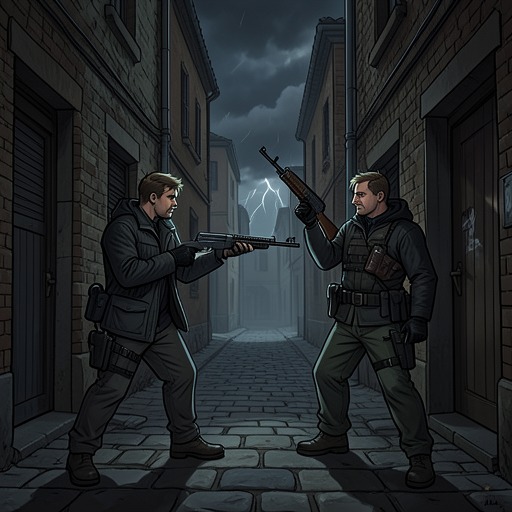
Mona Juul describes crouching with Terje Rød-Larsen behind an overturned car as people were being killed. What arrests them is the sight of two boys facing one another, one in uniform and one in jeans, both armed. Their faces appear identical to Mona and Terje: each bears the same fear and the same desire not to be there, facing the other boy. Mona identifies this encounter as the moment when their own effort began. The scene does not present the boys as the start of the uprising; it shows how the conflict’s human cost gave the couple a reason to try to change what might come next.
The scale and duration of the crisis emerge in Yossi Beilin’s account of the political circumstances. He says the Intifada has been going on in the Gaza Strip for five years, with Palestinians killing Israeli settlers and soldiers, Palestinians also dying, the Israeli army shooting back, and children among those killed. He describes the violence as visible to international audiences and says that European opinion is turning against Israel. His account connects the immediate human toll to a wider political pressure, while his frustration with negotiations at the existing table points to a further problem: the violence is continuing even as conventional diplomacy appears unable to produce results.
Retaliation and Civilian Consequences
In March 1993, a Palestinian youth in Tel Aviv kills two Israelis. Prime Minister Yitzhak Rabin responds by sealing the Gaza Strip, leaving 30,000 inhabitants out of work. The sequence makes the effects of retaliation concrete: an attack in one city is followed by a restriction that reaches a much larger population. The scene presents the closure as part of the widening conflict’s consequences for ordinary life, not as a resolution of the insecurity that prompted it.
Another reprisal intensifies the atmosphere around the diplomatic effort. After an Israeli border guard is killed, 400 Palestinians accused of terrorist links are deported to the rocky ground of Southern Lebanon and left without blankets, food, or water. Palestinian and Israeli diplomats respond publicly with opposing declarations: one holds Yitzhak Rabin responsible for the deportees, while the other says Israel will answer peace with peace and violence with violence. The exchange places negotiations amid competing claims of responsibility and retaliation; the deportation also shows how those pressures can fall on people far beyond the immediate participants in an attack.
Negotiation Amid the Uprising
The talks repeatedly turn on the gap between a concrete proposal and a general response. Ahmed Qurie asks where the Israeli side’s direct reply is to a specific offer concerning control of the Gaza Strip. Yair Hirschfeld points to the draft Declaration of Principles, but Qurie judges its language too general to answer the offer. Later, Uri Savir says Israel is willing to discuss much of the document but demands the removal of provisions he considers impossible. He rules out negotiating over sovereignty in Jerusalem, while Qurie maintains that the Palestinian demands are possible.
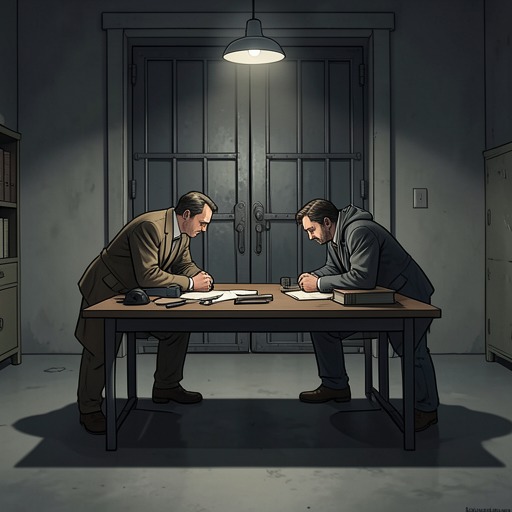
A possible exchange then brings the parties closer to a practical bargain. Savir says Israel is willing to relinquish control of the Gaza Strip; Qurie answers that the Palestinians will accept that only if Israel relinquishes control of Jericho at the same time. Their exchange does not erase the dispute, but it turns abstract disagreement into terms that can be negotiated. The talks proceed through changes in both language and relationship: the parties agree that unresolved disputes need not go to third-party international arbitration, and the Israeli side agrees to negotiate the transfer of the Gaza Strip and Jericho. Savir plans to tell Shimon Peres that Qurie rejected him, and Qurie plans to tell Yasser Arafat the same of Savir; two days later, Terje Rød-Larsen is to call with agreement to the Palestinian demands. Their staged insults conceal an intended diplomatic step rather than announce a breakdown.
Personal Contact, Agreement, and Return of Violence
The process depends not only on written terms but also on contact outside the formal negotiating room. At the talks, Rød-Larsen establishes a rule that participants may disagree inside a closed room but should share meals, talk about their families, and light the fire together outside it. He argues that personal exchange lets the participants see one another as people. Later, Ahmed Qurie and Uri Savir walk together in the snow on the estate grounds, while Rød-Larsen and Mona follow at a discreet distance. Savir says that he and Peres want the process to work; Qurie answers that the Chairman and he want it too. The walk and the stated commitments do not settle the disputes, but they show a changed mode of encounter alongside the formal bargaining.
The play sets the negotiations’ achievements against a later recurrence of violence. In September 2000, seven years after the Accords were signed, violence erupts again in the Occupied Territories, and the Second Intifada begins. That later outbreak distinguishes the signing of an agreement from the durable transformation of the conflict. The First Palestinian Intifada’s role in the narrative is therefore double: its violence helps explain why the negotiators pursue an alternative, while the later return of violence prevents the diplomatic breakthrough from being treated as a final peace.