Destruction of the Thaiquen civilization
OzymandiasThe Destruction of the Thaiquen civilization is the long-past catastrophe that left a once-inhabited planet barren and nearly erased its inhabitants’ material traces. Its cause is disclosed not through a surviving battlefield or a complete archaeological record, but through the ancient guide Ozymandias: the machine preserves the Thaiquens’ history and weapons knowledge, while the expedition’s military commander infers that a superweapon destroyed all life. The revelation makes the Thaiquen extinction both an archaeological discovery and a present danger, as the knowledge left behind is immediately treated as a resource for Earth’s own military rivalry.
The Dead World and the Limits of Archaeology
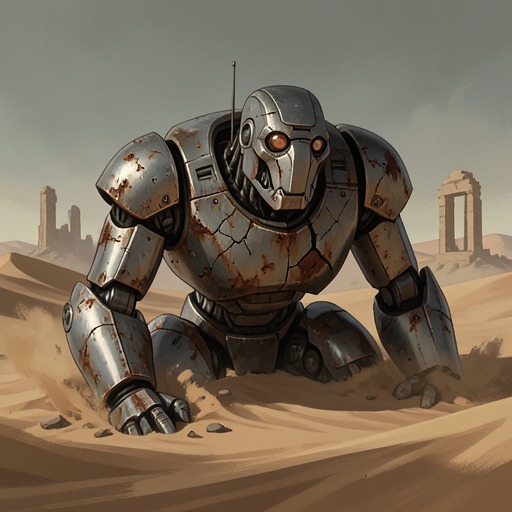
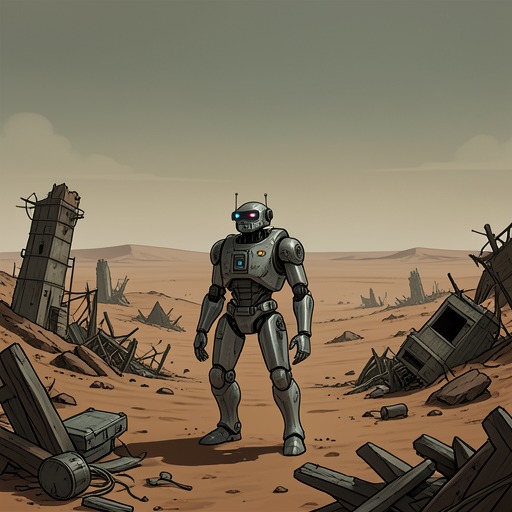
The expedition’s first impression, made as its ship descended toward the planet’s sere brown surface, was that the world had been dead for about a million years. The narrator says this first impression proved correct: Earth had completed a million orbits around Sol since the last living being there had drawn breath. The account establishes a vast interval between the catastrophe and its discovery, but it does not show the destruction itself or identify its exact date.
The physical evidence is exceptionally meagre. Sand, wind, and rain had worn the foundations of some buildings down to stumps; investigators found no artifacts, bones, teeth, utensils, or toys. Those foundations could confirm that a civilization had existed, but offered almost nothing from which to reconstruct its laws, technology, or philosophy. The archaeological party moved to another excavation site half a mile away, yet time had erased everything else. The desolation is therefore not merely the setting for the discovery: it is the central evidentiary problem, a silence that Ozymandias alone can partly overcome.
The Thaiquens and Their Preserved History
Ozymandias identifies its makers as the Thaiquens, a people who, according to the machine, lived and thrived for three hundred thousand years. In the declining period of their history, they built it as an indestructible guide to their cities, which they likewise intended to be indestructible. The contrast is stark: the cities crumbled, while their guide survived, carrying memories of a civilization whose physical world had disappeared.
At first the expedition understands the machine as a guide to ruins. It speaks in an alien language when addressed, and Dr. Leopold suggests it was built to give information to passersby. Once the team begins supplying words and meanings, Ozymandias learns enough English within two hours to sustain a passable conversation and lead the archaeologists through the vanished civilization. Its function expands from guide to archive: it can describe the city of Durab, once home to eight million people, and recount the Eleventh Dynasty and the Thaiquens’ first journeys to neighboring planets.
The machine’s memory also preserves what no excavation can recover. It recalls the Library of Durab, which held fourteen million volumes; none of those books survive, but Ozymandias says it read them after their builders were gone and memorized their contents. It recounts the Plague, which killed nine thousand people a day for more than a year, alongside the history of monuments and political eras. The narration presents this store of information as vast enough to occupy years of research, even though the material remains mediated by one surviving machine rather than corroborated by surviving books or other artifacts.
From Historical Record to Weapon Intelligence
The expedition was institutionally divided from the outset. Dr. Leopold’s archaeological group was assigned research on dead civilizations; Colonel Mattern and his military personnel were tasked with searching for fissionable material, alien weapons, and strategic resources such as lithium or tritium. The General Staff of the Armed Forces of the United States of America supplied 70 percent of the budget, and the expedition’s military purpose was sharpened by tension with the Other Hemisphere. Against this background, the Thaiquen history does not remain an abstract subject of study for long.
Leopold first attempts to reserve Ozymandias for the archaeological party, arguing that casual experiments could damage its memory. Mattern counters that the machine is of military use and says his men have already learned about the Thaiquen weapons. He interprets the planet’s complete absence of life as evidence that a superweapon could have sterilized it; in his account, the Thaiquens developed that weapon, and Ozymandias knows its details. This is a consequential explanation, but it is presented as Mattern’s conclusion from the barren planet and the machine’s information, not as a directly witnessed account of the weapon being fired.
The distinction between historical archive and military intelligence collapses when Mattern takes control. He declares the expedition ended, orders an immediate return to Earth, and reports that Ozymandias has been placed aboard the ship in sealed quarters under top-level security. The archaeologists’ find becomes the military group’s possession, and knowledge of the Thaiquen catastrophe is recast as a means of making America impregnable. The machine that could preserve a lost culture for study is instead removed from the archaeologists’ access because it may contain recipes for destruction.
Inheritance and Irony
The narrator recognizes the bitter shape of the discovery: the Thaiquens, dead by their own hand, have left behind the science that culminated in weapons capable of destroying all life on their world. The expedition has found something of immense value, but its value is measured in the capacity to produce death. The ruined planet thus changes the meaning of the mission’s apparent failure. Mattern had called it useless and argued for leaving; Leopold had insisted on investigating, and the find vindicates the archaeological work even as the military claims its result.
The episode’s central irony lies in the repetition of the catastrophe’s conditions. The Thaiquens’ weapon knowledge survives inside an indestructible machine, and a divided Earth—already organized around an arms race with the Other Hemisphere—now seeks to acquire it. The narrative does not establish that Earth will reproduce the Thaiquens’ fate, but it makes the danger legible: a civilization’s record of its own destruction can become another civilization’s strategic inheritance. The nearly empty landscape is the warning; Ozymandias’s surviving memory is both the means of understanding it and the instrument by which that warning may be ignored.