Discovery of Ozymandias
OzymandiasThe Discovery of Ozymandias transforms a failed archaeological survey into the expedition’s most consequential find: a seven-foot, ancient machine that outlasted the Thaiquen cities it was built to explain. At first, the planet seems to offer only ruins worn down by a million years of weather. The robot’s survival changes that judgment, revealing that the lost civilization persists not in its buildings or artifacts but in a mechanical memory—and that this memory can be claimed as military intelligence as readily as historical knowledge.
A Planet Judged Empty
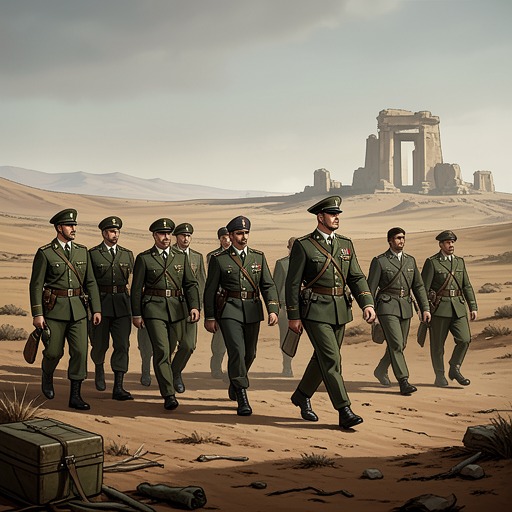
The expedition’s first impression of the planet is that it has been dead for about a million years. Its surface is sere and brown, and the human crew sees evidence that a civilization once existed but no sign of recent life. Colonel Mattern, whose military employers expect weapons and strategic materials from an expedition funded largely for those purposes, argues for leaving. From his perspective, a dead world without useful resources is a costly detour from the mission’s practical objectives.
The archaeologists’ initial search appears to vindicate his impatience. After transferring thousands of cubic yards of soil and digging a large hole, the crew finds no artifacts, bones, teeth, or everyday objects. Some building foundations have survived, but only as weathered stumps. Wind, sand, and rain have erased everything else; the exposed remains establish that a civilization stood there, but seem insufficient to reconstruct its laws, technology, or beliefs. The crew moves to another site half a mile away, still hoping for one tangible remnant. Nothing turns up. The planet’s barrenness is therefore not merely a first impression: it is the apparent result of a thorough material absence.
That absence supplies the discovery with its force. The expedition has no surviving library to excavate, no objects to classify, and no intact city to read as a record of its inhabitants. What appears to be the final limit of archaeology—the disappearance of almost all physical evidence—will instead make the one surviving artifact indispensable.
Leopold’s Find in the Sand
After the separate survey teams report scattered city remains but nothing archaeologically valuable, Dr. Leopold announces that he has found something too heavy to manage alone. He summons both groups to his location, roughly seventeen miles from one team and across the desert from the other. They arrive near nightfall. The headlamps first reveal empty ground; then the teams spot Leopold’s halftrack and the lights of a third vehicle approaching. Leopold is waiting beside an object he introduces with evident pride.
The object resembles a robot, standing seven feet or more and shaped in a rough humanoid form, with arms, legs, shoulders, and a head. Receptor plates occupy the places where a human face would have eyes, ears, and a mouth, though the body has no other visible openings. Its massive, squarish frame is covered in dark, pitted metal, corroded by the elements over centuries beyond counting. Sand buries it to the knees. At Leopold’s prompt, it speaks through its mouth receptors: a clanking sound followed by a high-pitched voice uttering words in an unfamiliar, singsong language. The expedition has spent three centuries in the Age of Space Exploration; its members recognize this as the first language they have heard that did not originate on Earth.
Leopold’s first interpretation is cautious and provisional. The robot does not seem to understand the humans yet, but begins speaking when addressed. He guesses that it is a guide to the ruins, built to inform visitors and somehow preserved after the civilization and its monuments disappeared. The machine’s movements support the idea: it turns ponderously, gestures toward the landscape, and resumes its narration. The humans cannot understand it, but its manner suggests that it is describing the vanished site’s former monuments.
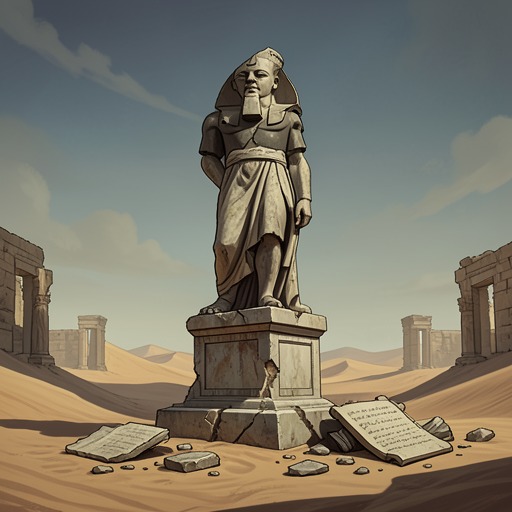
The contrast with Earth supplies Dr. Anderson with the name. He recognizes in the scene the image of a monument left to proclaim its makers’ greatness after their works have vanished, and calls the robot Ozymandias, invoking Percy Bysshe Shelley’s poem. The name captures the irony of the find: the cities are gone, but their surviving guide still appears to announce their glory to later arrivals. At this stage the parallel is suggestive rather than complete; the machine’s actual history and the extent of what it remembers remain unknown.
From Guide to Living Archive
The discovery’s decisive turn comes when the group returns to the robot and hears it speak in English. It says that Ozymandias has remained there, then produces fragments of the humans’ earlier conversation, including its own tentative description as a guide. The crew first reacts in confusion. Marshall wonders whether the machine is merely parroting what it heard; Anderson concludes that it has assembled coherent concepts and is communicating rather than repeating sounds without understanding.
The humans infer how it learned. Ozymandias had listened to their conversation the night before and, after they left, had worked out how to organize their speech into meaning. The group begins supplying vocabulary and definitions; within two hours the robot can hold a passable conversation. Its language learning changes its status. It is no longer simply a device that emits an inaccessible account of the ruins, but an interlocutor able to respond and a record the archaeologists can question.
Ozymandias then pulls its legs free from the sand that had held them for centuries and resumes the purpose for which it was built: guiding visitors through the civilization that made it. The machine’s first English utterances are small and awkward, but the new access quickly opens onto a history of extraordinary scope. The crew records its words as it moves through the desert, while the robot absorbs their comments and expands its vocabulary. Its account grows more detailed as the conversation proceeds, turning a guided tour into an evolving exchange rather than a fixed recital.
The testimony identifies the vanished people as the Thaiquens, a name the robot says its makers used, and says they lived and prospered for three hundred thousand years. In the declining period of their history, they built Ozymandias as an indestructible guide to their indestructible cities. The boast has outlived the cities but not the effects of time: Ozymandias alone remains, carrying memories of what disappeared. Its survival creates a striking imbalance between fragile settlements and a single durable machine, yet that machine can preserve its makers’ history only if someone can understand and access it.
A Civilization Recovered in Speech
The robot’s account gives the landscape names, scale, and chronology that the ruins themselves can no longer provide. It describes Durab as a city that once held eight million people and identifies the place where it stands as the former site of the Temple of Decamon, which rose sixteen hundred feet and faced the Street of the Winds. Those details convert a desert with scattered traces of buildings into a mapped civic world. The archaeologists are not uncovering the architecture itself; they are locating vanished structures through the testimony of the guide built to describe them.
Ozymandias also preserves political history. It dates the beginning of the Eleventh Dynasty to the accession of Chonnigar IV to the Presidium, in the eighteenth thousandth year of the city. It recalls the period in which neighboring planets were first reached, linking the Thaiquens’ civic chronology to a history of interplanetary expansion. Such information extends the find beyond local ruins: the robot’s memory contains a long civilizational account, including institutions and events no surviving building can explain.
Its recollections of the Library of Durab make the archive’s unusual form especially clear. The library once held fourteen million volumes; none survives on the site. Ozymandias says it read those books long after their builders were gone and has them memorized. The machine therefore preserves not only a guide’s descriptions of monuments but the contents of a library whose physical collection has vanished. Where ordinary archaeology has been left with foundations, the robot offers mediated access to a much larger body of historical material, stored in memory rather than on shelves.
The account also includes catastrophe: a plague that killed nine thousand people a day for more than a year. Alongside city dimensions, dynastic dates, and remembered books, this report gives the record the texture of a society’s lived history, though it reaches the expedition through a machine rather than surviving human witnesses or documents. The robot becomes, in the crew’s estimate, a storehouse of archaeological data they could study for years. The scale of its potential knowledge changes the expedition’s original problem. The question is no longer whether the barren planet has left enough material to study, but how much of a three-hundred-thousand-year history its surviving witness can disclose.
Discovery, Ownership, and Military Seizure
The find’s promise also changes the expedition’s internal balance of power. Dr. Leopold asks Colonel Mattern and his men not to interfere with Ozymandias. He argues that the robot is an archaeological treasure of immense value and fears that an ill-considered experiment could short-circuit its memory channels. He invokes the archaeological group’s rights and declares the machine part of its preserve. His claim follows directly from the discovery’s new meaning: the guide is the only known vessel of the vanished civilization’s extensive history, so physical damage could destroy knowledge that cannot be recovered from the exposed ruins.
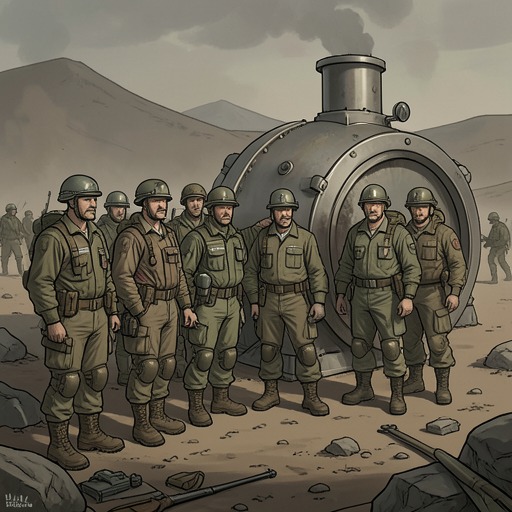
Mattern rejects Leopold’s attempt to reserve it. He says that Ozymandias is of military use, that it has been taken to the ship and placed in sealed quarters under top-level security, and that he is ending the expedition under his emergency authority. The return to Earth is to begin at once. The abrupt change from open archaeological encounter to sealed military custody makes control of the machine part of the event’s consequence: the same find that had seemed to belong to the survey now becomes an object the military can remove and restrict.
Mattern’s stated reason is the information inside Ozymandias. He claims it is a storehouse of Thaiquen weapons data and says the military has already learned things of astonishing scope. He further argues that the planet’s lack of life cannot be explained by a million years alone, and attributes its devastation to a Thaiquen superweapon. On this basis he treats the robot as a source of weapons knowledge that could make the United States impregnable, and declares that, although Leopold found it, it belongs to the military. His explanation places weapons history beside the robot’s records of cities, books, and plague, recasting the historical archive as strategic intelligence.
The claim about the superweapon is presented as Mattern’s explanation, not as a conclusion independently demonstrated by the archaeological remains in this scene. The ruins establish a lost civilization, the robot supplies a vast account of it, and Mattern interprets the planet’s lifelessness as the result of a weapon. That distinction matters: the same machine that overturns the archaeologists’ early assumption that nothing can be learned also becomes the basis for a consequential military inference and seizure. The discovery thus resolves one uncertainty while opening another, as access to the past is subordinated to the expedition’s strategic purpose.
The event completes the reversal at the center of the find. The expedition began with an apparently empty world and a dispute over whether archaeology could yield anything useful. Ozymandias turns that emptiness into an archive, but its knowledge does not remain simply a shared scientific resource: the military’s control of the expedition enables it to remove the machine and end the research. The surviving guide is at once the Thaiquens’ last historical monument, the archaeologists’ unprecedented source, and the military’s claimed repository of weapons data.