Mattern’s seizure of Ozymandias
OzymandiasMattern’s seizure of Ozymandias is the expedition’s decisive reversal: the durable guide to a vanished civilization, first approached as an archaeological archive, becomes military intelligence under Colonel Mattern’s control. By removing the machine to the ship, sealing it away, and declaring the expedition over, Mattern makes strategic usefulness—not scholarly custody—the deciding measure of what the crew may know and do.
Causes and Competing Mandates
The conflict is built into the expedition’s charter and financing. The crew has been sent to investigate worlds that a preliminary survey passed over after finding no present life. Dr. Leopold’s group is charged with archaeological research into dead civilizations; Mattern and his men search for fissionable material, alien weapons, and resources such as lithium or tritium that might serve military purposes. The General Staff of the Armed Forces of the United States of America supplied 70 percent of the budget, expecting results that could strengthen national security, while a Public Liaison provision preserved some rights for the archaeologists.
That division of authority reflects a larger political setting. Earth is divided, and the expedition’s military contingent is alert to the possibility that the Other Hemisphere might return to space after a century of quiescence. The archaeological team is therefore tolerated within an undertaking whose fundamental purpose is to find weapons and strategic materials before a rival power can. Mattern’s later action does not introduce a new priority so much as enforce the one that has governed the mission from the beginning.
The discovery initially appears to vindicate the archaeologists’ separate purpose. The planet has been lifeless for about a million years; wind, sand, and rain have reduced its buildings to foundations, leaving the researchers with almost no material evidence from which to reconstruct its society. Ozymandias, however, proves to be a surviving guide and an extraordinary storehouse of information. Once he begins speaking, Dr. Leopold recognizes a chance to investigate the civilization through the machine’s preserved memory rather than through the nearly erased ruins alone.
The Discovery Becomes a Custody Dispute
After the crew helps Ozymandias acquire words and converse, he takes them on a tour of the vanished Thaiquen civilization. He recounts that his people flourished for three hundred thousand years and built him, late in their history, as an indestructible guide to their cities. His testimony supplies details the landscape cannot: the city of Durab once held eight million people, its library contained fourteen million volumes, and he memorized the books after their builders were gone. For the archaeologists, the machine is not merely an artifact but access to a vast historical record.
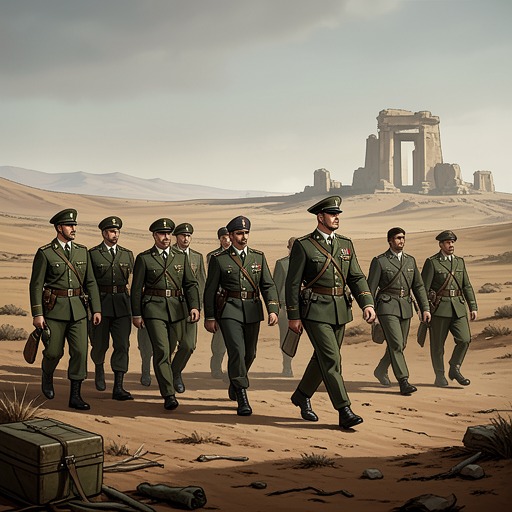
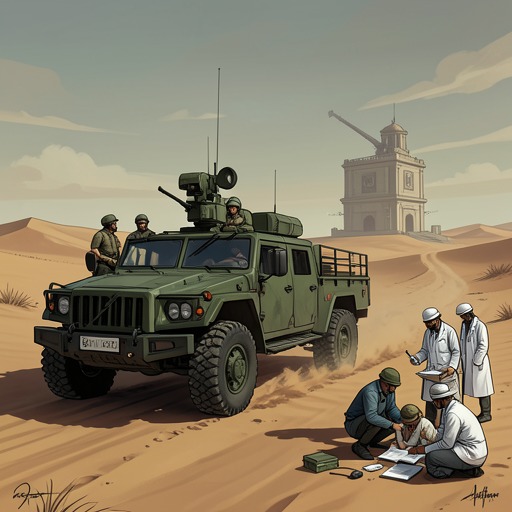
The next morning, Mattern tells the crew that he and his men have spent the night prospecting. He asks Leopold why he concealed the discovery of an object of extreme strategic importance, identifying the robot Leopold named Ozymandias. Mattern says the archaeologists’ behavior led his party to investigate the area; metal detectors registered an object about twenty miles to the west, where they found Ozymandias, who was surprised to learn that other Earthmen were present. The account turns a dispute over professional jurisdiction into a direct contest over who may approach and interpret the machine.
Leopold attempts to protect the find by invoking the archaeological group’s rights. He argues that Ozymandias is an archaeological treasure and that casual military experiments might short-circuit his memory channels. On that basis, he declares the robot part of the archaeologists’ preserve and off limits to Mattern’s men. Mattern answers with the same language of exclusion, declaring Ozymandias part of the military preserve and off limits to Leopold. The exchange makes custody itself the immediate stake: both leaders claim authority to determine who can handle a machine whose value has become apparent to each side.
Seizure and Justification
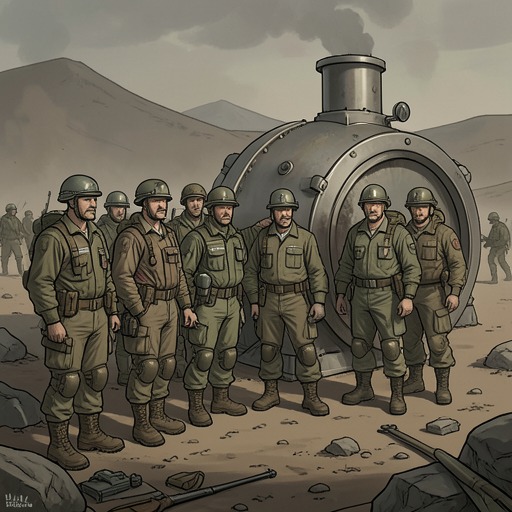
Mattern’s response is not simply to prohibit the archaeologists from further study. He reveals that his men have already taken Ozymandias to the ship and placed him in sealed quarters under top-level security. He invokes powers entrusted to him for emergencies and declares the expedition ended, ordering an immediate return to Earth with the robot. The abrupt change in schedule converts a remote research mission into the transport of a secured strategic asset.
To justify that decision, Mattern identifies the information he believes the machine holds: details of ancient Thaiquen weapons. He connects that knowledge to the planet’s present barrenness, arguing that a million years of natural passage would not by itself have left it without so much as a blade of grass, and that a superweapon must have done so. He further claims that the Thaiquens developed that weapon and others, and that Ozymandias knows their details. The story presents this as Mattern’s explanation for the devastation and the military rationale for taking the robot; it does not show the crew independently testing the claim before the seizure.
The force of Mattern’s case comes from a change in the machine’s assigned meaning. Leopold sees a source of archaeological knowledge whose memory must be protected from damage; Mattern sees intelligence that could make America impregnable. The physical object has not changed, but the discovery of weapons information changes which institution can plausibly claim it and which risks count most. Mattern treats possible damage to the archive as secondary to keeping its contents under military control.
Consequences and Significance
Leopold cannot stop the transfer of power. After Mattern announces the seizure and the mission’s termination, the archaeologists offer no answer or support; Leopold concedes that he cannot prevent the colonel from acting. He leaves without touching his food, described as suddenly old and defeated, while the narrator feels sick. The scene registers not only the loss of access to Ozymandias but also the collapse of the archaeological group’s practical authority inside an expedition it had joined under formally protected terms.
The seizure brings the mission’s institutional hierarchy into the open. Although archaeologists were included as a concession to public resistance to purely military expeditions, the narrative acknowledges that Mattern’s men were the expedition’s fundamentally important contingent. Their assignment was to acquire weapons and strategic materials for possible use against the Other Hemisphere. Once Ozymandias appears to contain precisely the kind of military knowledge sought, the expedition’s scholarly purpose cannot withstand the priority embedded in its funding and command structure.
It also alters the likely fate of the Thaiquen record. Before Mattern intervenes, the archaeologists imagine studying Ozymandias for years and recording the history of a civilization whose cities, books, and other material remains have disappeared. After the seizure, he is isolated in sealed quarters and removed from their access. The episode therefore makes preservation and control inseparable: the military may be protecting the machine from unsupervised handling, but it is also determining who can consult the archive and what purpose its accumulated knowledge will serve.
The irony lies in the contrast between the near-erasure of the Thaiquens and the durability of the one device built to remember them. Their cities have crumbled, their fourteen-million-volume library no longer exists, and the desert has swallowed nearly every trace; Ozymandias alone carries their past forward. Yet when that memory proves useful as weapons intelligence, its scholarly recovery is displaced by military possession. Mattern’s seizure thus turns the story’s central discovery into a test of the expedition’s values—and shows which side prevails when archaeological knowledge and strategic advantage claim the same object.