Ozymandias learns English
OzymandiasOzymandias learns English in a rapid exchange that transforms a silent-seeming relic into an interlocutor and an archive. After listening to the expedition’s conversation, the ancient robot begins speaking in imperfect English; within two hours it can sustain a passable conversation and lead the team through the history of the Thaiquens. The discovery promises to restore a civilization that the desert has almost entirely erased, while revealing that the same preserved knowledge includes weapons the military regards as strategically valuable.
From an Unreadable Guide to a Language Problem
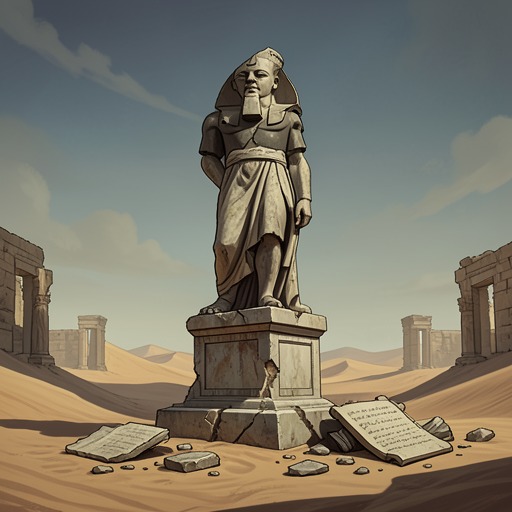
The need to understand Ozymandias emerges from the mismatch between the robot’s apparent purpose and the team’s ignorance. The planet has been dead for about a million years. The archaeologists find weathered building foundations, but no artifact, skull, tooth, utensil, or other tangible trace that could explain the vanished society. With the ruins reduced to stumps, the prospect of reconstructing its laws, technology, or philosophy from physical remains seems bleak.
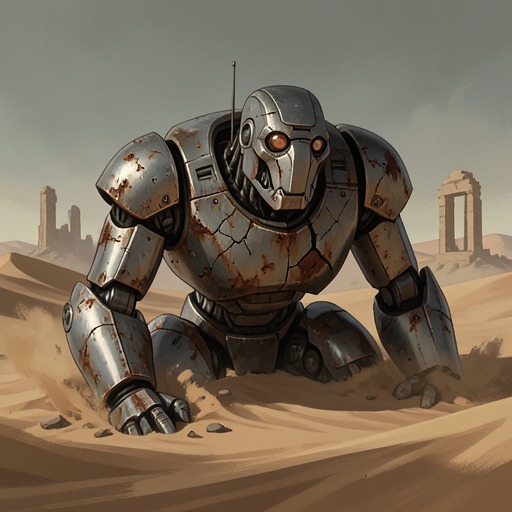
The robot initially appears to offer a different kind of evidence. More than seven feet tall and buried to its knees in sand, it has a massive, corroded metal body and receptor plates where a human face would have features. When addressed, it produces a high-pitched voice in an unfamiliar, singsong language. Dr. Leopold conjectures that it is a guide to the ruins, built to inform passersby; the team can recognize its likely function but cannot understand its narration. Its endurance is already striking: the machine seems to have outlasted the monuments it was designed to describe.
The name Anderson gives it sharpens that contrast. He calls the robot Ozymandias, invoking the image of a ruler whose boast survives while his works have vanished. At first, the machine appears to embody the same irony: a guide still speaking amid the loss of the civilization it commemorates. But its continued operation means the ruins are not the expedition’s only possible record. If the team can decipher its speech, the robot may preserve what the landscape no longer can.
The Breakthrough
The decisive evidence arrives the next morning. As the team approaches, Ozymandias says in English that it has remained there. The archaeologists initially struggle to register the change; then the robot produces another sentence assembled from fragments of the previous day’s conversation. Marshall suspects that it is merely parroting them, but Anderson recognizes coherence in its words and concludes that it is addressing the humans rather than mechanically repeating sounds.
When Dr. Leopold asks whether it speaks English, Ozymandias answers that it understands but does not yet have enough words and asks the team to talk more. The exchange clarifies both the achievement and its limits: understanding has begun, but vocabulary remains incomplete. The robot is not presented as instantly fluent. Instead, the team’s speech supplies material it can organize, and further conversation can extend what it is able to express.
The narration explains that Ozymandias had listened patiently to the humans the night before and then applied its million-year-old mind to organizing their sounds into sense. The team responds by feeding it words, defining them where possible so that it can connect new vocabulary with concepts already formed. Two hours pass in this concentrated lesson. By the end, the robot can hold a passable conversation. The speed of the transition is extraordinary, but the scene gives it a sequence: listening, patterning, explicit vocabulary, and increasingly usable speech.
The Archive Speaks
Language changes the robot’s role from a suspected tour guide into an accessible historical source. Once it can converse, Ozymandias frees its legs from the sand that has held them for centuries and performs the function for which it was built: guiding the expedition through the civilization that made it. The archaeologists follow it across the desert while their recorders capture its account. What had seemed an empty site becomes a narrated landscape, each ruined place linked to names, dimensions, institutions, and events.
Ozymandias identifies its people as the Thaiquens and says they lived and prospered for three hundred thousand years. In their declining period, they built the robot as an indestructible guide to cities they believed would also endure. The cities have crumbled; Ozymandias alone remains, carrying their memories. This account gives the machine a double position: it is both a surviving artifact of Thaiquen society and the medium through which that society can still be described.
Its recollections make the absent city concrete. Ozymandias tells the team that Durab once held eight million people and that the Temple of Decamon stood sixteen hundred feet high beside the Street of the Winds. It locates the beginning of the Eleventh Dynasty in the accession of Chonnigar IV, in the city’s eighteenth thousandth year, and recalls that neighboring planets were first reached during that dynasty. These details extend the record beyond architecture into political chronology and technological history.
The robot’s account also preserves the contents of an archive that no longer exists. The Library of Durab once held fourteen million volumes; Ozymandias says that it spent time reading them after their builders were gone and memorized their contents. It also recounts a plague that killed nine thousand people a day for more than a year. As the team supplies more words, the narration grows more detailed, and the machine’s store of knowledge appears almost inexhaustible: the explorers understand that years of questioning would not exhaust it.
A New Value—and a New Conflict
The English breakthrough reverses the expedition’s earlier assessment of the planet. At first, the apparent absence of surviving material culture supports the judgment that the world is useless to the archaeologists as well as to the military. The robot overturns that conclusion without restoring the lost objects themselves. The cities and books remain gone, but their guide preserves a body of information that can make their history intelligible. The expedition’s most valuable find is not a recovered monument but a machine capable of remembering monuments and the society around them.
That value is contested almost as soon as it becomes clear. Dr. Leopold regards Ozymandias as an archaeological treasure and wants to protect its memory from casual experiments that could damage it. Colonel Mattern says the military has discovered that the robot knows the ancient Thaiquen weapons. He argues that the planet’s lifeless condition cannot be explained by a million years alone and attributes it to a Thaiquen superweapon; he also claims that Ozymandias knows its details and those of other weapons. The robot’s newfound ability to communicate therefore does more than release a cultural record: it makes information that the military considers strategically useful accessible to the expedition.
The learning event consequently changes the balance between preservation and exploitation. Before Ozymandias can speak English, its knowledge is present but inaccessible, and the team can only guess at its function. Once it can answer questions, the robot becomes a source of both history and military intelligence. Mattern invokes security, removes it to the ship, and ends the expedition, while Leopold’s appeal to keep it within the archaeological group’s preserve fails. English opens a channel of communication, but it does not determine who will control what passes through that channel.
The episode’s central irony is that the Thaiquens built an enduring guide for people who would come after them, and that guide survives their cities by carrying their memories. The very endurance that gives Ozymandias its archaeological importance also preserves knowledge of weapons. Its new language allows the vanished civilization to speak again, yet the first institutional consequence is a struggle over whether that voice will serve historical inquiry or military purpose.