Military and scientific community conflict within the expedition team
OzymandiasThe conflict between the expedition’s military and scientific staffs turns a nominally shared exploration mission into a contest over who may define the value of a discovery and decide what happens to it. Dr. Leopold’s archaeologists win time to investigate a world the military dismisses as useless, but when Ozymandias emerges as both an extraordinary historical archive and a repository of ancient weapons knowledge, Colonel Mattern uses military authority to take control. The expedition’s governing imbalance, present from the start, becomes unmistakable in its ending: scientific discovery supplies the military with a new strategic asset, while the archaeologists lose access to the find and the expedition itself is called off.
Institutional Aims and Unequal Authority
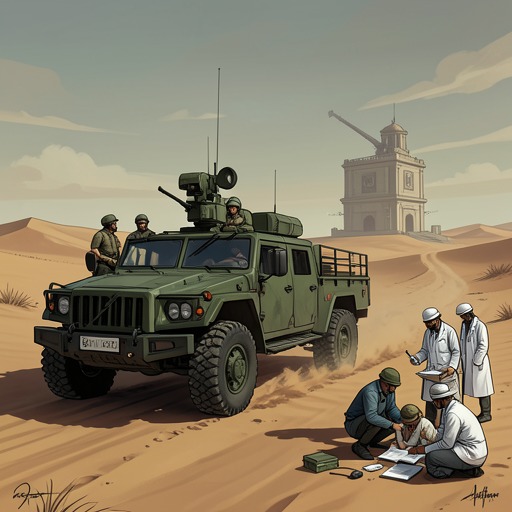
The dispute begins with a division of labor built into the expedition. Leopold leads the non-military group, assigned to conduct archaeological research on dead civilizations. Mattern and his men search instead for fissionable material, alien weapons, and resources such as lithium or tritium that might serve military purposes. The two groups therefore encounter the same worlds through different questions: what can be learned about the past, and what might be used in a future conflict. The narrative acknowledges that, by the expedition’s strategic measure, the archaeologists seem expendable. Their presence also answers public opposition in America to purely military expeditions, making scientific work both a genuine research project and a concession that helps justify the mission.
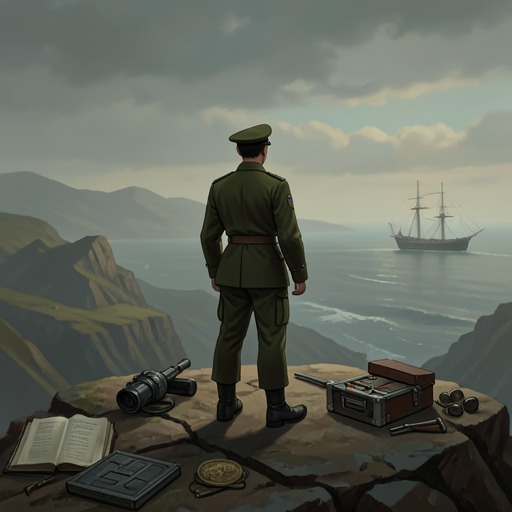
That arrangement reflects a larger political tension. The General Staff of the Armed Forces of the United States of America supplies 70 percent of the expedition’s budget and expects results in the form of weapons and strategic materials. The military’s Public Liaison branch has nevertheless ensured that the scientific party retains some rights. Those rights give Leopold a basis to resist Mattern, but they do not erase the material and institutional advantage enjoyed by the military. The narrator places this imbalance against renewed tension between America and the Other Hemisphere: if either side finds something useful in space, the other might seek it too. Archaeological inquiry is thus attached from the outset to a race for advantage, even when its subject is a civilization long gone.
The Research Clause and the First Reversal
On the newly reached planet, the military’s impatience appears reasonable by its own criteria. The surface is barren, the civilization has been dead for about a million years, and weather has reduced its monuments to stumps. Mattern wants to leave for a world of greater practical value. Leopold invokes the expedition’s limiting clause instead: the archaeologists may explore a world for at least 168 hours. The provision does not make the parties equal, but it prevents Mattern from ending the investigation immediately and gives the scientific group a protected interval in which to work.
The first work seems to vindicate the military’s contempt. The crew transfers thousands of cubic yards of soil and digs a large hole without finding artifacts, bones, or ordinary objects. Only weathered building foundations remain, offering little basis for reconstructing the vanished society’s laws, technology, or philosophy. Yet the apparent emptiness also sharpens the consequences of the eventual discovery. Where ordinary traces have failed, Ozymandias is a surviving source of knowledge that the archaeological team could not have recovered from the ruins alone.
Ozymandias and Competing Definitions of Value
When Leopold addresses Ozymandias, the robot answers in an unfamiliar language. Leopold first understands him as a guide to the ruins, built to inform visitors and durable enough to outlast the monuments he described. The scientific group sees the discovery as a breakthrough: when Ozymandias later speaks in English, it becomes clear that he listened to the humans and worked out their language from their conversation. Within two hours of vocabulary lessons he can hold a passable conversation, free his legs from the sand, and guide them through the lost civilization. Leopold calls him a magnificent find; the narrator’s reference to the name Ozymandias captures the irony of a guide intended to preserve the glories of a people whose cities have disappeared.
The robot’s function expands as the expedition learns what he contains. Ozymandias is not merely a speaking monument or a guide to a ruined site, but a storehouse of archaeological data. He identifies his people as the Thaiquens and recounts a civilization that endured for three hundred thousand years. They built him in their declining days as an indestructible guide to their cities; those cities crumbled, leaving him to carry their memories. For Leopold’s group, that combination of preservation and testimony makes him an unparalleled research resource. Mattern’s later claim does not cancel this value; it changes the institutional category through which the value is judged. The same durable memory that can support years of archaeological inquiry can also, in Mattern’s account, disclose the Thaiquens’ weapons.
Seizure, Security, and the End of the Expedition
The conflict becomes overt after Mattern’s men investigate the area during the night. Mattern says that the previous day’s events led them to search, and that detectors indicated a metal object about twenty miles west. They find Ozymandias, learn that other Earthmen are present, and bring the robot to the ship. Leopold objects that the machine belongs within the archaeological group’s preserve and warns that casual military experiments could short-circuit its memory channels. His claim puts the scientific stakes in concrete terms: control matters not only because the robot is valuable, but because careless access could damage the very archive the scientists came to study.
Mattern reverses Leopold’s attempt to reserve the robot for archaeology. He declares Ozymandias part of the military preserve and says his men have placed him in sealed quarters under top-level security. Mattern justifies the seizure by identifying the robot as a source of information on ancient Thaiquen weapons. He further argues that a superweapon explains why the planet has no life—not even grass—and says that Ozymandias knows the details of such weapons and others. These are Mattern’s conclusions and claims within the dispute; their importance to the conflict is that they transform the robot, in the military’s eyes, from a historical find into an urgent security asset. Mattern then invokes emergency power to declare the expedition ended and orders an immediate return to Earth with Ozymandias.
Leopold does not manage to stop him. After the military announces its control and its intention to take the robot away, the archaeologists remain silent when Leopold looks to them for support. He accepts that he cannot prevent Mattern’s decision, leaves without touching his food, and appears broken to the narrator. The narrator, a member of the scientific party, feels sick. The failed appeal and their silence mark more than a personal defeat: the clause that had secured time for research cannot secure the scientists’ continuing access to their discovery once military authorities define it as strategically important.
Knowledge as a Strategic Asset
The conflict’s central irony is that the archaeological party’s success strengthens the military position it had been trying to resist. Ozymandias can preserve a past that the landscape no longer records, but the more consequential his memory proves, the less freedom the scientists retain to study it. Military control of the robot also means control over access to the information he carries. The expedition does not resolve the competing purposes of research and security; it resolves who has the power to act when those purposes collide.
The story connects this transfer of control to the expedition’s wider political setting. The crew has been sent to search worlds near the Galactic Rim, some of which once supported intelligent life, while the Other Hemisphere remains a potential rival in space. The military’s concern is therefore not simply a personal ambition attributed to Mattern: it follows the mission’s stated strategic priorities and the rivalry that made the search urgent. But the outcome exposes the cost of those priorities for scientific work. Once knowledge is classified as militarily useful, the archaeologists’ discovery becomes military property in practice, and an expedition that had promised both inquiry and extraction ends as a vehicle for carrying a captured archive back to Earth.