Global Split and Military Standoff
OzymandiasEarth’s division and military confrontation are the political conditions that make the expedition to Planet Four more than an archaeological survey. The crew’s work is organized around rivalry between America and the Other Hemisphere: even a dead civilization’s surviving knowledge is judged by whether it might confer a strategic advantage.
A divided planet, an divided expedition
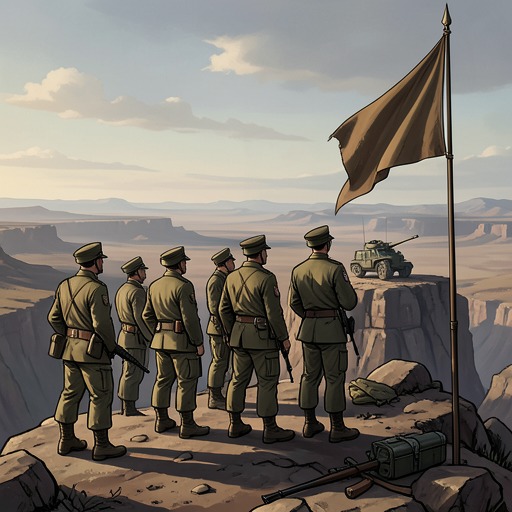
The expedition’s charter sent it to investigate worlds near the Galactic Rim that an earlier survey had passed over in search of life. Its two branches had sharply different assignments. Dr. Leopold led the archaeologists in the study of extinct civilizations; Colonel Mattern and his military personnel searched for fissionable material, alien weapons, and possible lithium or tritium supplies for fusion. The imbalance was built into the expedition’s finances: the General Staff of the Armed Forces of the United States of America supplied 70 percent of its budget and expected practical results, especially weapons and strategic materials.
The archaeologists were included partly because American public opinion had frowned on purely military expeditions. Their presence served as a public-facing qualification, not evidence that the mission’s priorities were evenly shared. Mattern treated his personnel as the expedition’s genuinely important members and the archaeologists as ballast. The narrator acknowledges that, from a narrowly pragmatic security perspective, the archaeologists could seem expendable.
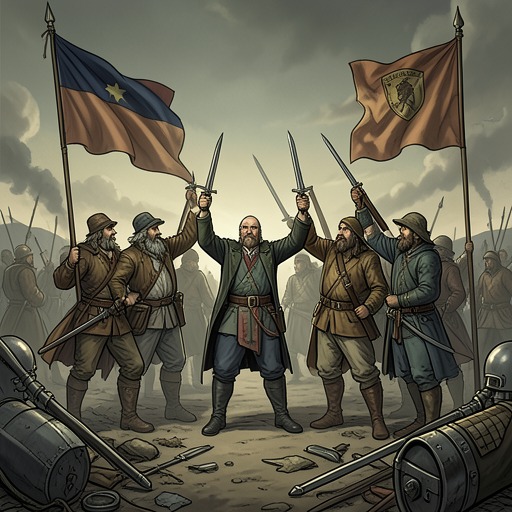
That hierarchy reflects a wider political fracture. Earth is described as sadly disunited, and the Other Hemisphere, dormant for a century, remains a potential rival in renewed space activity. The expedition therefore operates not as a common human venture, but as an American mission conducted under the pressure of anticipated competition. The narrator’s bitterly comic reflection that the crew came from Earth only “abstractly speaking” makes the point: national division persists even beyond Earth.
Rivalry defines what counts as useful
When the crew first surveys Planet Four, its dead surface appears to confirm that the world has nothing worth exploiting. Mattern presses for departure, consistent with the purpose his employers have set for him: finding resources or technologies that could serve national security. The archaeologists’ detailed work is less immediately useful to that purpose, and the expedition’s institutional arrangement gives the military branch greater practical authority even while reserving some rights for the scientists.
The barren excavation sharpens the contrast between the branches’ standards of value. The crew moves thousands of cubic yards of soil and finds no artifacts, bones, or small objects; only weathered building foundations remain. Those traces can establish that a civilization once existed, but offer little basis for reconstructing its culture or technology. For a moment, the planet seems useless to both archaeology and the military. The later discovery of Ozymandias overturns that judgment: the very knowledge the archaeologists prize will also become strategically valuable.
Archaeological knowledge becomes military intelligence
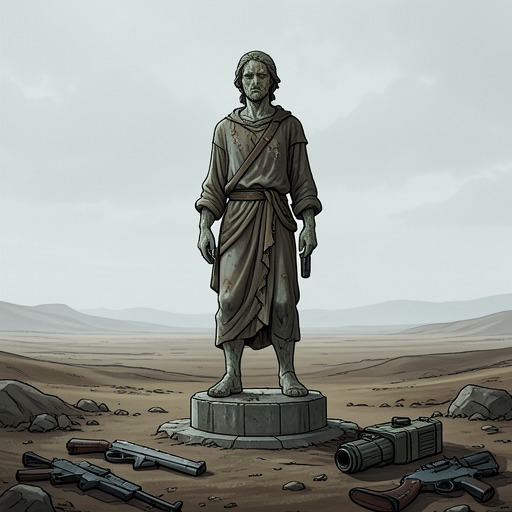
Dr. Leopold initially understands Ozymandias as an ancient guide to the ruins, built to inform passersby. When the robot begins speaking, the crew cannot understand its language. Leopold proposes deciphering it and recognizes the find as extraordinary; after the robot learns English, it becomes a far richer resource than the ruined foundations. Ozymandias can recount the history of the Thaiquens and their cities, a storehouse of archaeological information that the expedition could study for years.
The possibility of military use changes the meaning of the discovery. Colonel Mattern later says his men found Ozymandias after investigating a metal reading some twenty miles west, following the archaeologists’ behavior the previous night. Dr. Leopold argues that the robot belongs within the archaeological group’s preserve, partly because careless military experiments could damage its memory. Mattern rejects that claim and declares the robot his own branch’s preserve instead. The dispute is not simply over access to a machine: it is a contest over which institution gets to define the discovery and direct its use.
Mattern says Ozymandias contains detailed knowledge of ancient Thaiquen weapons. He also argues that the planet’s absence of life cannot be explained by a million years of natural passage alone, and attributes its desolation to a Thaiquen superweapon. The account therefore links the evidence of a vanished civilization to the expedition’s present arms race. The robot’s historical archive is, in Mattern’s interpretation, also a military intelligence source.
Strategic advantage overrides the scientific mission
Once he classifies Ozymandias as a security asset, Mattern has him taken to the ship and placed in sealed quarters under top-level security. Invoking emergency authority, he ends the expedition and orders an immediate return to Earth with the robot. His decision makes the mission’s underlying priorities explicit: the archaeologists’ presence and the charter’s research purpose cannot outweigh the prospect of acquiring weapons that could make America militarily impregnable.
The military’s control of the discovery leaves Leopold unable to protect either his research or the robot from appropriation. He concedes that he cannot stop Mattern and leaves without touching his food, defeated. The narrator recognizes the outcome as a confirmation of the expedition’s actual structure: anthropologists had been added to a fundamentally militaristic mission, whose central purpose was to find weapons and strategic materials for use against the Other Hemisphere.
The irony is that archaeological success does not escape the system that made it secondary. Ozymandias survives as a guide and bearer of historical memory, but the expedition’s political order recasts that memory as a strategic resource. The long history of the Thaiquens culminates, for the crew, not in an unrestricted account of their civilization but in a struggle over who may control the weapons information left behind.