Planet Four’s lifeless, barren condition
OzymandiasPlanet Four’s lifeless, barren condition first appears to confirm that the world has nothing left to offer: its civilization has been gone for about a million years, and wind, sand, and rain have reduced its cities to foundations. Yet the desolation becomes more than an archaeological obstacle. When the expedition discovers Ozymandias, the surviving robot’s account of the Thaiquens and Colonel Mattern’s military interpretation turn the empty landscape into a possible record of planetary-scale destruction—and into the prize in a dispute over who may control the knowledge that survives.
First Impressions and Physical Conditions
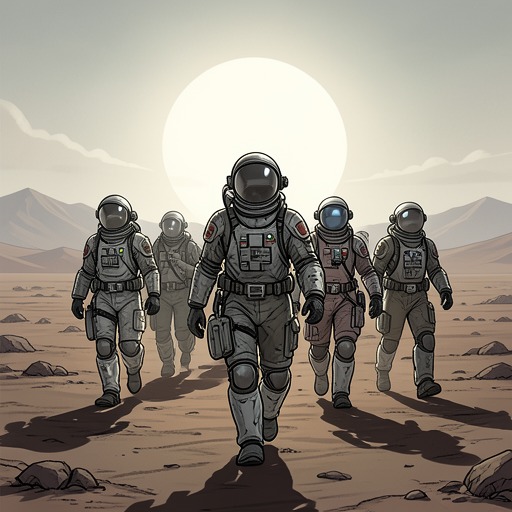
The expedition’s initial judgment is blunt: the planet is dead. From orbit, its surface appears sere and brown, and the narrator’s first impression—that its last living being drew breath a million years ago—proves correct. Colonel Mattern immediately sees this condition as a reason to leave, since he expects the mission to produce strategically useful materials or weapons rather than spend time among ruins.
Planet Four is Earthlike in size but not hospitable in its present state. It measures about 6,100 miles in diameter, has a gravity index of .93, and averages 45 degrees Fahrenheit, with daily temperature changes of roughly ten degrees. Its thin atmosphere consists mostly of carbon dioxide, with traces of helium and nitrogen and only a slight amount of oxygen. The crew practices breathing-mask drills before going outside. The possibility that the air might have supported humanoid life a million years earlier only sharpens the contrast with its present barrenness.
The landscape offers the archaeologists little to read. They see a dry, windblown plain punctuated by stumps that may once have been monumental buildings. After digging and shifting thousands of cubic yards of soil, they find no artifacts, bones, teeth, or everyday objects. The foundations survive only as weathered remnants. They establish that a civilization once stood there, but cannot, by themselves, disclose its laws, technology, philosophy, or ordinary life. A second excavation half a mile away yields no tangible remains either.
The planet’s setting reinforces its remoteness. Its day lasts thirty-five hours, and it has no natural satellites. As the sun sets and the somber sky darkens, the expedition returns to base after seven hours of fieldwork with little more than a few hundred feet of tridimensional film documenting foundations. The scale of the ruin is visible; its history remains inaccessible. To the archaeologists, the emptiness threatens to make the world scientifically mute.
A World Judged by Competing Missions
The barren condition matters because the expedition has two incompatible definitions of useful evidence. Dr. Leopold leads the archaeologists, whose assignment is to study dead civilizations; Mattern and his military contingent search for fissionable material, alien weapons, and resources such as lithium or tritium. The military supplied 70 percent of the budget, and the General Staff expects results with strategic value. Against those expectations, a world stripped of artifacts seems to justify Mattern’s impatience.
The expedition’s charter nevertheless gives Leopold a limited right to continue research. The group has been sent to examine worlds that an earlier survey hurriedly passed over after finding no present life. A minimum research period of 168 hours applies once the expedition lands, and Leopold invokes that clause to prevent an immediate departure. The condition that makes the planet look worthless thus also activates the archaeologists’ reason for being there: its past, not its present resources, is their subject.
That division is set against a renewed terrestrial arms race. Earth is politically divided, and the Other Hemisphere might resume space exploration after a century of quiescence. Mattern insists that the expedition’s military personnel are the important half; the archaeologists are, in his view, ballast. The narrator acknowledges that the military assessment is not entirely baseless: without evidence of surviving material culture, the archaeologists have little to work with. But the expedition’s composition exposes the larger tension between general knowledge and national security. A lifeless planet seems to offer nothing for either side—until the surviving machine changes what the emptiness means.
Ruins, Memory, and the Last Survivor
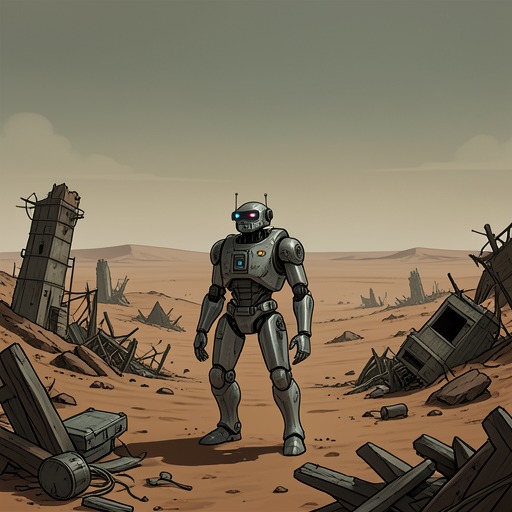
The barren surface is not absolutely empty. After the field team has struggled to find anything, Dr. Leopold reports a machine at the base. Ozymandias is an ancient guide, built to explain the ruins to visitors, and its massive, sturdy construction has outlasted the cities and monuments it describes. At first it speaks in an alien language. The archaeologists can observe its movements and hear its voice, but cannot yet recover the knowledge it carries.
Ozymandias soon begins to decipher the crew’s language and address them in English. Its ability to communicate reverses the expedition’s experience of Planet Four: where excavated soil yielded no usable objects, the surviving guide can supply historical information at extraordinary scale. It identifies its people as the Thaiquens, who flourished for 300,000 years and built it in their civilization’s declining period as an indestructible guide to their supposedly indestructible cities. The cities have crumbled, while the machine remains, carrying memories of the society that made it.
Its testimony gives specific form to what the ruins alone cannot show. Ozymandias describes Durab as a city that once held eight million people and locates the Temple of Decamon, which stood 1,600 feet high, and the Street of the Winds. It recounts the Eleventh Dynasty, the accession of Chonnigar IV, and the first journeys to neighboring planets. It remembers the Library of Durab, said to have held fourteen million volumes; its books no longer exist, but Ozymandias claims to have read them after their makers were gone and to have memorized their contents. It also recalls a plague that killed nine thousand people a day for more than a year.
The guide’s growing conversation makes the contrast between physical survival and cultural survival stark. The archaeologists follow it through the desert, recording its words as it absorbs their comments and adds vocabulary. Foundations have endured only as stumps, yet a single machine holds what the narrator describes as the totality of a 300,000-year culture. Planet Four is therefore both almost unreadable as an archaeological site and, through Ozymandias, an unexpectedly concentrated archive.
The Empty Landscape as Evidence—and Dispute
The cause of the planet’s lifelessness emerges through a different evidentiary layer. In the expedition’s final confrontation, Mattern says that the Thaiquens developed a superweapon and argues that it explains why the world is bare even of grass. In his account, a million years of ordinary time would not suffice to produce such complete lifelessness; the weapon, rather than slow erosion alone, destroyed life. He further claims that Ozymandias contains detailed knowledge of that and other weapons.
This explanation is consequential, but it reaches the reader as Mattern’s interpretation of the machine’s military value, not as an independently demonstrated cause. The text directly establishes the planet’s current lifelessness, the apparent survival of foundations, the absence of ordinary artifacts in the archaeologists’ excavations, and Ozymandias’s long historical memory. Mattern connects those observations to a Thaiquen superweapon and uses the connection to justify taking control of the robot. The distinction matters: the barren landscape is observed, while the weapon’s role in producing it is asserted in the course of a struggle over access to the archive.
Once Mattern classifies Ozymandias as a strategic asset, the archaeological interpretation of the planet is overtaken by military urgency. He has the robot brought to the ship and confined in sealed quarters, declares the expedition ended, and orders an immediate return to Earth. Leopold cannot stop him. The world that had seemed useless because nothing remained has yielded knowledge valuable enough to end the research and remove its sole surviving witness.
Significance of the Desolation
Planet Four’s condition structures the story’s reversals. First, the dead world appears to vindicate Mattern’s demand to move on. Then the failure of ordinary excavation makes the ancient guide more astonishing: against a landscape that seems to have lost everything, Ozymandias preserves an immense cultural record. Finally, the very barrenness that made the planet seem irrelevant becomes the basis for Mattern’s claim that the Thaiquens possessed weapons of unprecedented power.
The condition also makes survival radically uneven. Cities, books, monuments, and living beings are gone; foundations and one durable guide remain. Ozymandias can describe a civilization that lasted hundreds of thousands of years, but it cannot restore the people whose history it remembers. The desert is therefore not simply empty scenery. It is the visible limit of what material ruins can disclose, the setting for a surviving archive, and the contested evidence through which scientific inquiry is converted into military possession.