Long-term preservation and continuous operation of Ozmandias
OzymandiasOzymandias’s long survival is the paradox at the heart of the expedition’s discovery: on a planet whose cities and material traces have nearly vanished, an ancient guide robot remains intact enough to speak, learn, remember, and lead visitors through the lost world. Built by the Thaiquens to explain their civilization to future passersby, he outlasts the civilization and monuments he was meant to interpret. His body becomes the surviving medium of a history that the desert has almost entirely erased—and, once that history is recognized as military intelligence, the object of a contest over who may possess and use it.
Survival in a Vanished World
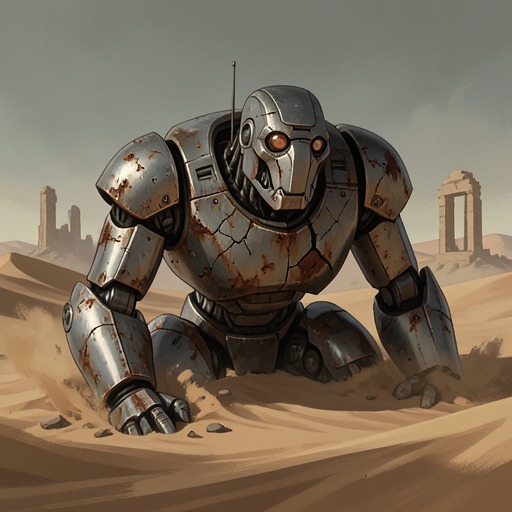
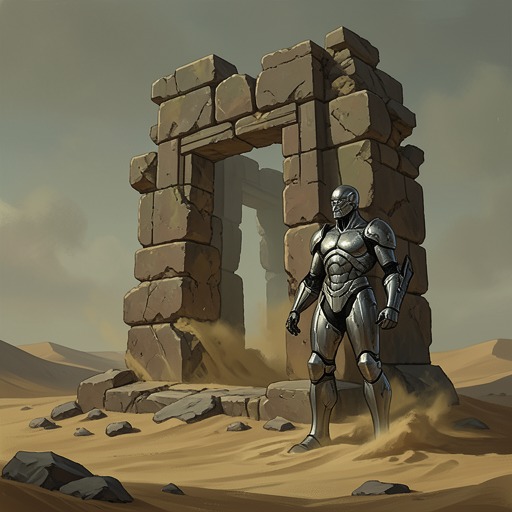
The expedition first sees a dead planet, and its initial impression proves accurate: the last living being there had died roughly a million years earlier. Archaeologists search the ground and find no artifacts, bones, teeth, utensils, or toys. Even the foundations of buildings have been worn down to stumps by sand, wind, and rain. The contrast establishes the extraordinary character of Ozymandias’s survival. Where ordinary objects and monumental architecture alike have disappeared, the robot’s massive, corroded metal body has endured.
At seven feet or more, Ozymandias is vaguely humanoid, with arms, legs, and a head set above a heavy, squarish torso. Receptor plates occupy the places where a human would have eyes, ears, and a mouth; his dark metal skin is pitted by the elements, but the construction remains substantial. He has been buried in sand up to his knees, not reduced to the scattered fragments that the archaeologists hoped to find. The visible corrosion registers immense age, while the intact mechanism demonstrates a different kind of persistence from the ruined buildings around him.
His apparent durability is matched by continued operation. When addressed, he produces speech in an unfamiliar language through his mouth-receptors; after falling silent, he turns ponderously on his base, raises an arm toward the landscape, and resumes his narration. The expedition’s first explanation is that he is a guide to the ruins, made to provide information to passersby. That interpretation proves strikingly apt: he is not simply a machine preserved as an artifact, but a functioning interpretive device whose original purpose survives the world that gave it meaning.
A Living Archive of the Thaiquens
Ozymandias’s most consequential survival is not merely physical. He has retained an immense body of historical knowledge, including material that the archaeologists could not have recovered from the nearly barren site. Once he begins to understand English, he becomes what the expedition recognizes as a walking and talking Rosetta Stone: a means both to communicate with the explorers and to make the lost civilization legible to them.
The change begins after he has listened to the archaeologists speaking the previous night. Left alone afterward, he has applied his ancient mind to organizing their sounds into sense. At first his English is limited, but the explorers supply words and explanations, and he rapidly incorporates them. Within two hours he can sustain a passable conversation, free his legs from the sand that has held him for centuries, and resume his designed role by taking the team on a guided tour. His endurance therefore includes adaptability: the memories preserved in his mind can be reached through a newly learned language, allowing an encounter across an immense historical distance.
Through Ozymandias, the archaeologists learn that his people called themselves the Thaiquens and had lived and thrived for three hundred thousand years. In their declining days, they built him as an indestructible guide for their supposedly indestructible cities. The reversal is contained in the machine’s own continued presence: the cities have crumbled, but the guide remains, carrying memories of what has been. The record survives not in the architectural setting it was meant to explain but within a mobile, speaking witness to its loss.
That record reaches beyond names and broad chronology. Ozymandias recalls Durab as a city that once held eight million people and describes the Temple of Decamon, which rose sixteen hundred feet and faced the Street of the Winds. He recounts the beginning of the Eleventh Dynasty with the accession of Chonnigar IV to the Presidium, and the first journeys to neighboring planets during that dynasty. These details show how the machine’s long operation preserves civic, political, and technological history—not merely a generalized memory that a civilization once existed.
His archive also contains knowledge of a vanished library. The Library of Durab stood on the spot where he speaks; it held fourteen million volumes, none of which remain. Ozymandias says that long after the builders were gone, he spent time reading its books, and that their contents are memorized within him. The destroyed library and the still-functioning robot form an especially sharp contrast: the written collection has disappeared, while one durable reader retains what it contained. His memory does not restore the physical books, but it gives the explorers access to a body of knowledge for which the site itself offers no surviving artifacts.
The account includes catastrophe as well as achievement. Ozymandias describes a plague that killed nine thousand people a day for more than a year. As the archaeologists continue speaking with him and supply additional vocabulary, his narration grows more detailed; their recorders capture his words as he wheels across the desert. For the team, the result is a historical source they believe they could study for years without exhausting. The robot’s preserved memory thus replaces, in practical terms, much of the material evidence that time has erased, while opening a vast record of the Thaiquens’ history to interpretation.
From Guide to Contested Evidence
Ozymandias’s purpose and importance change according to who is interpreting him. For the archaeological group, he is an exceptional historical source: a storehouse of data whose value lies in the possibility of learning about a civilization that ordinary excavation cannot reconstruct from bare foundations. Dr. Leopold says that the group should try to decipher the language and recognizes the robot as a magnificent find. The prospect of studying the surviving archive leads the archaeologists to conceal their discovery from the military contingent, hoping to protect their access to it.
That concealment is temporary. The military team investigates after the archaeologists’ excitement arouses suspicion, follows detector readings of a metal object about twenty miles to the west, and finds Ozymandias in the desert. When Leopold asks Colonel Mattern to keep away from the robot, he invokes the archaeological group’s rights and declares Ozymandias part of its preserve. The claim is grounded in a specific fear: casual military experimentation might short-circuit the robot’s memory channels. His continued functioning is therefore not an abstract matter of wonder; it is vulnerable to the consequences of handling and to the competing claims made over his knowledge.
Mattern rejects Leopold’s attempt to reserve the find. He has Ozymandias brought to the ship and placed in sealed quarters under top-level security, then declares the expedition over and orders an immediate return to Earth. This decision converts the archive from an archaeological resource encountered in the open desert into a controlled object of military custody. The robot’s survival has made possible a rare recovery of cultural memory, but it does not guarantee that the memory will remain available to those who sought to study it.
Mattern justifies the seizure by claiming that Ozymandias contains extensive knowledge of ancient Thaiquen weapons. He argues that the planet’s lifeless condition—without even a blade of grass—cannot be explained by a million years alone, and attributes it to a Thaiquen superweapon. He further asserts that Ozymandias knows the weapon’s details, along with information about other formidable weapons. These are Mattern’s claims about what the archive reveals and what caused the planet’s devastation; the evidence establishes that he uses the military value he assigns to the robot to override the archaeologists’ claim, not that the expedition independently verifies every part of his explanation.
The Irony of Endurance
Ozymandias’s name, proposed by Dr. Anderson, draws attention to the mismatch between the grandeur a civilization might wish to preserve and what actually survives it. At first the robot appears to be a guide still announcing the glories of a world whose monuments have vanished. The explorers’ recognition of the allusion gives that image its force: the cities are gone, but the machine remains to describe them. His persistence makes the lost civilization present in speech, even as the empty landscape testifies to the limits of monuments and material survival.
His durability also complicates the idea that preservation alone serves historical knowledge. Ozymandias has been made to keep a record accessible, and his ability to learn English briefly makes that record available to the archaeological party. Yet the same stored memories can be classified as strategic intelligence and placed behind military security. The change in control does not erase what the robot remembers, but it changes who can approach the archive and what purposes govern access to it.
As the only surviving guide to the Thaiquens, Ozymandias embodies both the power and the limits of memory. He can retain the scale of Durab, the contents of its library, political succession, plague, and weapons knowledge, while the buildings, books, and ordinary artifacts that might corroborate or contextualize those memories are gone. His long operation rescues a civilization from total silence, but it also leaves its history concentrated in a single machine—one whose continued survival is remarkable and whose future use is controlled by the expedition’s military authorities.