Assassins' Guild Council
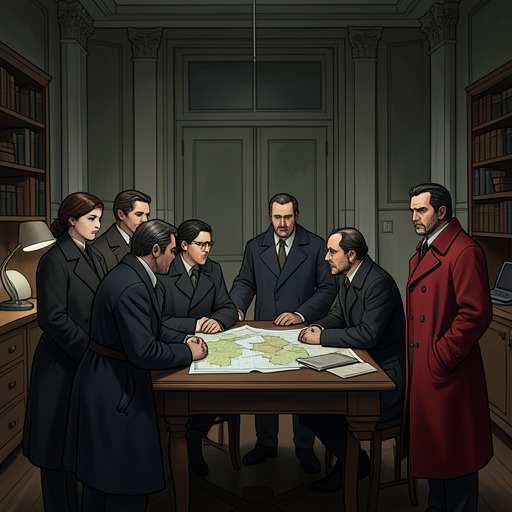
PeacemakerThe Guild Council is the Assassins’ Guild’s central body for adjudicating disputes and overseeing the procedures that can authorize lethal action. Its authority rests not merely on command of Guild personnel but on a public, documented process: filings, depositions, deliberation, and opportunities to settle. The political crisis following Murini’s coup exposes how fragile that authority becomes when leaders bypass procedure, records are suspect, and the Council itself cannot establish a trusted account of what happened.
Charter and Legal Authority
A legal assassination begins with a Filing of Intent. The parties’ claims are entered into an official state registry as permanent, sealed, ribboned records, and any answer is filed in the same way. The Guild Council must publicly advise that it is considering action and give both sides an opportunity to provide depositions. It first decides whether adequate cause exists for a filing, then debates its merits and considers whether a remedy short of lethal action is possible. At its discretion, the Council can hear from Guild members serving either side about prospects for settlement, and it can impose a further delay while seeking resolution.
Only after these measures fail can the Council approve a filing by vote and set a date after which action may proceed. Publication and notification give the targeted party’s bodyguard time to prepare; for lords and officials with permanent guards, both sides’ units remain in contact with the central Guild throughout. Either side can ask the Guild to suspend action and mediate a mutually acceptable solution. The process therefore gives the Council a role both in authorizing force and in creating repeated opportunities to avert it.
Smaller disputes, especially those involving property or divorce, may be approved by a Council office without full Council debate, but still require witness depositions. Such a filing usually expires after ninety-nine days, when attempts to carry out the assassination must cease. These limits make legal force conditional and temporary rather than an open-ended license. A Filing of Intent is required before action against a person or institution, except when responding to an illicit attack; the Guild’s rules recognize immediate defense as a separate case.
Administration, Records, and Appointments
The Council’s authority also depends on the administrative machinery that supplies it with personnel and information. Shishogi, who had held the Office of Assignments for forty-two years, recommended units for short-term filings and defensive work, as well as long-term posts in units and protection assignments for lords, houses, and institutions such as the Bujavid. He also recommended plain-clothes Assassins serving as household staff on defensive assignments. His office appointed investigators serving the Guild Council, who examined whether the claims in a filing were true.
Shishogi was the tenth holder of the Office of Assignments in the modern Guild. His cramped, untidy office was crowded with files; he had outlived his clerks and secretaries without replacing them, and the antiquated, pre-computer system had become a Guild joke. Yet his personal command of personnel information had made the office’s disorder seem manageable. The Council’s investigatory capacity thus relied on a specialist whose accumulated knowledge and records could reach far beyond the appearance of a neglected office. When Shishogi was considered at risk of dismissal, the prospect that he might destroy records became a central concern: the Council could not establish violations without evidence.
Coup and Crisis of Confidence
During Murini’s takeover, senior Guild officers objected when assassinations were ordered without due process or proof of guilt. Their objections were overruled; several officers were arrested and their records marked. In the first hours of the coup, the legitimate Guild mistakenly accepted orders from conspirators. After reports that Tabini had survived the attack at his Bujavid residence, and then had supposedly been killed in Taiben, Guild personnel again followed their superiors and Murini, without understanding that trusted sources of orders included the people hunting Tabini and Damiri. The Shadow Guild violated the established rules, while the legitimate Guild continued to follow its rulebook even as conspirators exploited its channels.
That contrast created a problem deeper than identifying individual traitors. The Shadow Guild’s orders and the records attached to them could not be trusted as an accurate account of responsibility. After Murini’s defeat, the aiji-dowager and Tabini discovered that many who had fought against Tabini had been misled by forged orders. Some had followed orders they should have questioned, but the source and authorship of the instructions could not be established. The aiji-dowager concluded that the disorder could not all be attributed to Murini.
The senior leadership’s refusal to return or cooperate prolonged the institutional reckoning. Two former Council members sent a message saying that, in a new era of cooperation with humans and an atevi presence on the space station, they considered their usefulness ended and wanted younger members to sit in Council. They rejected the investigation and would not submit to Guild inquiry. Other former members remained underground, lived under changed names, or continued to be listed as dead. They would not answer summonses or disclose information that could expose the whereabouts or contacts of fellow missing members. The resulting list, known within the Guild as the Missing and the Dead, became a point of contention: its subjects regarded the reconstructed records as corrupt and the demand for explanations as an insult.
Disputed Leadership and Restoration
Even a year after Tabini regained power, the legitimate Guild’s relationship with him remained strained over his personal bodyguard. The Guild kept its secrets, and Tabini was still receiving high-level information from his grandmother, who commanded the most senior team, rather than from the channels that should have informed him. His young bodyguard also had to be told information the Guild ought to have supplied. The continuing effort to reconstruct the coup hour by hour, inside headquarters and across its communications, showed that restored government had not yet produced a complete or trusted institutional record.
Later, Jago described a three-member Council: one member followed the other two and was more a failure than an active danger, while the other two had a pattern of actions that the opposing group questioned. They had rapidly approved Office of Assignments recommendations without debate, including appointments of chief officers in Dojisigin Marid. During trouble in the west, the Guild moved forces so slowly that Tabini went into the field himself; his presence carried more weight than the process of querying the Council. When the Guild in exile might have helped Tabini and his allies in the south, the Guild instead sent a mission to arrest its two most senior retirees, diverting attention for an extended period.
The exiled members’ return was therefore not simply a contest for control of headquarters. They were wary of humans and had not previously favored Tabini because of his association with them, but they were described as loyal to law and willing to work with humans when restoring the Guild. They agreed to leave their identities for a second time, separate from families, and break off marriages in order to return, examine records, and restore lawful practice. Their aim was to prove their case before the membership, not to have Tabini impose a settlement by decree. Because proof was essential to law enforcement, destroying records or winning only through the aiji’s authority would leave the Guild’s legitimacy damaged. Under its charter, only Tabini and the aiji-dowager could demand the Council’s attention regardless of its agenda; the dowager wished to do so, though her eastern identity was expected to make the Guild in exile hesitate.
The eventual operation caused limited damage within headquarters: three people died, including the target, while the other two were killed firing at a senior Guild officer who had identified himself. Banichi’s plan enabled the returning Guild to enter the heart of the building, while Cenedi’s action took place in the administrative wing during the initial distraction. The aftermath made the purpose of restoration tangible to junior members who had entered the Guild in recent years: the rules written in the books were again to be the rules in operation.
Autonomy and Constitutional Limits
The Guild’s position in the wider political order combines independence with limits. After the war, the aiji proposed that guilds recruit and assign members across regional and clan boundaries, according to qualification rather than kinship or association. The guild heads accepted the principle, which became internal guild practice and placed membership authority in the hands of guild masters. Regional associations and clan lords had little leverage over the arrangement if they wanted Guild services.
At the aiji’s request, the Assassins’ Guild also accepted a prohibition on its members seeking or holding political office or lordship. In return, it received statutory protections against political pressure: lords could not summon its records, its members testified only before their own Council, and the Guild alone could investigate and deal with a member’s disappearance or death under its own rules. These provisions gave the Council and the Guild substantial jurisdiction over their internal affairs, while making reliable internal procedure especially consequential. When records are compromised or the Council’s actions depart from the rules, the same autonomy that protects the Guild from political interference can make the recovery of public confidence more difficult.