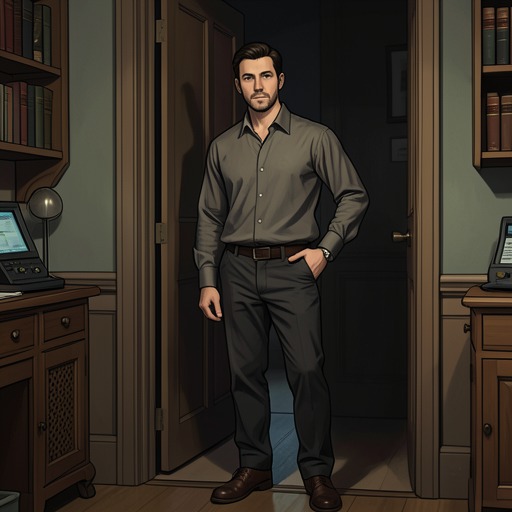
Don’t say you’re sorry
PiercingDon’t say you’re sorry is a survival instruction that returns to Kawashima Masayuki during his confrontation with Sanada Chiaki. Its meaning shifts from a childhood defense against abuse to a voice he recognizes as his own; that recognition marks both a moment of regained agency and a dangerous turn toward domination.
Origin and Meaning
The instruction belongs to an inner voice that once protected Kawashima as a child. It counsels him not to seek forgiveness while being hurt, but to endure the attack and, when it is over, meet the other person’s eyes. In this logic, surviving without apologizing or looking away means he has not been defeated.
The voice has returned to him before, including when he was looking at Sanada Chiaki’s bandage. During the confrontation, Kawashima understands its advice as a form of protection learned in childhood: the voice tells him that Sanada Chiaki is crying, afraid, and no longer holding her weapon, so he can lower his guard.
Role in the Confrontation
As Kawashima lowers his arms, the remembered instruction offers a way to interpret Sanada Chiaki’s sobbing without asking her to comfort him or apologize. He watches her, and the voice’s counsel to endure and then look directly at her shapes his response to the encounter. The phrase is therefore not simply an injunction to suppress pain; it is part of a learned method for deciding when an attack has ended and what survival means afterward.
That method is bound to a harsher belief Kawashima recalls from his past. Remembering his mother’s fear and request for help, he connects asking for help with weakness and concludes that help does not exist. In the present, he applies this belief to Sanada Chiaki’s fear, interpreting it as a reason to make her understand that no one will rescue her. The protective voice thus sits beside, and helps reveal, the worldview through which he turns suffering into a justification for control.
Recognition and Transformation
Kawashima eventually recognizes that the voice is not an independent protector: he created it as a child because his own voice seemed too weak and vulnerable. He had imagined an adult, authoritative speaker, but now considers himself grown and able to speak and act for himself. The old instruction’s return consequently leads not to a simple recovery of childhood safety but to a declaration of adult power.
The change is sharply ironic. The voice that helped him endure abuse becomes part of his claim that the frightened woman before him should fear him. His recognition explains the voice’s origin, but does not free him from the beliefs formed around it; instead, the shift from imagined adult guidance to self-authorized action accompanies his intention to teach Sanada Chiaki a lesson. Don’t say you’re sorry therefore names both a strategy for surviving victimization and the point at which Kawashima’s survival logic is turned outward against another person.