It doesn’t hurt
Piercing“It doesn’t hurt” is both a phrase and a practiced mental strategy in the novel: Kawashima Masayuki uses it to describe how he learned to endure childhood abuse by distancing himself from pain, then teaches the same method to Sanada Chiaki when she is in immediate danger. Its recurrence links the two characters through a technique shaped by violence, without making that technique a reliable promise of safety.
Childhood Origins
Kawashima recounts that after his father died, his mother repeatedly beat him. He tried to endure the abuse by telling himself that the person being struck was not really him. The expression names the conclusion of that effort: not proof that the harm has stopped, but a way to make it feel remote enough to survive.
He describes the process as something he trained himself to do. His mother became angrier when he did not cry out and hit him harder, while he concentrated more intensely on separating himself from the pain. He also feared that he might detach so completely that he could not return, so he made himself wait nearby and come back when circumstances allowed. The phrase therefore belongs to a larger, deliberate practice of distancing and return.
A Survival Method Passed On
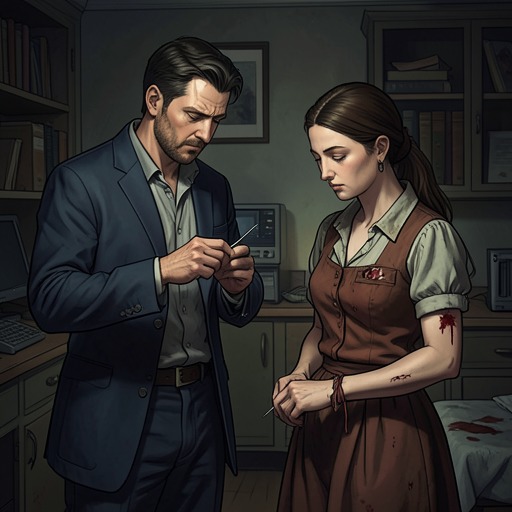
During the confrontation with Sanada Chiaki, Kawashima tells her to believe that pain can be shut out and to focus her eyes as though looking through a three-dimensional picture. He presents the instruction as something learned from his own childhood, briefly describing his mother’s abuse as its source. His speech is slurred, and the scene gives no assurance that the method can protect Chiaki; it shows instead that he is trying to apply his own survival rule to another person in a crisis he has created.
The transfer is sharply ambivalent. Kawashima offers Chiaki a technique formed under abuse while restraining and threatening her. The same words can sound like advice about endurance and remain inseparable from the immediate danger in which he gives them. His account explains the phrase’s origin, but does not make his actions safe or his guidance dependable.
Chiaki’s Response and the Phrase’s Limits
As she tries to escape, Chiaki recalls the instruction and attempts to follow it. She focuses on the ceiling, but cannot find a point beyond it on which to fix her attention. The scene marks a limit to Kawashima’s method: remembering the words does not give her control over the situation or guarantee that she can distance herself from pain.
Afterward, Chiaki remembers an earlier moment of danger and wonders whether her lack of fear came from resignation, exhaustion, or curiosity. That uncertainty does not establish that the phrase worked. Instead, the narrative leaves her response unresolved, distinguishing Kawashima’s confident-sounding lesson from Chiaki’s own uncertain experience.
Narrative Significance
The expression connects Kawashima’s childhood history to his adult conduct through repetition: a strategy once formed to withstand abuse returns as an instruction spoken during another person’s ordeal. The recurrence is not presented as simple healing or rescue. A means of surviving powerlessness becomes entangled with Kawashima’s own capacity to endanger someone else.
The phrase also sits within a broader pattern in which distress disrupts language and brings painful memories to the surface. In Sanada Chiaki’s experience, words can recede as memories return; for Kawashima, the childhood practice of mentally separating himself from pain offers a way to endure, but also reveals how deeply that past continues to shape his responses. “It doesn’t hurt” thus carries the contradiction at the center of the episode: a claim of mastery used where neither safety nor control is assured.