“Narrow roads at night”
PiercingNarrow roads at night is the image that gives form to Kawashima Masayuki’s childhood isolation and returns, years later, at a moment of acute danger. His drawings repeatedly follow the same subject: a road narrowing into darkness, first as a boy’s refuge in imagination and later as a memory surfacing beside his infant daughter’s crib.
Origins in childhood
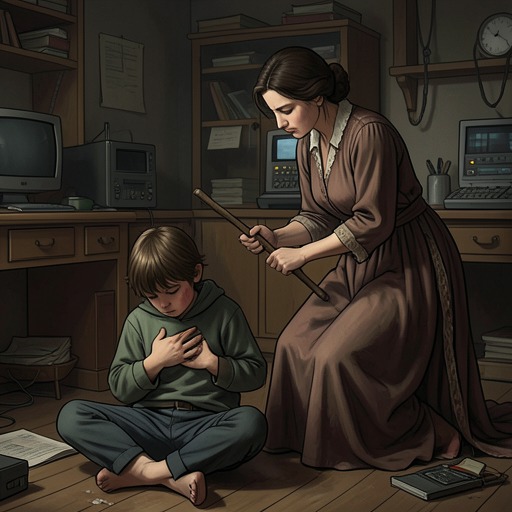
Kawashima began drawing after a middle-school teacher arranged for him to be placed in the Home for abused children. Before then, his mother had singled him out for beatings while leaving his younger brother untouched. She eventually began locking Kawashima in the house while taking his brother to the Playland on the roof of a department store in Odawara. Once, Kawashima climbed out a window and ran after them; his mother dragged him back and tied him to the bathroom water pipes. He fell asleep on the tile floor. When he woke in the dark, the narrow road outside the window was all he could see.
That remembered road belongs to a landscape of exclusion as much as to a child’s imagination: his mother and brother are elsewhere, while he is confined inside. After his placement in the Home, he drew nothing but pictures of narrow roads at night. The image began as an artistic subject at the same time that it recorded a specific experience of abandonment and confinement.
Repetition and the moonlit road
As an adult, Kawashima still drew narrow roads in the moonlight, and no other subject had interested him. The image’s persistence ties his present to the childhood room where, as a boy, he had sat with the moon as his only light and drawn a long road vanishing into the distance. His later recollection of that scene makes the road less a single remembered place than a repeated visual form through which the earlier experience continues to return.
The novel connects that recurrence to Kawashima’s account of his night terrors and of the abuse that shaped his childhood. He described learning to endure beatings by telling himself that the person being hurt was not really him, and by trying to remain prepared for the next blow. The road does not erase that history; its repeated appearance gives it a recognizable shape without making the pain disappear.
A departure from the usual subject
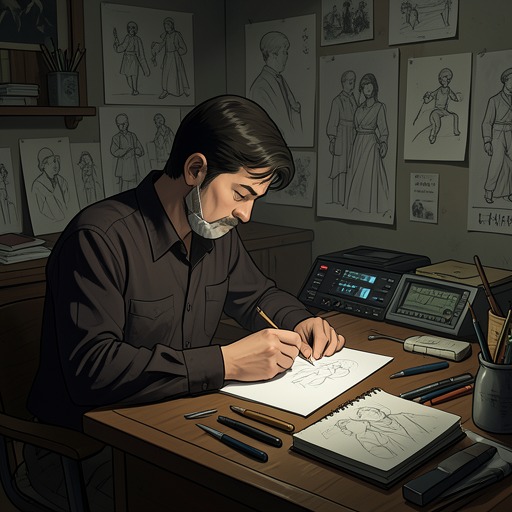
Near the end of summer, while working at a graphic design firm and meeting Yoko regularly, Kawashima drew her face from memory. It was a rare departure from the roads that had monopolized his drawings. When he gave her the sketch on their next date, Yoko invited him to her apartment for the first time and disclosed her earlier suicide attempt after a breakup. His response was accepting, and they moved in together not long afterward.
The portrait does not replace the recurring road, but it marks a moment when Kawashima’s attention turns toward another person. The contrast is concrete: the roads were the only subject he had pursued, whereas Yoko’s likeness emerged from a relationship developing beyond the page. Drawing her becomes part of the sequence that brings them closer, rather than another image of an isolated landscape.
Return beside the crib
Years later, while Yoko slept, Kawashima stood over their four-month-old daughter, Rie. This had become a nightly pattern, continuing for ten nights. In the bedroom, a narrow strip of moonlight cut across the crib and the pocket of his corduroy slacks. The light recalled the childhood room in which he had drawn roads by moonlight. Taking care not to prick his finger, he lifted the ice pick from his pocket and drew back Rie’s blanket, exposing her neck and upper chest.
The recollection returns at the point where the recurring image meets a present threat. Kawashima’s sweat and the trembling ice-pick tip make visible a separation between his actions and his sense of himself: he thinks of the sweating figure as a stranger who resembles him. The scene does not establish that he harms Rie. Instead, it places the childhood image beside the possibility of violence in the present, so that the road’s return carries both the memory of an isolated child and the unresolved danger of the man standing over the crib.