Kawashima Masayuki
PiercingKawashima Masayuki is a husband and new father whose attempt to manage an intrusive fear of harming his infant daughter becomes a plan to commit murder. His arc joins domestic tenderness to calculated violence: insomnia and childhood trauma shape a private ritual around the baby’s crib, while a dissociative inner voice recasts violence as a way to master fear. His confrontation with Sanada Chiaki brings that split into the open, but does not resolve it; even after recognizing the voice as his own, he returns to the logic of the abuse he endured.
Identity and Background
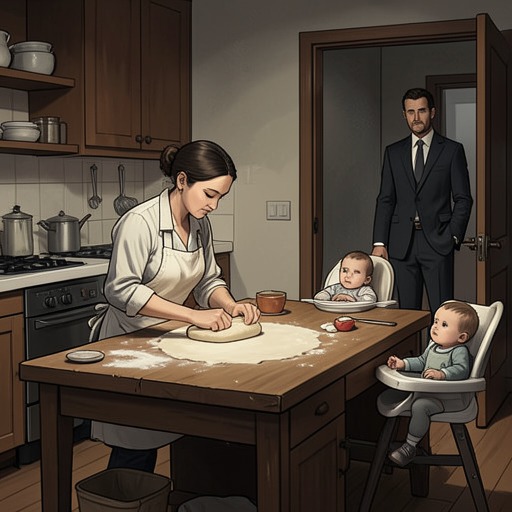
Kawashima is married to Yoko and has a newborn daughter, Rie. He has suffered from insomnia since elementary school, and his anxiety about the baby’s sleep grows out of fear that she might inherit the problem. Yoko, by contrast, is described as a healthy twenty-nine-year-old who sleeps regularly and teaches popular bread and pastry classes from their apartment. Their ordinary household routine—Yoko preparing for work, students coming to lessons, and the baby asleep nearby—forms the domestic setting against which Kawashima’s increasingly alarming private thoughts develop.
His history includes recurrent night terrors. He tells Yoko that, as a child, he would wake in panic, scream, and sometimes run around the room, later remembering only that he had been terrified and had lost his sense of who people around him were. The episodes have become less severe with adulthood, but remain part of his life. When one wakes him after he and Yoko have begun living together, he leaves the apartment alone and returns about two hours later to explain what has happened. Yoko asks why he did not let her comfort him; he does not offer an answer. The exchange establishes both her concern and his tendency to face distress in isolation.
Fear, Family, and the Inner Voice
For ten consecutive nights, Kawashima stands over Rie’s crib after midnight while Yoko sleeps. He uses a penlight to check that the baby is asleep, worrying that his own insomnia might foreshadow suffering for her. The ritual changes after an episode in the bath: for a moment he cannot identify who is with him, and, once his attention clears, the image of an ice pick has become fixed in his mind. He repeatedly tries to reassure himself that he will not harm the baby, but an opposing thought insists that he might. From then on, he cannot go to bed until he has stood by the crib with the ice pick and checked that he will not use it.
The fear does not remain confined to the bedroom. In an encounter with a dissociated version of himself, Kawashima is led to reinterpret a memory of having stabbed a woman as proof that violence can quiet his anxiety. The other self presents another attack as the means of overcoming fear. Kawashima experiences the conclusion as a revelation, and his earlier concern about Rie gives way to a different, dangerous objective: to prove that he can act against another person.
His memories of Kawashima Masayuki’s mother help explain the emotional structure of that shift. In one recollection, he remembers being excluded while she posed with another child for a photograph; he had wanted her to become angry and strike him, and felt rejected when she instead looked through him. Later, he recalls being mistreated as a child and developing a protective internal voice that gave him rules for surviving abuse. As an adult, he once struck his mother after she appealed to him for forgiveness. He associates asking for help with helplessness and believes that no help will come. Those learned assumptions later shape how he reads Sanada Chiaki’s fear and distress.
Planning and the Keio Plaza Hotel
Kawashima approaches his planned crime with methodical concentration, describing the work of organizing his thoughts as a calm, practical exercise. In Kawashima's notes, he weighs the identity of a potential victim, the choice of location, the likelihood of police attention, and ways to misdirect an investigation. He reasons that anonymity and limited scrutiny could work to his advantage, while considering how a hotel reservation, a borrowed identity, and planted clues might shape what investigators believe. The details reveal not sudden loss of control but sustained planning; his ordinary capacity for practical judgment is being put in the service of violence.
He tests hotel arrangements at the Akasaka Prince Hotel, then chooses the Keio Plaza Hotel in West Shinjuku for the encounter. On a busy Friday afternoon, weddings and conferences crowd the hotel lobby, and the desk clerk gives him little attention. He checks in using the assumed name Yokoyama Toru and carries the items he has prepared in an overnight bag. Even while arranging the encounter, he is affected by memories of his mother and by the sight of family groups. He tries to set those memories aside and think instead about the woman expected to come to his room, treating the assumed identity as if it might separate him from his own history.
The plan meets events he cannot control. In the corridor, after avoiding an elderly couple who might notice him, Kawashima sees Sanada Chiaki stagger out of a nearby room and realizes she needs help. The sight interrupts the role he has constructed for himself and confronts him with an unexpected person rather than the situation he had planned. His response draws him into Sanada Chiaki’s unfolding crisis and away from the neat sequence of decisions he had prepared.
Confrontation with Sanada Chiaki
Later, at Sanada Chiaki’s apartment, Kawashima becomes tired and increasingly confused. Sanada Chiaki prepares soup; he eats without suspecting that she has concealed crushed Halcion in it. As she cleans, he watches her precise, repeated care with the dishes and the unusually orderly room, while thinking about returning to the hotel and reading his notes. His attention then shifts to the possibility that she has understood his intentions. He suspects she has read Kawashima's notes and inferred that he was staying at a different hotel and had not called her for the encounter she might have expected. Uncertainty hardens into suspicion that she knows enough to threaten him.
The drug and exhaustion coincide with a further disturbance in his perception. As the room seems to move around him, childhood memories return, and the voice that once guided him through abuse supplies its old rules: endure the attack, do not apologize, and look at the other person when it is over. Sanada Chiaki’s resistance and eventual exhaustion interrupt his certainty about what is happening. He recognizes that the voice belongs to him—not to an independent adult, but to a protective voice he created as a child because his own seemed too vulnerable. For a moment, this recognition appears to mark a new capacity to act and speak for himself.
That change proves unstable. Kawashima interprets Sanada Chiaki’s fear as an opportunity to impose the lesson he believes he learned from his mother: that frightened people cannot rely on anyone to rescue them. He speaks about his childhood mistreatment and tells her how he learned to withstand pain, but the disclosure becomes part of a renewed threat rather than a straightforward appeal for understanding. When he picks up the ice pick, the image of Rie flashes through his mind. Before he can continue, memories of his mother overwhelm him, and he loses consciousness.
Relationships and Significance
Yoko represents an intimate life Kawashima has entered but cannot fully trust himself within. He monitors the sleeping baby while Yoko rests, and the contrast between her regular sleep and his insomnia sharpens his fear that his own suffering might be passed on. Although his concern begins in the language of protecting Rie, it becomes entangled with an intrusive fear that he will hurt her. The nightly check offers temporary confirmation, but its repetition also makes the feared possibility the center of his attention.
His relationship with Sanada Chiaki develops from a planned commercial encounter into a confrontation neither of them can control. Kawashima first approaches her through the false identity Yokoyama Toru and the elaborate expectations recorded in his notes. At Sanada Chiaki’s apartment, suspicion, the effects of Halcion, and his own memories reshape the encounter. Sanada Chiaki’s resistance exposes the instability of his plan; his response reveals how readily he recasts another person’s fear through the template of his own abuse.
After Kawashima loses consciousness, Sanada Chiaki finds his wallet and identifies him as Kawashima Masayuki. A photograph behind his driver’s licence shows him with Yoko and their newborn daughter, Rie. The stern, expressionless face in the picture contrasts with the family scene around him, while Sanada Chiaki’s recognition that he is a client rather than an established partner underscores the gulf between his private domestic identity and the violence she has encountered. He remains asleep for more than ten hours. At this point, his recognition of the inner voice has not freed him from the inherited rules it once helped him survive: the same voice that protected a frightened child coexists with an adult who threatens another person with the lesson that no help is coming.