Kawashima Masayuki’s mother
PiercingKawashima Masayuki’s mother is remembered through the childhood violence and exclusion she inflicted on Kawashima Masayuki, and through the lasting habits he formed to survive them. She beat him while sparing his younger brother, and later offered an explanation tied to his resemblance to his father. Her presence persists not through a sustained account from her own perspective but through Kawashima Masayuki’s memories: a remembered voice, a narrow road, and a learned separation from pain that resurfaces in adulthood.
Identity and Family Background
Kawashima Masayuki’s mother is the mother of Kawashima Masayuki and his younger brother. His father died when Kawashima Masayuki was four. Kawashima Masayuki retained no clear memory of his father, only a vague impression of being taken out for drives. His mother, by contrast, repeatedly characterized the father as foolish for taking on a car he could not afford. At Kawashima Masayuki’s high-school graduation, she explained that she had treated him as she did because he reminded her of that man. The explanation connects her violence to the father in her own account, but the narrative does not make it an excuse or suggest that Kawashima Masayuki understood it as one when he was a child.
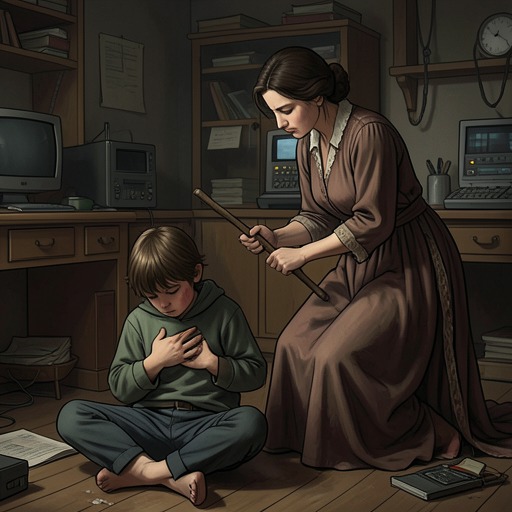
The abuse was unequal within the household. Kawashima Masayuki recalls that his mother hit him but never laid a hand on his younger brother. The distinction became a particular source of distress: he was not only afraid of being hurt, but troubled by being singled out while his brother was spared. The remembered pattern presents the mother as the source of both physical danger and an unstable family hierarchy in which Kawashima Masayuki could not count on equal treatment.
Childhood Abuse and Exclusion
Kawashima Masayuki describes repeated beatings, sometimes without warning, and an atmosphere in which he tried to remain prepared for the next one. His account also recalls intimidation and punishment involving household objects and restraint. The details establish that the violence was not a single remembered incident; it formed a recurring condition of childhood, shaping his expectations before anything happened and his efforts to endure it once it did.
One episode joins that threat to deliberate exclusion. The family lived in a small town whose nearest sizable city was Odawara, where a department store had a children’s Playland on its roof. Kawashima Masayuki remembers that the three family members went there together a few times. When he was about five or six, his mother began locking him in the house and taking only his younger brother. On one occasion, he climbed out a window and ran after them. His mother brought him back and tied him to the bathroom pipes. He fell asleep on the tiled floor; when he woke, it was dark, and the narrow road outside the window was empty. The scene condenses the combination of separation, punishment, and helpless waiting that defines his recollection of her care.
Survival and Lasting Effects
To endure the beatings, Kawashima Masayuki taught himself to think that the person being hit was not really him. He concentrated on that separation until he could distance himself from the pain. His mother responded to his refusal to cry or cry out by hitting him harder, but the increased violence reinforced rather than broke the mental strategy. He feared that distancing himself too far might leave him unable to return, so he imagined himself waiting nearby and coming back when circumstances allowed. His dissociation is thus presented as a method he developed under pressure, not as an abstract or chosen detachment from his past.
The same protective arrangement included a voice that instructed him how to endure. It adopted the sound of a generic adult because, in his childhood understanding, his own voice was too vulnerable to protect him. At a later point in his life, that inner voice helped him manage distress; after meeting Yoko, he heard less from it. During the crisis with Sanada Chiaki, it returns and recalls the lessons of childhood, including the advice not to seek forgiveness in the midst of an attack. Kawashima Masayuki eventually recognizes that the voice was one he had created as a boy. Its reappearance shows how the mother’s abuse remains active in his present: survival rules formed around her continue to govern how he reads fear, pain, and the possibility of help.
Adult Encounters and Narrative Role
Kawashima Masayuki says that he had not seen his mother for years before the meeting at his high-school graduation. He later remembers another encounter in which she looked much smaller than he had expected. When she appeared frightened and asked for forgiveness and help, he struck her. He recalls reacting not with relief at her vulnerability but with anger at the appeal itself, which he associated with the belief that help does not exist. The reversal is stark: a child once trapped by her violence becomes an adult who answers her fear with violence of his own. The narrative records this action without presenting it as repair or reconciliation.
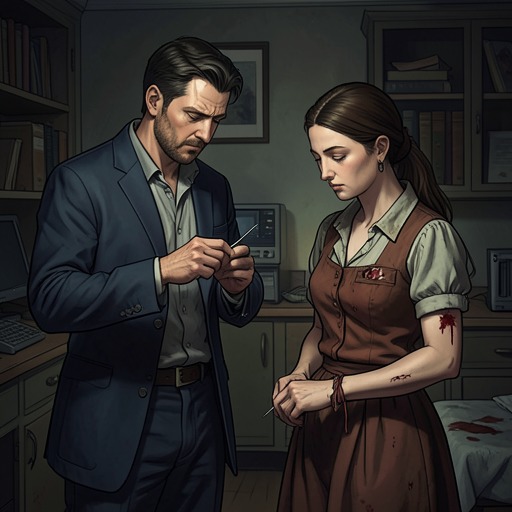
Her memory also intrudes during Kawashima Masayuki’s attempt to harm Sanada Chiaki. As he is about to use an ice pick, the remembered presence of his mother enters his awareness, accompanied by recollections of abandonment and a locked door. He experiences the feeling as if she has entered and taken possession of his body, and then loses consciousness. This is not evidence that she is physically present; it is the return of an unresolved memory at the point when childhood violence threatens to be repeated against someone else. The mother therefore occupies the story chiefly as an origin and recurrence: the remembered abuser whose treatment trained Kawashima Masayuki to divide himself from pain, and whose influence resurfaces in the violence he directs toward others.