Albatrosses
PiranesiThe Albatrosses are among the House’s most consequential animal inhabitants: their arrival, courtship, nesting, and chick’s growth give Piranesi a relationship with creatures whose needs he can observe but never fully command. He responds not by treating them as symbols or possessions, but by adapting his supplies to their nesting requirements; their continued presence in the Forty-Third Vestibule becomes part of the House’s changing ecology and of his understanding of its life.
Arrival and First Encounter
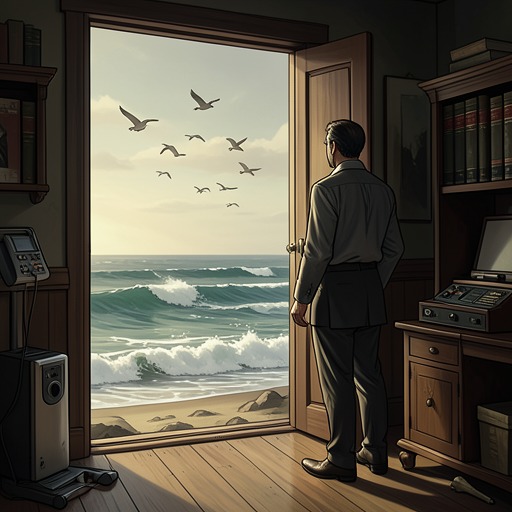
In the year that Piranesi names for their arrival, a vast white shape comes into view above the grey waves. At first it resembles a shining cross; as it approaches, he recognizes a bird of extraordinary size. The Albatross glides through a doorway on outstretched wings, wider than the opening, without once beating them. Piranesi spreads his arms to mirror its flight and imagines, with excitement and some fear, that they might merge into an Angel. The image registers his openness to the House’s wonders, but the encounter soon becomes less a vision than a meeting with an animal moving on its own terms.
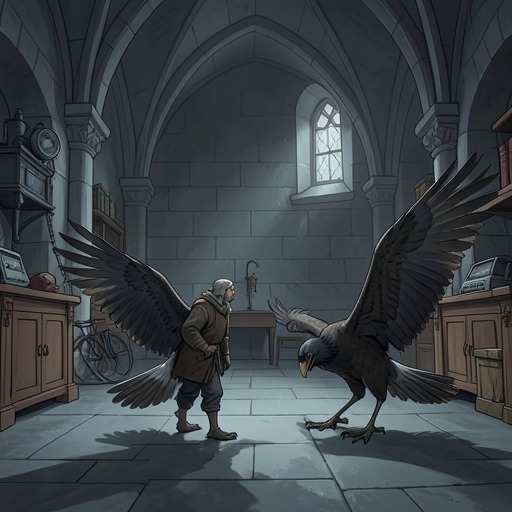
The bird continues directly towards him, then greets him with its wings spread and its throat extended towards the ceiling. Its wings are dark on the back, each marked with a white, star-like shape; its throat makes a clacking, whirring sound that Piranesi takes as a greeting. While he gathers seaweed, the bird walks about the Hall, its greyish-pink feet slapping on the pavement, and periodically approaches to inspect his work. These small acts establish a pattern of proximity without domestication: the bird is curious about Piranesi, but remains an independent presence within the Hall.
Pairing and Nest-Building
When Piranesi returns the following day, he finds that the bird has gone up a staircase to the Forty-Third Vestibule. There is now a second Albatross with it. He cannot tell which bird is male or female, and explicitly leaves that uncertainty open; what he can observe is their different feather markings. The newcomer has pale flecks across the back of its wings, like silver rain, unlike the star-shaped marks on the first bird. Together the pair spread their wings, dance around one another, point their beaks towards the ceiling, shriek, and tap their long pink beaks together. The scene makes their courtship legible through movement and sound while preserving the limits of Piranesi’s knowledge about them.
A few days later, the mood in the Vestibule has changed. One bird has brought up cold, wet seaweed from the Lower Hall and repeatedly heaps it, rejects the arrangement, and tries another place. Piranesi infers that the pair are trying to build a nest but lack dry material suitable for an egg. Rather than assuming that the seaweed is enough, he attends to the birds’ repeated rearrangement and offers what he has stored. The exchange begins in observation: their restless work gives him evidence of a need he can help meet.
Piranesi prepares the material in the Third Northern Hall, lining a fishing net with heavy-gauge plastic and filling it with dry seaweed. The amount is substantial, approximately three days’ fuel, and giving it away may leave him colder. He nevertheless judges that cost against the possibility of a new Albatross in the World. He adds clean white feathers that he had kept because he liked them, and a hole-ridden woollen jumper that is of little use as clothing but might line an egg’s nest. Dragging the net to the Forty-Third Vestibule, he sees one bird seize a beakful of dry seaweed and test it in different places. The birds’ response is practical rather than ceremonial: they take up the supplied material and continue their own work.
The Chick and Ongoing Care
The Albatrosses build a tall nest, about a metre wide at its base, and lay an egg. Piranesi later records that they are excellent parents, devoted first to the egg and then equally diligent with their chick. The chick grows slowly and has not shown signs of being ready to fledge. This account extends the episode beyond the moment of arrival or the satisfying completion of the nest: the birds remain in the House as a family, with a prolonged cycle of care and development that Piranesi follows over time.
Their connection with him does not mean that he can handle them at will. When preparing for a flood, he calculates how the Forty-Third Vestibule will be affected and concludes that at most it will receive only a thin skin of water. The grown chick is now a very large bird, and Piranesi does not attempt to carry it upstairs. He believes the Albatrosses consider him a friend, but expects that they would not allow him to move their chick and would prevail in any struggle. His care therefore includes respecting a boundary: he protects the birds by checking their likely exposure, not by taking control of them.
Birds, Attention, and the House’s Ecology
The Albatrosses belong to a broader world of bird life that Piranesi learns to watch. He regards birds as comparatively easy to read because their behaviour seems to express immediate concerns such as food or rain, but he also allows that their wisdom may be greater than it first appears and may reveal itself only intermittently. In one episode, smaller birds perch first on a Gardener statue and then on a statue of a woman carrying a beehive. Piranesi wonders whether the images of industriousness amount to a warning; when a storm subsequently drives fish away from his usual fishing grounds, he recognizes that acting on the birds’ indication helped him secure food beforehand. This broader pattern gives the Albatrosses’ behaviour a context: animal action can carry practical meaning even when Piranesi cannot claim certainty about what the animals intend.
The Albatrosses also make concrete the difference between Piranesi’s reverence for the House and The Other’s contempt for it. The Other describes the place as lifeless rooms filled with decaying figures and bird droppings. Piranesi counters that the Lower Halls contain sea creatures and vegetation, the Middle Halls contain birds and men, and even the droppings are signs of life; he understands the moving tides and varied halls as parts of a living environment. The Albatrosses do not merely illustrate this disagreement. Their arrival, courtship, need for dry nesting material, and attentive parenting are events that alter the House’s ecology and demand a material response from Piranesi.
Significance
Piranesi names the year the Albatrosses arrive the Year the Albatross Came to the South-Western Halls, making their arrival a marker by which he orders his life. The naming records more than an unusual sight: it gives a place in his personal chronology to a continuing presence whose nest, egg, and chick he watches develop. In the House, where distances and repetitions might make change difficult to grasp, the birds’ family life supplies a clear sequence of arrival, pairing, building, laying, and growth.
Their story also shows Piranesi’s particular form of attentiveness. He first meets the Albatross as a near-mythic white shape, but his lasting response is grounded in distinctions and needs: one bird’s star-like wing marks, the other’s pale flecks, the difficulty of finding dry nesting material, the cost of donating fuel, and the risk of disturbing a large chick. The episode joins wonder to practical care. The Albatrosses remain neither humanized dependants nor mere emblems; they are animals whose behaviour, requirements, and limits help disclose the House as a world inhabited by lives beyond Piranesi’s own.